First Domestic Nylon Production... Pioneering the Textile Industry
14 Years as Chairman of the Korea Employers Federation... Contributing to Labor-Management Cooperation
"Successful Corporate Management, Contributing to National Economic Development"
The late Lee Dong-chan, former chairman of Kolon Group, will be inducted into the Korea Business Hall of Fame.
On the 20th, the Korean Academic Society of Business Administration announced at the induction ceremony held at the Plaza Hotel in Jung-gu, Seoul, that Chairman Lee was finally selected as an inductee in the entrepreneur category of the Korea Business Hall of Fame.
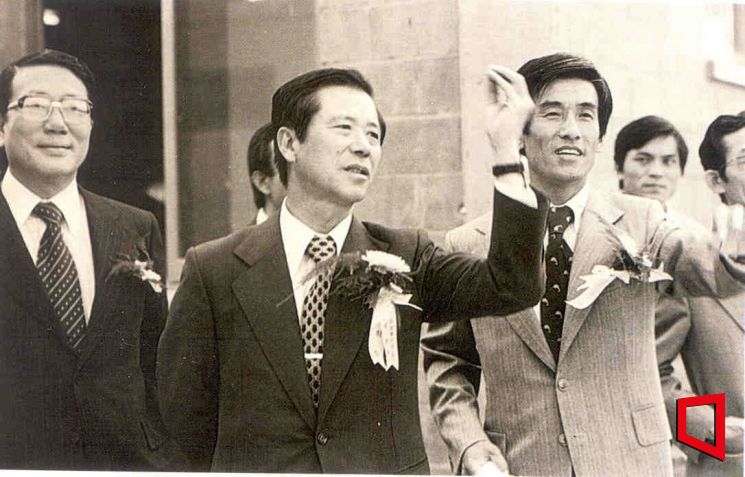 Lee Dong-chan, former chairman of Kolon Group (center), attending the completion ceremony of Kolon Petrochemical Ulsan Plant in 1977, encouraging employees (Provided by Kolon Group)
Chairman Lee was a pioneer of the Korean textile industry and an entrepreneur who led the economic development of South Korea. This year marks the 10th anniversary of his passing.
In 1954, he established Gaemyeong Trading Company, the predecessor of Kolon Trading Company, and introduced nylon to Korea for the first time. In 1957, together with his father and founder Lee Won-man, he founded "Korea Nylon Co., Ltd.," the foundation of Kolon Group, and built the first nylon yarn factory in Korea.
During the times of Japanese exploitation and the Korean War, when food, clothing, and shelter were scarce, nylon production began with the intention of helping the impoverished people to dress better. This revolutionized Korea's clothing culture.
After becoming chairman of Kolon Group in 1977 and serving as chairman of the Korea Federation of Textile Industries, Chairman Lee sought to modernize the domestic textile industry. He also actively pursued diversification into new growth industries such as chemicals, construction, pharmaceuticals, electronics, and information and communications. He set an exemplary standard by practicing corporate social responsibility, declaring early on that healthy profit-seeking should protect consumers and contribute to national development.
During a period of serious labor-management conflicts, he served as chairman of the Korea Employers Federation for 14 years starting in 1982, contributing to the stabilization of labor relations under his belief that "people are the core of a company." In 1990, he launched the National Economic and Social Council, a permanent labor-management consultative body, and led social agreements with the Korean Confederation of Trade Unions in 1993 and a joint declaration for industrial peace in 1995, laying the foundation for labor-management cooperation.
He also expanded his influence by serving as president of sports organizations such as the Korea Basketball Association and the Korea Golf Association, and took the lead in sports diplomacy as a member of the Korean Olympic Committee. As the inaugural chairman of the organizing committee for the 2002 Korea-Japan World Cup, he contributed to the successful hosting of the event. Notably, he actively supported the less popular sport of marathon, playing a significant role in producing an Olympic gold medalist in 1992.

In recognition of his contributions to domestic and international management activities, he received the 'Gold Tower Order of Industrial Service Merit' in 1982, the highest honor for entrepreneurs, and in 1992, he became the first businessperson to receive the 'Order of Civil Merit, Mugunghwa Medal,' the highest individual award. He also received numerous sports honors, including the White Horse Medal in 1982, the Geosang Medal in 1986, and the Blue Dragon Medal in 1992.
After retiring from active management in 1996, he continued various social contribution projects as chairman of the Oun Cultural Foundation, promoting the "A World Worth Living" campaign. From 2001, he established the "Ujeong Good Deeds Award," named after his pen name Ujeong (牛汀), to discover and honor cases of good deeds and exemplary stories, personally awarding recipients annually until his passing in 2014.
Kim Yeon-seong, president of the Korean Academic Society of Business Administration, stated, "As a representative entrepreneur of South Korea, Chairman Lee demonstrated outstanding management achievements. His successful corporate management for future industrial innovation and economic growth has been recognized as a significant contribution to the remarkable development of our country's economy," explaining the background of his induction.
© The Asia Business Daily(www.asiae.co.kr). All rights reserved.


















