Foreign Exchange Authorities and National Pension Service Expand Foreign Exchange Swap Limits
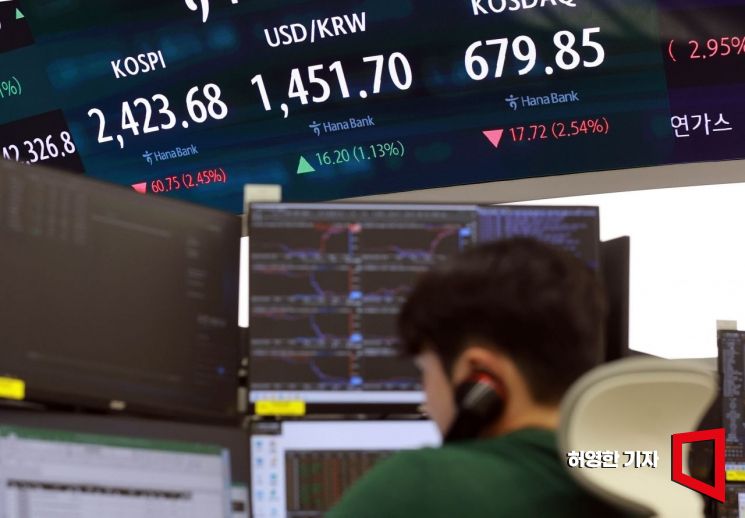 Various indices are displayed in the dealing room of Hana Bank's Euljiro headquarters in Seoul. Photo by Heo Young-han
As the government takes measures to stabilize the foreign exchange market, the soaring won-dollar exchange rate is showing signs of stabilization.
On the 20th, in the Seoul foreign exchange market, the won-dollar exchange rate opened at 1,450.0 won, down 1.9 won from the previous trading day. As of 9:35 a.m., it is trading at a similar level. Following news that the U.S. is slowing the pace of interest rate cuts, the won-dollar exchange rate surpassed 1,450 won for the first time since March 2009, near the end of the global financial crisis.
As the exchange rate surged, the foreign exchange authorities took consecutive market stabilization measures. To reduce volatility in the foreign exchange market, the authorities announced the extension of the foreign exchange swap transaction with the National Pension Service until the end of next year and increased the limit from the existing 50 billion dollars to 65 billion dollars. The National Pension Service also extended the period for raising the currency hedge ratio to a maximum of 10% until next year.
Experts expect the exchange rate to move around the mid-1,400 won range for the time being amid cautious intervention by the foreign exchange authorities. However, due to the continued global strong dollar, it is expected to take some time before the rate falls below the 1,400 won level.
Regarding the background of the sharp rise in the exchange rate, Minhyuk Lee, an economist at KB Kookmin Bank, analyzed, "The Federal Reserve's slowing pace of interest rate cuts and the resulting dollar strength, political instability such as South Korea's emergency martial law situation and impeachment crisis, as well as sluggish domestic demand and a slowdown in export conditions."
Economist Lee forecasted, "Despite the foreign exchange authorities' market intervention and the National Pension Service's currency hedging and other exchange rate stabilization measures, the global dollar strength and the concurrent won weakness trend continue, making it difficult for the exchange rate to turn downward in the near term."
© The Asia Business Daily(www.asiae.co.kr). All rights reserved.
![Clutching a Stolen Dior Bag, Saying "I Hate Being Poor but Real"... The Grotesque Con of a "Human Knockoff" [Slate]](https://cwcontent.asiae.co.kr/asiaresize/183/2026021902243444107_1771435474.jpg)











