The Oldest Existing Ten Commandments Engraved in Hebrew
Used as Road Stone for Decades... Also Controversy Over Authenticity
The stone tablet known as the oldest inscribed with the Ten Commandments was sold at auction for $5.04 million (approximately 7.3 billion KRW), far exceeding expectations despite controversy over its authenticity.
The New York Times (NYT) reported on the 18th (local time) that an anonymous buyer purchased the tablet at Sotheby's auction in New York for slightly over $5.04 million. The initial estimated price for the tablet was between $1 million and $2 million (approximately 1.4 billion to 2.9 billion KRW). The buyer is reportedly planning to donate the tablet to an Israeli institution.
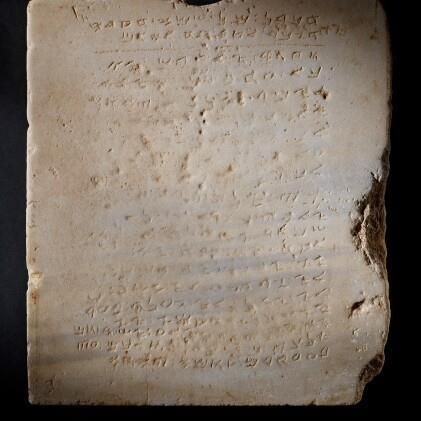 A 1,500-year-old stone tablet engraved with the Ten Commandments in Hebrew sold for $5.04 million. Sotheby's website
Weighing about 52 kg and standing approximately 61 cm tall, this tablet was created during the Roman-Byzantine period about 1,500 years ago. It was discovered in 1913 at a railway construction site in the southern coastal region of present-day Israel. The discovery site is near the ruins of early Jewish synagogues, mosques, and churches. The tablet contains only nine of the Ten Commandments from the Book of Exodus, written in ancient Hebrew known today as Paleo-Hebrew. The Book of Exodus is the second book of the Old Testament, following Genesis.
At the time of its discovery, the tablet was not recognized for its historical value and was used as paving stone for about 30 years. In 1943, a scholar who belatedly recognized its value took possession of the tablet. Later, in 1995, it was donated to the Living Torah Museum in Brooklyn, New York, after passing through an Israeli antiquities dealer, and in 2016 it became the property of collector Mitchell S. Kapel for $850,000 (approximately 1.2 billion KRW).
Sotheby's explained that fierce bidding competition drove the final price to more than double the estimated value. Ahead of the auction, Sotheby's emphasized the tablet's significance, calling it "the cornerstone of law and morality and a foundational document of Western civilization," and "not only a very important historical artifact but also a tangible link to the beliefs that helped shape Western civilization." They also analyzed that the original location of the tablet was likely destroyed either by Roman invasions around 400?600 BCE or as a result of the Crusades in the late 11th century.
However, some experts have warned that the tablet might be a forgery. Dr. Patty Justenbliss of DePaul University College of Law pointed out that the tablet "lacks an objectively verifiable provenance as it was not found through documented archaeological excavation." She added, "The auction price exceeding $5 million is astonishing," and emphasized that "serious doubts about the tablet must be taken seriously." Another expert, Professor Christopher A. Rolston of George Washington University, also noted, "The absence of any documentation from 1913 is problematic," and said, "Looters and forgers often fabricate such stories to lend authenticity to inscriptions."
© The Asia Business Daily(www.asiae.co.kr). All rights reserved.
![Clutching a Stolen Dior Bag, Saying "I Hate Being Poor but Real"... The Grotesque Con of a "Human Knockoff" [Slate]](https://cwcontent.asiae.co.kr/asiaresize/183/2026021902243444107_1771435474.jpg)
















