Announcement of 1st Generation New Town Metropolitan Transportation Measures
"Traffic Volume Greatly Increased After 1st Generation New Town Redevelopment"
"Complete Roads and Railways on Time to Accommodate Traffic Volume"
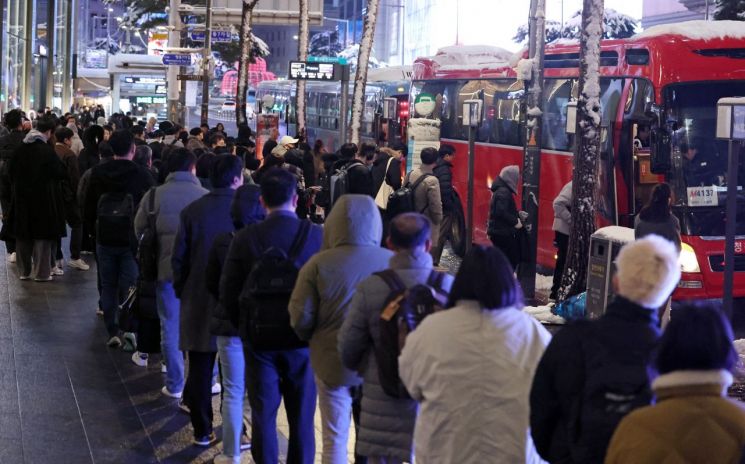 Citizens are waiting for the bus at the Myeongdong bus stop in Jung-gu, Seoul. The photo is unrelated to the article. Photo by Yonhap News.
Amid expectations of a surge in traffic volume following the redevelopment pilot district projects in the first-generation new towns, the government has announced that it will ensure timely completion of road and railway projects near these new towns without delays. The Ministry of Land, Infrastructure and Transport (MOLIT) explained that the increase in traffic volume due to redevelopment projects can be managed with the existing facility expansion plans alone, without any separate new measures.
According to MOLIT on the 20th, the first-generation new towns, as satellite cities of Seoul, have transportation networks concentrated toward Seoul, resulting in a low public transportation mode share. For example, the mode share is 41.2% in Bundang New Town, Seongnam City, Gyeonggi Province, and 35.9% in Ilsan New Town.
In this context, traffic volume is expected to increase after the redevelopment of the first-generation new towns. According to an analysis by the Metropolitan Transportation Committee of MOLIT, the daily traffic volume in the first-generation new towns was 2.46 million people last year and is projected to rise by 17% to 2.88 million by 2040. The traffic volume is expected to increase the most in the order of Bundang New Town in Seongnam City, Ilsan New Town in Goyang City, Pyeongchon New Town in Anyang City, and Sanbon New Town in Gunpo City.
MOLIT has committed to completing 35 ongoing road and railway projects on schedule by 2035. Lee Jeong-hee, Director of the Metropolitan Transportation Policy Bureau at the Metropolitan Transportation Committee, stated, "We confirmed with the Korea Transport Institute that timely completion of projects alone can alleviate congestion to a certain extent," adding, "We have also received 40 proposed projects from local governments, and additional transportation measures will be developed."
In Bundang New Town, efforts are underway to pass the preliminary feasibility study for the No. 1 Circular Line from Pangyo to Toegyewon to reduce traffic congestion. The underground expressway project from Giheung to Yangjae on the Gyeongbu Line will be expedited. This underground expressway project is currently undergoing a private investment feasibility assessment.
The Seongnam to Bokjeong Bus Rapid Transit (BRT) line is scheduled to open in 2026. Additionally, the structure of the Jayuro Road in Bundang New Town will be improved to reduce congestion when entering Seoul.
In Pyeongchon and Sanbon New Towns, the GTX (Great Train Express) Line C project is being promoted with a target completion year of 2028. The Isu to Gwacheon complex tunnel construction is planned to be completed by 2030.
For Jungdong New Town, discussions are underway to pass the preliminary feasibility study for the Gyeongin Expressway to minimize congestion toward Seoul and Incheon. Construction of the Daejang Hongdae Line will begin in the third quarter of next year. The preliminary feasibility study for the Western Metropolitan Express Railway (Gimpo?Janggi?Bucheon Sports Complex) will also be discussed within next year.
Additionally, the Goyang Eunpyeong Line project is progressing with a goal to open by 2031, and the preliminary feasibility study for the extension of Incheon Line 2 is being negotiated.
To enhance public transportation convenience, transfer centers will be established at major transportation hubs such as Seongnam Station, KINTEX Station, Daegok, and Geumjeong Station. Support for the installation of urban trams will also be provided in line with the establishment of these centers.
MOLIT plans to review incorporating projects proposed by local governments into higher-level transportation plans such as the 5th Metropolitan Transportation Implementation Plan and the 5th National Railroad Network Construction Plan, considering their relevance to the first-generation new towns, the concreteness of project plans, and feasibility.
© The Asia Business Daily(www.asiae.co.kr). All rights reserved.