Yoon Claims Election Fraud Using 'Emergency Martial Law Justification'
NIS Reconfirms 'Election Commission Security Inspection' Results
"Possible Infiltration and Manipulation, Actual Occurrence Not Confirmed"
President Yoon Suk-yeol raised allegations of election fraud as a justification for declaring martial law, but intelligence agencies repeatedly confirmed their position that they could not determine the presence of election fraud based on the Korea National Election Commission's (KNEC) security inspection results.
The National Intelligence Service (NIS) stated on the 19th that it was unable to make a judgment regarding election fraud based on last year's KNEC security inspection results, and that this stance remains unchanged. This information was also recently reported to the National Assembly.

From July last year, the NIS conducted a two-month security assessment in collaboration with the KNEC, Korea Internet & Security Agency (KISA), and others. An NIS official explained, "The scope of last year's security inspection was limited to 317 out of 6,400 IT devices (5%). We discovered multiple hacking vulnerabilities, such as the possibility of marking early voters as non-voters or non-early voters as voters, and recommended corrective measures."
According to the NIS, the KNEC's computer network was vulnerable to external intrusion even in systems requiring security. The operational network handling key election systems related to voting and counting was supposed to be separated from external access, but due to poor system management, proper network separation was not implemented. For example, default passwords from the initial product release were still in use, which made it possible to steal or manipulate the integrated voter registry.
Furthermore, the NIS revealed that it had notified the KNEC of eight hacking attempts by North Korea prior to these inspections, but the KNEC neglected to investigate the causes of the hacks or verify whether any data had been leaked. The NIS also pointed out that although the KNEC, which had previously refused on-site inspections by the NIS, submitted a self-assessment score of "100" in 2022, a joint inspection reevaluated the score to only 31.5.
The NIS's announcement at the time focused on the "possibility" of intrusion. While it confirmed that the system was vulnerable to intrusion and manipulation at any time, it was difficult to determine whether any actual attacks on the election network had occurred in the past. Reasons cited included insufficient personnel, limited time, and the restricted scope of inspected equipment. The KNEC countered by stating, "Such a scenario is practically impossible without the organized involvement of multiple internal collaborators."
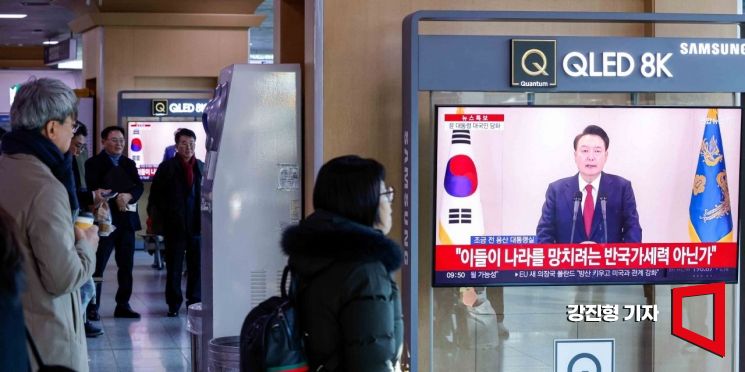 On the 12th, citizens at the Seoul Station waiting room are watching the urgent statement announcement regarding President Yoon Seok-yeol's declaration of martial law. Photo by Kang Jin-hyung
Following the martial law incident, President Yoon said in a statement on the 12th, "How can the public trust election results when the computer system managing elections, the core of democracy, is so flawed?" The next day, during an emergency question session at the National Assembly, KNEC Chairman Noh Tae-ak responded to the question, "Is South Korea a country where election fraud is possible?" by saying, "We believe it is impossible based on our system."
© The Asia Business Daily(www.asiae.co.kr). All rights reserved.


















