December FOMC Meeting Results Announcement
The U.S. central bank, the Federal Reserve (Fed), has significantly reduced its forecast for the number of rate cuts next year from four to two. At the final Federal Open Market Committee (FOMC) meeting of this year, the Fed cut rates by 0.25 percentage points, marking the third consecutive cut, but signaled a slowdown in the pace of monetary easing due to concerns over inflation. The 'hawkish (monetary tightening preference) cut' decision caused turmoil in the financial markets. The New York stock market plunged across the board, and South Korea's KOSPI opened down more than 2%. In the Seoul foreign exchange market, the won-dollar exchange rate surpassed 1,450 won.
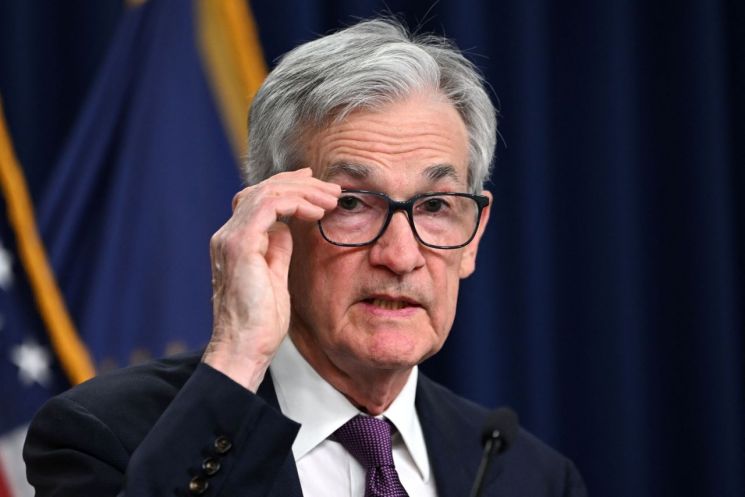
US Fed, 3 Consecutive Rate Cuts... Next Year’s Cut Forecast Reduced from 4 to 2
On the 18th (local time), the Fed announced in the policy statement released after the regular FOMC meeting that it had decided to lower the federal funds rate from the previous 4.5-4.75% range to 4.25-4.5%. This marks the third consecutive cut following the big step (0.50 percentage point cut) in September and the cut in November. As a result, the interest rate gap with South Korea (3.0%) narrowed to 1.5 percentage points at the upper bound.
Although this was the expected outcome in the market, it was not a unanimous decision. Among the 19 FOMC members participating in the meeting, four argued that rate cuts were unnecessary under 'appropriate monetary policy.' Beth Hemark, President of the Federal Reserve Bank of Cleveland, voted against the cut, advocating for a rate hold. Fed Chair Jerome Powell confirmed the existence of dissent by stating at the subsequent press conference, "It was a closer call, but today's decision was the right one."
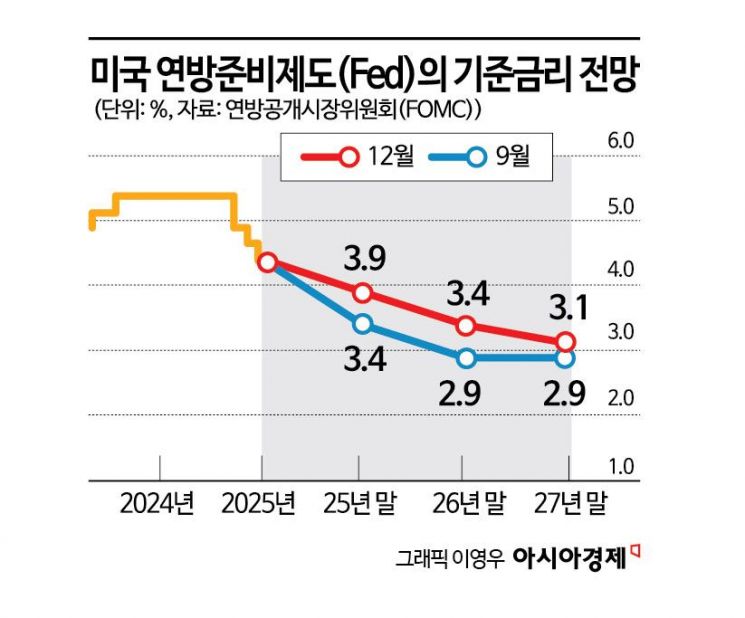
The market’s focus was also on the dot plot showing members’ rate projections. In the new dot plot, the Fed raised the median year-end rate forecast for 2025 from 3.4% to 3.9%. The September dot plot had predicted four 0.25 percentage point cuts (a total of 1.0 percentage point) next year, but this time it forecast only two 0.25 percentage point cuts (a total of 0.5 percentage points). The year-end rate forecast for 2026 was raised from 2.9% to 3.4%, and for 2027 from 2.9% to 3.1%.
Recent inflation and the robust growth of the U.S. economy were the background for adjusting the rate cut outlook. The Fed’s adjustment was also interpreted as reflecting increased uncertainty, including concerns about 'Trumflation' (price increases caused by policies such as tariff hikes and illegal immigration bans under President Donald Trump). In the Summary of Economic Projections (SEP) update released on the same day, the Fed raised the forecast for next year’s core Personal Consumption Expenditures (PCE) price index increase to 2.5% and the GDP growth forecast to 2.1%, up 0.3 and 0.1 percentage points respectively from previous estimates. The unemployment rate forecast for the end of next year was lowered from 4.4% to 4.3%.
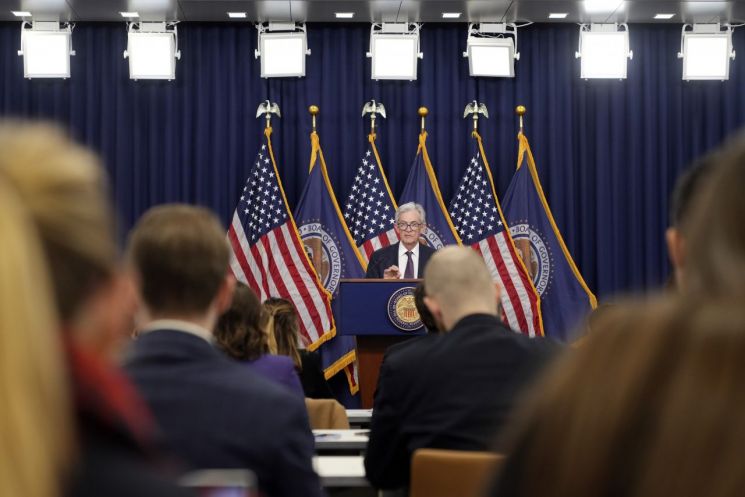
"Cautious on Additional Cuts Due to Inflation"... Hawkish Cut Shakes Financial Markets
At the press conference, Chair Powell repeatedly signaled a slowdown in the pace of monetary easing going forward. He said, "The policy rate has fallen by 1 percentage point from its peak, and monetary policy is now significantly less restrictive," adding, "From here, we enter a new phase, and we will be cautious about additional rate cuts." He cited inflation as the reason for lowering the forecasted number of cuts next year, explaining, "We will consider progress on inflation when reviewing additional rate cuts."
He also acknowledged that the forecast partly reflected the economic policy impact of the second Trump administration, which will take office in January next year. Powell said, "Some FOMC members have begun to factor in the impact of the next administration’s policies, but we can only evaluate after observing the actual implementation process, and we have not yet reached that stage."
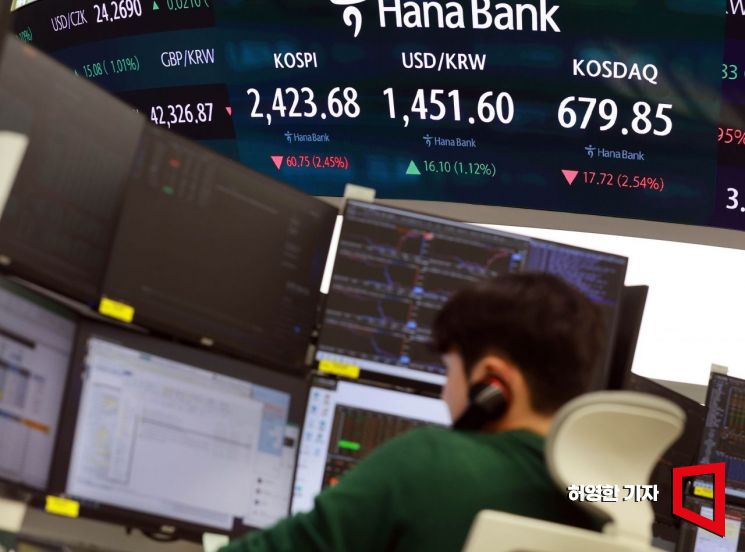 As the U.S. Federal Reserve (Fed) hinted at slowing the pace of interest rate cuts, the New York stock market plunged sharply, and on the 19th, the domestic stock market also started with a significant decline. The KOSPI opened at 2,426.55, down 57.88 points (2.33%), and the KOSDAQ also started down by more than 15 points. Various indices are displayed in the dealing room of Hana Bank's headquarters in Euljiro, Seoul. Photo by Heo Young-han
The hawkish cut by the Fed caused the New York stock market to plunge across the board. On that day, the Dow Jones Industrial Average on the New York Stock Exchange (NYSE) closed down 2.58% from the previous trading day. The large-cap S&P 500 index fell 2.95%, and the tech-heavy Nasdaq index dropped 3.56%. The U.S. 10-year Treasury yield, a global bond benchmark, surpassed 4.5% for the first time in six months.
In the Korean market, the KOSPI opened down more than 2%. As of 9:26 a.m. on the 19th, the KOSPI stood at 2,444.26, down 40.17 points (1.62%) from the previous close, effectively giving back all the gains from the previous day in just one day. At the same time, the KOSDAQ index also showed weakness, falling 11.00 points (1.58%) to 686.57. Han Ji-young, a researcher at Kiwoom Securities, said, "The December FOMC was more hawkish than expected, causing the U.S. stock market to plunge and the exchange rate to surge. The domestic stock market is also exposed to downward pressure."
In the Seoul foreign exchange market, the won-dollar exchange rate opened at 1,453.0 won, up 17.5 won from the previous day. This is the highest level since the global financial crisis. Lee Min-hyuk, a researcher at KB Kookmin Bank, evaluated, "The December FOMC result was quite hawkish, and as the dollar showed ultra-strong performance, the exchange rate hit a new high." Park Hyung-jung, head of the investment strategy team at Woori Bank, predicted, "As the Fed’s monetary policy reaches a turning point, pressure for dollar strength is expected to increase."
Currently, Wall Street expects the Fed to temporarily pause rate cuts in January next year and resume as early as March. According to the Chicago Mercantile Exchange (CME) FedWatch, the federal funds futures market on that day priced in a 93.6% probability that the Fed will hold rates steady at the January FOMC. The probability of a 0.25 percentage point cut was only 6.4%. Whitney Watson, co-Chief Investment Officer (CIO) of Bonds and Liquidity Solutions at Goldman Sachs Asset Management, said, "The Fed ended this year with three consecutive rate cuts, but its New Year’s resolution seems to lean toward more gradual easing. The Fed is expected to hold rates in January and resume cuts in March."
© The Asia Business Daily(www.asiae.co.kr). All rights reserved.
![Clutching a Stolen Dior Bag, Saying "I Hate Being Poor but Real"... The Grotesque Con of a "Human Knockoff" [Slate]](https://cwcontent.asiae.co.kr/asiaresize/183/2026021902243444107_1771435474.jpg)


















