Announcement of Possibility to Treat Paralysis Patients at Hanlim Roundtable Discussion on the 20th
Neuroengineering specialist company Ybrain announced on the 18th that it will discuss the importance of Neuralink technology and industry at the Korean Academy of Science and Technology's 'Academy Roundtable Discussion' to be held on the 20th. The discussion, themed 'Neuralink, Communication Between the Brain and the World,' will feature leading experts in the domestic neuroengineering and BCI (Brain-Computer Interface) fields sharing technical and industrial perspectives.
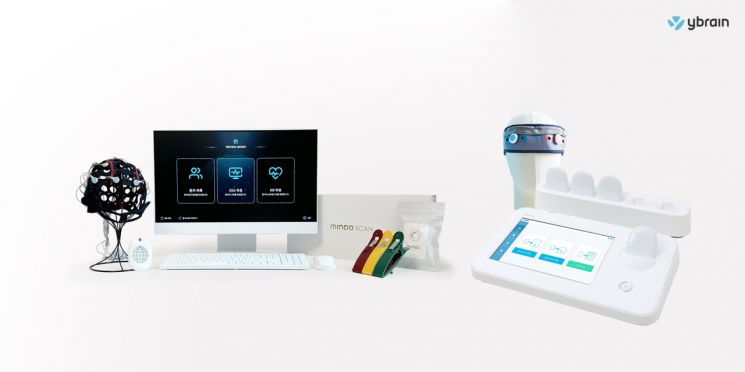 MindBrain's core BCI components: the electroencephalogram diagnostic device MindScan (left) and the electronic medicine for depression MindSteam image. Provided by MindBrain
The discussion will be held simultaneously online and offline at 3 p.m. on the 20th in the main auditorium of the Korean Academy of Science and Technology building, and registration is free on the Academy's website. Professor Lim Chang-hwan of Hanyang University (Department of Biomedical Engineering) will present on 'The Present and Future of Brain-Computer Interfaces,' and Professor Jeong Jae-seung of KAIST (Department of Brain and Cognitive Sciences) will present on 'Brain-Robot Interfaces and New Opportunities.' In the designated discussion session, chaired by KAIST Distinguished Professor Lee Hyun-joo, panelists include ▲Lee Ki-won, CEO of Ybrain ▲Woo Se-jun, Head of Research and Development Center at Bundang Seoul National University Hospital ▲Park Geon-hyeok, Principal Researcher at the Korea Institute of Oriental Medicine ▲and Park Jeong-hwan, Professor at Seoul National University.
CEO Lee Ki-won is expected to emphasize the medical applications and industrial potential of BCI-based Neuralink technology during the discussion. In particular, he plans to deeply address the core role of Neuralink technology in treating patients with limb paralysis and the possibility of creating new industries from an industrial perspective.
BCI technology has gained global attention as Neuralink, founded by Tesla entrepreneur Elon Musk, has begun clinical trials. Neuralink aims to directly connect computers and humans by implanting microchips into the brain, restoring movement for paralyzed patients and improving auditory and visual impairments. Approximately 50 million people worldwide suffer from nervous system damage, and the number of paralyzed patients in Korea has exceeded 400,000. The domestic application of advanced technologies like Neuralink is expected to enable a paradigm shift in treatment, allowing more patients to benefit from cutting-edge medical care, according to industry insiders.
CEO Lee stated, "If the globally spotlighted Neuralink technology is introduced to the domestic market, it will not only bring industrial achievements to Ybrain but also expand new treatment options from a broad medical perspective. This will positively impact not only medical technology innovation but also the qualitative improvement of medical welfare and the establishment of patient-centered treatment environments, making government support crucial."
© The Asia Business Daily(www.asiae.co.kr). All rights reserved.

















