Bank of Korea 'Comparison of Inflation Trends in Major Countries Since the Pandemic and Implications'
South Korea Reached Inflation Target Earlier Than Major Countries
"Price Levels Remain High...Selective Support Needed for Vulnerable Groups"
It has been analyzed that South Korea was able to stabilize prices faster than major countries due to a relatively small COVID-19 shock, favorable labor supply, and smooth coordination between monetary and fiscal policies.
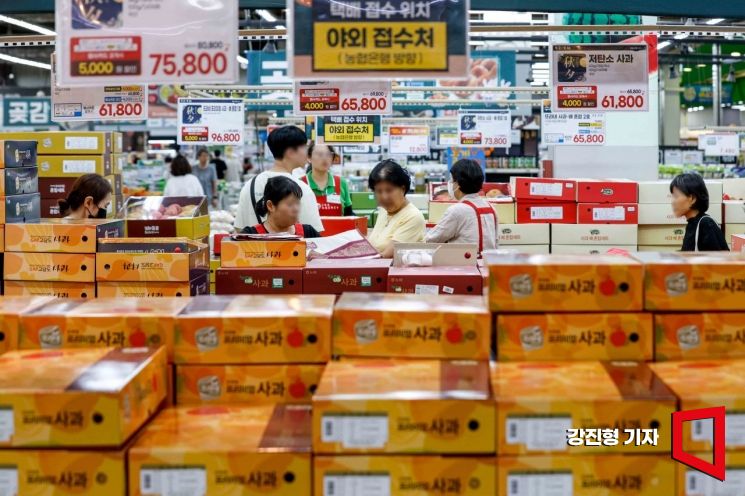 On the 5th, ahead of the major national holiday Chuseok, apple gift sets are being sold at Hanaro Mart Yangjae Branch in Seocho-gu, Seoul. Photo by Jinhyung Kang aymsdream@
According to the report "Comparison of Inflation Trends in Major Countries After the Pandemic and Implications" released by the Bank of Korea on the 18th, recently, major countries including South Korea are approaching their inflation target levels after passing the "last mile," where disinflation progressed slowly, thereby laying the foundation for price stability. The inflation phases in major countries after the pandemic can be divided into ▶initial rise (late 2020 to first half of 2021) ▶surge period (second half of 2021 to first half of 2022) ▶disinflation period (second half of 2022 to first half of 2023) ▶convergence period (second half of 2023 onward), and the U.S., Euro area, and South Korea have all entered the convergence phase.
South Korea reached the inflation target level (2%) earlier than other major countries after the pandemic. South Korea's consumer price inflation peaked at 6.3% in July 2022 and fell to 1.5% last month. In contrast, the U.S. CPI inflation peaked at 9.1% in June 2022 and declined but remained at 2.7% as of last month. The Euro area's CPI inflation rose to 10.6% in October 2022 and dropped to 2.3% last month.
South Korea's rapid price stabilization was largely contributed by the slowdown in service prices. Due to the decline in international raw material prices, major countries including South Korea saw significant deceleration in food and energy prices (non-core inflation). Core goods prices have also remained stable thanks to improvements in supply chains and weakened demand. However, unlike South Korea, where service prices have shown a downward stabilization trend approaching the target level, the U.S. and Euro area still maintain service inflation at around 4-5%.
The Bank of Korea cited the reasons South Korea reached the inflation target earlier as ▶the relatively small pandemic shock ▶favorable labor supply ▶proactive and aggressive coordination between monetary and fiscal policies. At that time, South Korea mitigated the initial supply shock impact through policy support such as refraining from raising public utility fees like electricity and gas and implementing fuel tax cuts. On the demand side, the scale of fiscal support and households' accumulated excess savings were smaller compared to major countries, resulting in relatively lower inflationary pressures.
Thanks to favorable quarantine conditions, the initial labor supply reduction during the pandemic was relatively small, and labor supply quickly recovered, especially among women and the elderly, which also contributed to price stability. This contrasts with major countries that experienced labor shortages during the pandemic. The rise in unit labor costs, which can gauge labor market-driven inflation pressures, slowed faster compared to the U.S. and Euro area, and inflation expectations remained relatively stable.
Moreover, South Korea responded actively to inflation by starting interest rate hikes earlier than major advanced countries in August 2021 and raising rates a total of 10 times, including two big steps by January 2023, totaling 300 basis points (100 basis points = 0.01 percentage points). The government also quickly shifted to a sound fiscal stance after the initial pandemic response, resulting in effective policy coordination between monetary and fiscal policies.
A Bank of Korea official stated, "In future crises, it is necessary to identify shocks early and respond flexibly with policies to maintain economic resilience," adding, "Considering the unavoidable costs such as interest rate hikes to ease inflation and that although inflation rates have stabilized, the price level remains quite high, selective support for groups vulnerable to high interest rates and high prices should continue."
He continued, "In the medium to long term, it is necessary to examine the possibility of structural changes in prices," adding, "With geopolitical risks, abnormal weather, and other supply-side shocks becoming more frequent, along with aging, fragmentation, and the spread of artificial intelligence (AI) accelerating, the need for research on structural changes in inflation and its long-term levels has increased."
© The Asia Business Daily(www.asiae.co.kr). All rights reserved.

















