Low-priced products' prices rise 3 times more than high-priced products
Low-income groups have a higher spending share on low-priced products
Effective inflation rate 1.3%p higher than high-income groups
"Need to maintain price stability and stabilize prices of mid- to low-priced products"
Since the COVID-19 pandemic, 'Cheapflation,' where the prices of low-priced goods rise more sharply than those of high-priced goods, has occurred, revealing that low-income groups, who spend a higher proportion on low-priced goods, have suffered greater inflation pain than high-income groups.
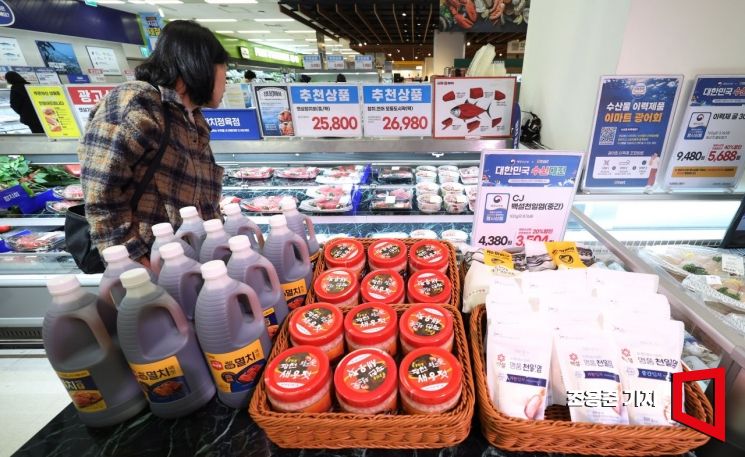 As the kimchi-making season begins in earnest, customers visiting a large supermarket in Seoul on the 19th are purchasing agricultural and marine products such as salted seafood, radishes, and napa cabbage to prepare for kimchi-making. Photo by Jo Yong-jun
According to the 'BOK Issue Note, Cheapflation and Inflation Inequality After the Pandemic' report released by the Bank of Korea on the 18th, an analysis of cumulative price increases from January 2020 to September 2023 based on processed food sales data showed that the prices of low-priced goods (1st quintile) rose by 16.4%, while the prices of high-priced goods (4th quintile) increased by only 5.6%. This means that the prices of low-priced goods rose about three times more than those of high-priced goods.
The gap in price increase rates between low-priced and high-priced goods widened significantly during the inflation surge period. In July 2022, the overall Consumer Price Index (CPI) rose by 6.3% year-on-year, peaking at that time, while the processed food CPI, focusing only on processed foods, rose to the 10% range by February 2023. In early 2023, the price increase rate for low-priced goods (1st quintile) exceeded 8%, whereas high-priced goods (4th quintile) showed an increase rate in the low 3% range, demonstrating a significant gap.
Low-income groups suffer more from inflation surge... Effective inflation rate 1.3%p higher than high-income groups
As a result, low-income groups experienced greater hardship due to inflation. From the 4th quarter of 2019 to the 3rd quarter of 2023, the cumulative effective inflation rate for low-income groups (bottom 20%) was 13%, which is 1.3 percentage points higher than the 11.7% for high-income groups (top 20%). This is because low-income groups spend a relatively larger proportion on low-priced goods, whose prices rose faster. Including the inflation rate gap of 1.1 percentage points caused by differences in consumption item composition by income quintile, inflation inequality based on household income has deepened further.
The researchers analyzed that the sharp rise in imported raw material prices and the shift in spending toward cheaper goods triggered Cheapflation domestically. Low-priced goods tend to use relatively cheaper imported raw materials to reduce manufacturing costs, but after the pandemic, due to the Russia-Ukraine war and other factors, the prices of imported raw materials surged and were passed on to the selling prices of low-priced goods. Additionally, during periods of high inflation, households moved to buy cheaper products and shop at places offering lower prices to reduce the burden caused by decreased real income, which increased demand and further raised the prices of low-priced goods.
"Maintain price stability policy and focus on stabilizing prices of mid- to low-priced goods"
To alleviate inequality caused by Cheapflation, it is suggested to maintain an overall price stability stance through monetary policy and focus on stabilizing prices of mid- to low-priced goods through government policies. Jo Gang-cheol, deputy head of the Price Trends Team at the Bank of Korea’s Research Department and author of the report, said, "Cheapflation, which causes more pain to low-income groups, tends to appear mainly during periods of rapid price increases," adding, "Maintaining an overall price stability stance through monetary policy is ultimately the way to ease the difficulties of low-income groups."
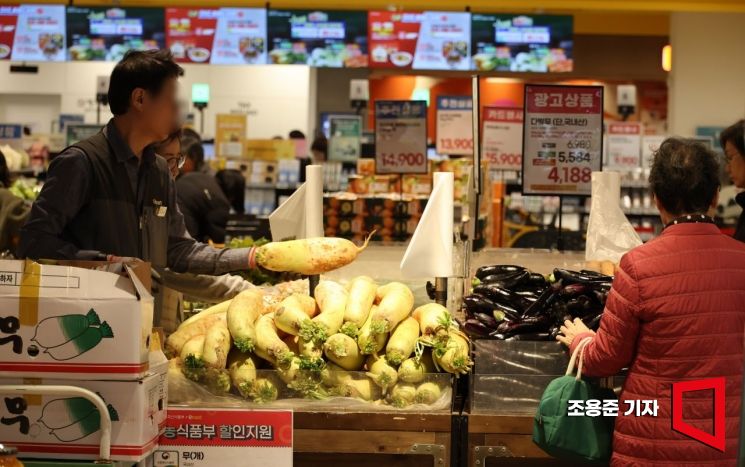 As the peak kimchi-making season arrives, customers visiting a large supermarket in Seoul on the 19th are purchasing agricultural products such as radishes, green onions, napa cabbage, and salted seafood to prepare for kimchi-making. Photo by Jo Yong-jun
He continued, "From the government policy perspective, it is necessary to focus on stabilizing prices of mid- to low-priced goods during periods of high inflation in the future to alleviate the burden on vulnerable groups," adding, "Measures such as selective support for mid- to low-priced goods through allocation tariffs to buffer overseas supply shocks or discount support for items with sharp price increases can be considered."
© The Asia Business Daily(www.asiae.co.kr). All rights reserved.


















