15.6km Line from Saejeol Station to Seoul National University Entrance Station
Total Project Cost Up 4.24% Reflecting Construction Cost Exception
Will Do Our Best to Shorten Period Including Central Government Consultations
The urban railway project agreement connecting Eunpyeong-gu and Gwanak-gu in Seoul has passed the government investment review. After 16 years, the long-awaited project for residents in the southwestern and northwestern regions is finally on track, promising the creation of a representative light rail line linking transportation-disadvantaged areas.
On the 18th, the Seoul Metropolitan Government announced that the 'Western Line Urban Railway Implementation Agreement' passed the review of the 5th Private Investment Project Deliberation Committee of the Ministry of Economy and Finance held on the 12th of 2024. Three line agendas, including the Western Line, Ui-Sinseol Line, and Wirye-Sinsa Line, were also reviewed and approved on the same day.
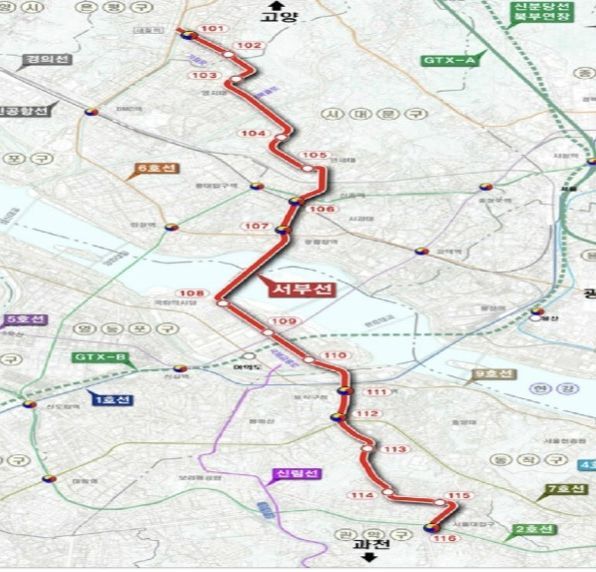
The Western Line is a light rail line promoted to resolve public transportation difficulties in the northwestern and southwestern regions of Seoul, which are vulnerable in terms of urban railway infrastructure. The project connects 15.6 km from Saejeol Station (Line 6) in Eunpyeong-gu to Seoul National University Station (Line 2) in Gwanak-gu. There are 16 stations, crossing along the north-south axis, allowing transfers to Lines 1, 2, 6, 7, and 9. It operates across a wide area including Eunpyeong-gu, Seodaemun-gu, Mapo-gu, Yeongdeungpo-gu, Dongjak-gu, and Gwanak-gu, expected to contribute to reducing commuting time and balanced development.
So far, the Seoul Metropolitan Government has been fully committed to securing project feasibility and passing the implementation agreement to expedite the construction of the Western Line. To this end, they actively reviewed an increase in the total project cost reflecting the surge in construction expenses and incorporated special provisions in the basic plan during this private investment review. This was achieved through cooperation with the Ministry of Economy and Finance, project operators, and related agencies despite the deteriorating conditions for private investment projects in the construction industry due to rising raw material costs, labor costs, and interest rates.
Accordingly, the total project cost has increased by 4.24%. It has been raised by 64.2 billion KRW from the previous plan to 1.5783 trillion KRW. Related procedures will be initiated in the first half of 2025 to conclude the implementation agreement. The construction target is set for 2026. However, due to difficult project conditions such as rising construction costs and a shrinking project financing market, some construction investors have withdrawn, so support will be provided to allow the project operator to recruit new construction investors.
Yoon Jong-jang, Director of Transportation at Seoul City, stated, "We have mobilized all our capabilities to meet the long-standing hopes and expectations of residents in the western region, resulting in the passing of the private investment review after 16 years." He added, "We will swiftly proceed with the remaining follow-up procedures and thoroughly prepare the project to ensure smooth progress to the construction stage."
© The Asia Business Daily(www.asiae.co.kr). All rights reserved.

















