The Rise in Per Capita Gross National Income (GNI) Outpaces the Slower Growth of Household Total Disposable Income (PGDI)
Citizens' Perceived Income Continues to Weaken
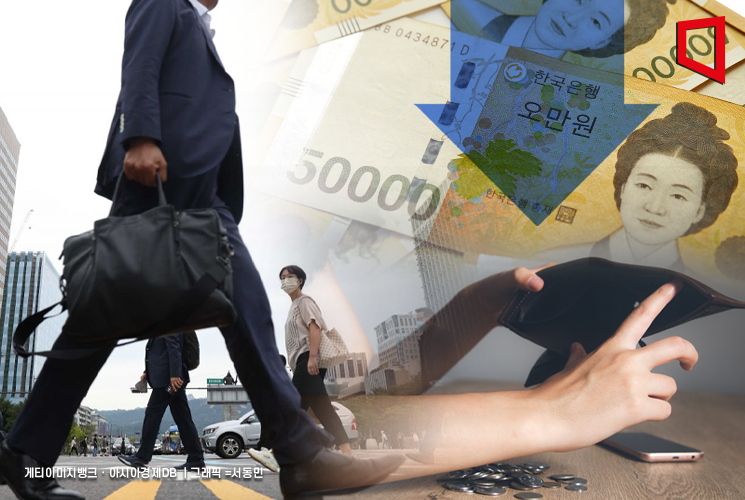
Although South Korea's per capita Gross National Income (GNI) continues to rise, the perceived income of its citizens is weakening.
According to the "Second Revision Results of the 2020 Base Year National Accounts" released by the Bank of Korea on the 18th, South Korea's per capita GNI (in dollars) increased 540 times from $67 in 1953 to $36,194 last year. The average annual growth rate was 9.4%. During the same period, the country's economic scale (nominal Gross Domestic Product (GDP)) also grew from 47.7 billion won to 2,401 trillion won, with an average annual growth rate of 16.7%.
On the other hand, South Korea's household Gross Disposable Income (PGDI) was $19,498 last year, increasing at an average annual rate of only 8.0% from $482 in 1975. PGDI is an indicator representing the amount of disposable income (purchasing power) after deducting taxes and insurance premiums from household income. It refers to the income households can freely use for consumption and savings. Since GNI includes income from not only households but also businesses and the government, PGDI more accurately reflects the purchasing power of households.
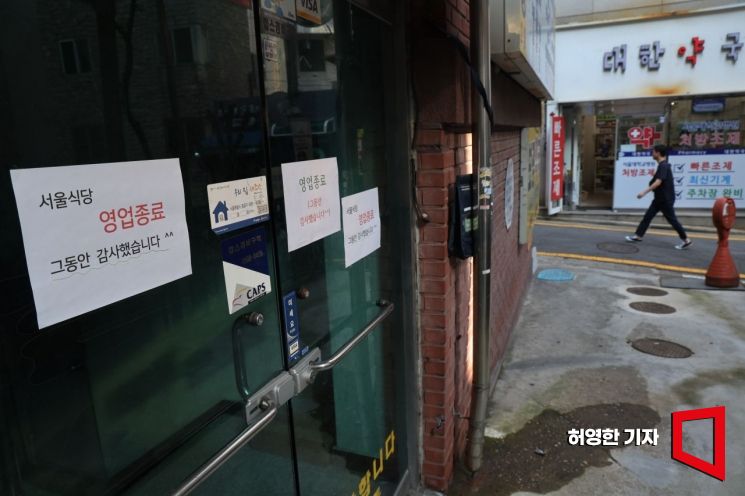 A closure notice is posted in front of a restaurant on a street with pharmacies and restaurants near Seoul National University Hospital in Jongno-gu, Seoul. Photo by Heo Younghan younghan@
The ratio of South Korea's per capita PGDI to GNI was 77.5% in 1975 when statistics began to be compiled, but it has shown a continuous decline since then, reaching a record low of 53.9% last year. This means that the growth rate of the national economy is outpacing the perceived income growth of households.
From 1954 to last year, South Korea's average annual economic growth rate (real GDP growth rate) was 6.9%, while the average annual growth rates of real GDI and real GNI were both 6.6%, indicating that the real income growth rate lagged behind the economic growth rate. From 1976 to last year, the average annual growth rate of real PGDI was 5.0%, which was lower than the 6.0% growth rate of real GNI.
A Bank of Korea official stated, "The real GDI growth rate exceeded the real GDP growth rate in the 1980s, supported by improved terms of trade due to oil price stabilization, but since the 1990s, the terms of trade have deteriorated due to falling export prices of ICT products, generally causing the real GDI growth rate to lag behind the real GDP growth rate."
The gross savings rate, which refers to the remainder after subtracting final consumption expenditure from final income, is also trending downward, especially among households. South Korea's gross savings rate rapidly rose to 41.8% in 1988 but gradually declined to 33.5% in 2023. While the corporate sector's savings rate steadily increased from 8.5% in 1975 to 23.4% last year, the household sector's rate fell from 8.1% to 5.5% during the same period. This indicates a decreasing capacity for household savings.
The household net savings rate, which represents the amount that can be purely saved after deducting taxes and consumption from total savings, also steadily declined from 23.3% in 1988 to just 4.0% last year. The Bank of Korea explained, "In the past, the growth rate of household income exceeded that of household consumption, but this trend has slowed down recently."
© The Asia Business Daily(www.asiae.co.kr). All rights reserved.


















