EU Trade, Environment and Human Rights → Economic Security
"Caution Needed for Secondary Battery Companies and Others"
With the prospect of strengthened American nationalism under President Donald Trump's potential return to power, there are claims that the newly launched second term of Ursula von der Leyen's European Union (EU) Commission this month will focus its trade policy more on economic security rather than the existing emphasis on environment and human rights. It has been suggested that export companies, such as those in the secondary battery sector, need to be cautious.
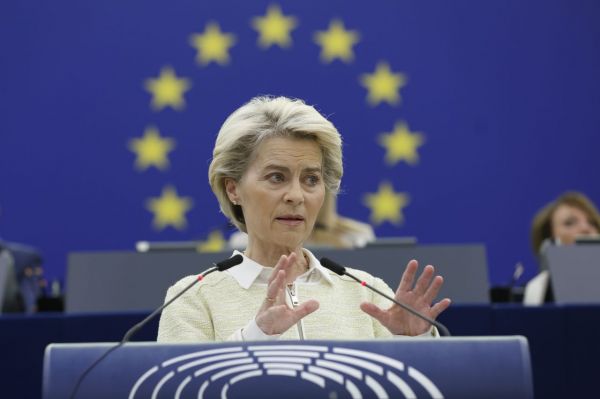
According to the report "Von der Leyen's Second Term EU Trade Policy" published on the 18th by the Korea International Trade Association's International Trade and Commerce Research Institute, the second-term EU Commission led by the reappointed President Ursula von der Leyen plans to strengthen industrial competitiveness and economic security. This marks a shift from the first-term Commission, which pursued trade policies centered on 'values' such as environment and human rights.
The second-term Commission intends to transform the existing 'Green Deal' policy into a 'Clean Industry Deal,' expanding investments in eco-friendly technologies and infrastructure. It is expected to solidify a strategy that strengthens industrial competitiveness while achieving carbon neutrality goals.
Through the 'Buy European' policy, the Commission plans to prioritize the purchase of intra-regional products in public procurement. It is also considering introducing requirements for the use of eco-friendly steel in the automobile and wind power industries.
To counter China and protect regional industries, there is a possibility of implementing import regulations such as anti-dumping and countervailing duties, introducing the Foreign Subsidies Regulation (FSR), and enforcing export controls and investment restrictions. The FSR is a system that regulates distortions of competition caused by foreign government subsidies in areas such as public procurement and corporate mergers.
However, the report forecasts that the likelihood of imposing high tariffs on China, as the U.S. has done, is low due to the EU's continued high dependence on trade and investment with China. Instead, it advises domestic companies to be cautious about the impact of the EU's sanctions on Chinese companies.
This is because, as in the case of the epoxy resin anti-dumping investigation conducted by the EU in July, there is concern that local companies harmed by Chinese oversupply might file complaints not only against China but also against Korean companies.
Han Areum, a senior researcher at the Korea International Trade Association, stated, "The expansion of EU investment in eco-friendly sectors is expected to be an opportunity factor for our secondary battery companies that are pushing for large-scale new and expanded factories locally," but added, "Since the EU is also considering introducing requirements for sourcing raw materials and components from within the region, companies entering the market need to be especially cautious."
© The Asia Business Daily(www.asiae.co.kr). All rights reserved.
![User Who Sold Erroneously Deposited Bitcoins to Repay Debt and Fund Entertainment... What Did the Supreme Court Decide in 2021? [Legal Issue Check]](https://cwcontent.asiae.co.kr/asiaresize/183/2026020910431234020_1770601391.png)















