17th National Assembly Judiciary Committee Passes Basic AI Act
Disagreements on Scope and Copyright Despite Agreement for Prompt Passage
Objections to Science and Technology Fact-Finding Clause Added in Alternative Bill
This year, the basic law on artificial intelligence (AI), which had been a challenge for the information and communication technology (ICT) industry, passed the National Assembly's Legislation and Judiciary Committee. Although there were disagreements regarding the scope of the law's application and AI data copyright issues, the Ministry of Science and ICT emphasized the position that "follow-up legislation can be enacted."
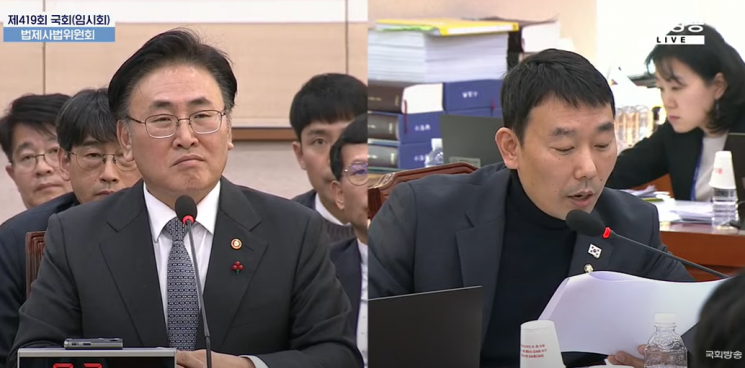 On the 17th, at the National Assembly Legislation and Judiciary Committee plenary meeting, Yusang-im, Minister of Science and ICT, is listening to a question from Kim Yong-min, a member of the Democratic Party of Korea. Photo by National Assembly Broadcasting System capture.
On the morning of the 17th, the National Assembly's Legislation and Judiciary Committee held a plenary session and approved the Basic Law on AI Development and Trust Foundation (hereinafter referred to as the AI Basic Law). The National Assembly's Science, Technology, Broadcasting and Communications Committee had previously proposed the bill as an alternative by integrating and coordinating 19 AI-related bills submitted by both ruling and opposition parties.
The AI Basic Law stipulates necessary matters for AI development and the establishment of a trust foundation and defines related concepts. It includes the legal basis for the establishment of the Presidential National AI Committee and the AI Safety Research Institute.
It also defines AI that can have a significant impact on human life, physical safety, and fundamental rights or cause risks as "high-impact artificial intelligence" and contains provisions to ensure its safety.
Members of the Legislation and Judiciary Committee agreed on the prompt enactment of the AI Basic Law but showed differing opinions on the scope of AI affected by the bill.
According to Article 4, Paragraph 2 of the bill, AI developed or used for defense or national security purposes, as defined by Presidential Decree, is excluded from the application of this law.
Democratic Party member Kim Yong-min questioned this, saying, "Defining it by Presidential Decree means broadly excluding everything," and asked, "During the recent insurrection, the location of lawmakers was tracked; couldn't it be used like this?" He added, "Was there any consideration of alternative measures within the legal system for such situations?"
Minister Yoo Sang-im of the Ministry of Science and ICT stated, "The position is that the AI Basic Law should proceed as a basic law," and added, "If necessary, new legislation should be enacted for defense-related matters."
Kim also suggested that defense-related AI should be included within the scope of high-impact AI. However, Minister Yoo reiterated the principle of follow-up legislation, saying, "Regulations that require individual laws should be addressed through subsequent bills, which is the intent of the AI Basic Law."

Park Jun-tae, a proportional representative of the People Power Party, raised objections regarding the Ministry of Science and ICT's authority to conduct fact-finding investigations. According to Article 40 of the bill, the Ministry can investigate when it discovers or suspects violations related to the AI Basic Law or receives reports or complaints about violations.
Park said, "The alternative bill includes content related to fact-finding investigations that are not present in existing laws," and added, "Including content not in the original text is not a desirable legislative direction."
There was also an opinion that copyright provisions for AI data used in creative works should be added. Jeong Hyang-mi, Director of the Copyright Bureau at the Ministry of Culture, Sports and Tourism, stated, "Within the AI transparency obligation clause, paragraph 4 should include a provision requiring disclosure of only the list of training data related to generative AI, that is, AI development and utilization related to creative acts."
Democratic Party member Kim Hyun opposed this, saying, "It is unacceptable," and explained, "The AI Basic Law has a clause that defers to other laws if special provisions exist, so adding new provisions is unnecessary."
Minister Yoo also said, "This matter was resolved after Acting Prime Minister Han Deok-su organized it this morning, and I was notified that the Ministry of Culture, Sports and Tourism's opinion was addressed," adding, "It seems the director did not follow the proper hierarchy."
Meanwhile, on the same day, the Legislation and Judiciary Committee also passed a bill to repeal the Act on the Improvement of Distribution Structure of Mobile Communication Terminals (the Mobile Device Distribution Act).
© The Asia Business Daily(www.asiae.co.kr). All rights reserved.


















