
The annual performance of major domestic financial holding companies is set to reach an all-time high this year. While the domestic economy is deteriorating rapidly, the banking sector is experiencing an expansion in the interest rate spread between deposits and loans due to regulatory measures on household loan management.
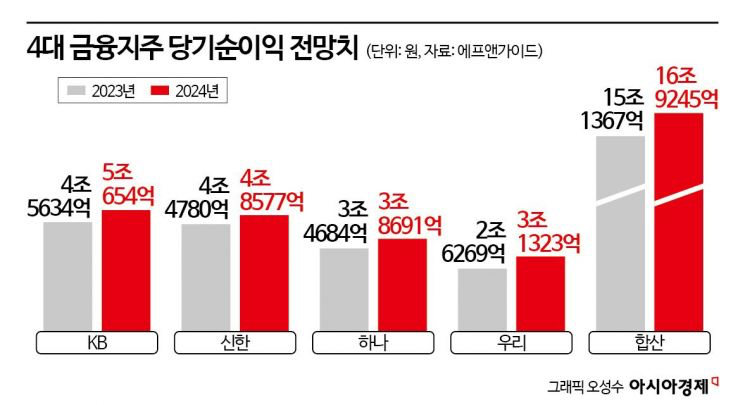
According to financial information provider FnGuide on the 17th, the fourth-quarter net profit forecast for the four major domestic financial holding companies (KB, Shinhan, Hana, Woori) is 2.43 trillion KRW, an 81.1% increase compared to the previous year (1.3421 trillion KRW).
Specifically, KB Financial is expected to report a net profit of 676.8 billion KRW, up 220.1% year-on-year; Shinhan Financial is forecasted to earn 734.3 billion KRW, a 27.5% increase. Hana Financial is projected to record 621.2 billion KRW, up 35.1%, and Woori Financial is expected to post 398.3 billion KRW, a 319.4% increase in net profit.
With the improvement trend continuing through the fourth quarter, the four major financial groups are also expected to achieve record annual performance. According to FnGuide, the annual net profit forecast for the four major financial groups is 16.9245 trillion KRW, an 11.8% increase from the previous year (15.1367 trillion KRW), approaching approximately 17 trillion KRW. This far surpasses the previous record set in 2022 (15.6503 trillion KRW).
Despite entering a period of declining interest rates, the reason financial holding companies are maintaining a positive outlook is attributed to the widened interest rate spread between deposits and loans. According to the Korea Federation of Banks, the interest rate spread on new household loans at the five major banks increased more than twofold from 0.43 percentage points in July to 1.04 percentage points in October.
As authorities have actively managed household loans to curb the year-round expansion of household debt, banks have maintained high additional interest rates, which has resulted in the expansion of the interest rate spread. Additionally, the industry explains that there was a base effect from the large-scale setting of loan loss provisions related to real estate project financing (PF) defaults in the fourth quarter of last year.
With the domestic economy in recession and, on top of that, President Yoon Suk-yeol’s emergency measures and impeachment crisis unfolding, there is also speculation that pressure for win-win finance on the banking sector enjoying a 'solo' boom may intensify.
Authorities and the banking sector are already discussing additional financial support measures for self-employed individuals and small business owners. According to the Korea Federation of Banks, the banking sector plans to prepare customized debt restructuring for small business borrowers facing repayment difficulties even before delinquency, and introduce a 'low-interest long-term installment repayment program' for small business owners struggling to continue their operations. Furthermore, for small business owners with the will to recover and the potential to enhance competitiveness, plans are underway to arrange 'win-win guarantees and loans for small businesses' in cooperation with guarantee institutions to provide additional business funds.
Cho Yong-byeong, chairman of the Korea Federation of Banks, stated at a recent small business and local commercial district public discussion, "I believe more sustainable support measures for small business owners are necessary," adding, "We will work with financial authorities to prepare areas where the banking sector can contribute."
© The Asia Business Daily(www.asiae.co.kr). All rights reserved.


















