German Chancellor Olaf Scholz was voted out of confidence by the Bundestag on the 16th (local time). Following Scholz's immediate request for the dissolution of the parliament and an early general election, Germany is set to hold the election at the end of February next year, seven months earlier than originally planned.
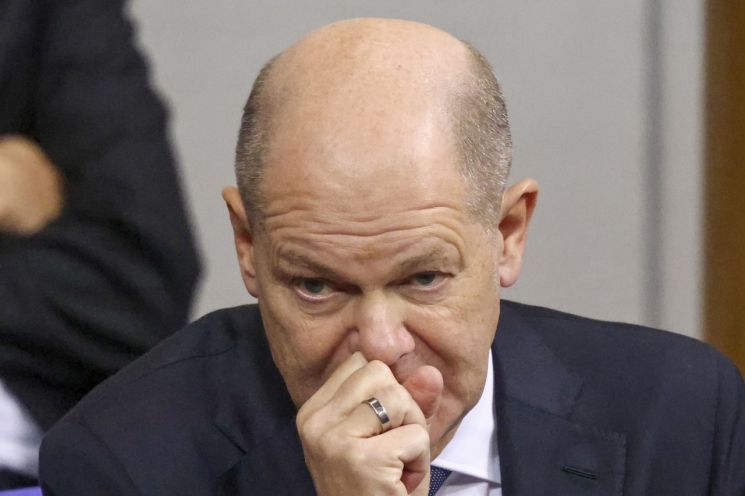
According to DW, the German parliament rejected the confidence motion proposed by Chancellor Scholz with 207 votes in favor, 394 against, and 116 abstentions. Among the 733 members, the Social Democratic Party (SPD) to which Scholz belongs, along with three independents and three members of the far-right Alternative for Germany (AfD), voted in favor. Other opposition parties, including the Christian Democratic Union (CDU) and Christian Social Union (CSU) alliance?the main opposition?and the Free Democratic Party (FDP), which withdrew from the "traffic light" coalition government, all voted against. The Green Party members, who remain in the minority coalition with the SPD, abstained in line with the party's stance.
Chancellor Scholz immediately went to Bellevue Palace in Berlin to request President Frank-Walter Steinmeier to dissolve the parliament and call for an early general election. The president must decide on the dissolution within three weeks. If dissolved, the election must be held within 60 days. DW reported, "President Steinmeier's approval is certain. He has already indicated his agreement with the election date agreed upon for February 23 next year," adding, "After consultations with the parliament and hearing the opinions of party leaders, a decision is expected after the Christmas holidays."
Earlier, the SPD and the CDU-CSU alliance agreed last month on February 23 next year as the election date after Scholz announced his intention to hold an early election following a confidence vote. This development is a result of the so-called "traffic light coalition" collapsing after about three years in power, triggered by conflicts over economic policy with the FDP-origin finance minister and his dismissal. Until a new government is formed following the election, Chancellor Scholz and the current cabinet will exercise their authority.
In a speech delivered in parliament before the vote, Chancellor Scholz stated, "My goal is to bring forward the general election," calling it "the path that does not jeopardize the future of our country." He emphasized that he could no longer tolerate divisions within the government, saying, "Politics is not a game." He particularly blamed former Finance Minister Christian Lindner of the FDP for the coalition's collapse, stating, "Due to weeks of obstruction by the FDP, the coalition could not continue. To participate in politics, moral qualifications are necessary."
This is the sixth time a German chancellor has put a vote of confidence to the parliament, including during the former West Germany era. Of the previous five confidence votes, three led to the dissolution of the parliament and early general elections.
While Chancellor Scholz is expected to seek re-election in the general election at the end of February, the outlook is bleak. According to recent public opinion polls, the CDU-CSU alliance leads with 32% support. The CDU-CSU alliance has nominated Friedrich Merz, CDU leader, as their chancellor candidate. Following them is the far-right AfD, which advocates for exiting the Eurozone, with 19%. The SPD stands at 17%, followed by the Green Party at 13%.
British broadcaster BBC predicted, "While the SPD led by Scholz is significantly trailing, the CDU led by Merz is expected to make a comeback." American CNN also forecasted, "Unless there is an unexpected twist, Merz of the CDU-CSU will become Germany's new chancellor." Prior to the "traffic light coalition" led by Scholz, the CDU led coalition government for about 16 years during former Chancellor Angela Merkel's tenure. However, since it is expected to be difficult for the CDU-CSU alliance to secure the majority seats in parliament, forming a coalition will be essential. Major foreign media outlets anticipate that, besides the SPD, the Green Party will play a key role in the coalition formation process. DW explained, "Major parties have rejected forming a coalition with the AfD."
Friedrich Merz, the leading candidate for the next chancellor, is considered a more right-leaning figure compared to former Chancellor Merkel, who pursued a liberal line. Merz advocates for stricter illegal immigration controls and a review of the nuclear phase-out policy. Regarding the Russia-Ukraine war, he actively supports Ukraine, including advocating for the provision of German-made Taurus missiles. CNN noted, "Merz is known for shifting the CDU to the right. During his rise to party leadership, he pledged not to be a Merkel-style successor," adding, "If he becomes chancellor, it will mark the end of the CDU's centrist policies." On this day, Merz also criticized Chancellor Scholz's economic policies as "failed policies."
© The Asia Business Daily(www.asiae.co.kr). All rights reserved.

















