Danya of Jungwon Cultural Heritage Research Institute Successfully Conducts Casting Experiment
Also Identifies Impact of Additives on Iron Recovery Rate
The National Research Institute of Cultural Heritage's National Jungwon Cultural Heritage Research Center announced on the 17th that it successfully produced iron using ancient methods, achieving weapon manufacturing at that time.
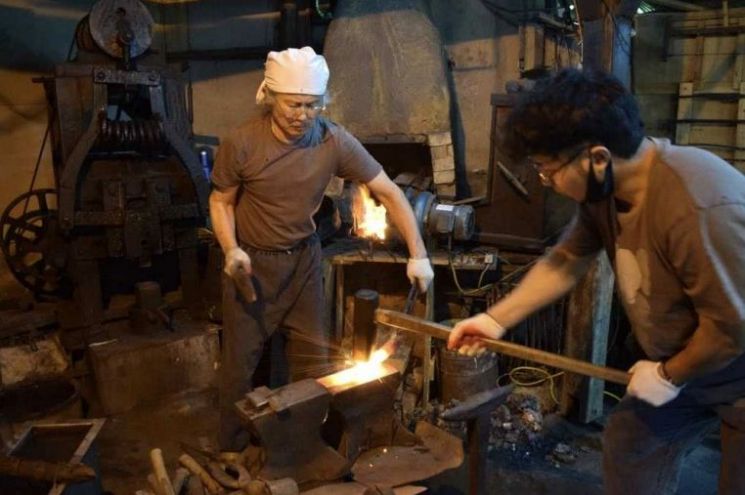
The research center has been conducting smelting experiments since 2014 to produce pig iron (the primary process of extracting iron from raw materials such as iron ore, limonite, and laterite). Pig iron is the material used to make forged iron tools. It is produced through the reduction reaction of iron ore. Its surface has pores, and the material is somewhat soft.
Since 2022, the center has attempted to manufacture ancient tools using pig iron. These include forging, a technique of shaping iron by hammering, and casting, a process of pouring molten iron into molds to produce cast iron tools.
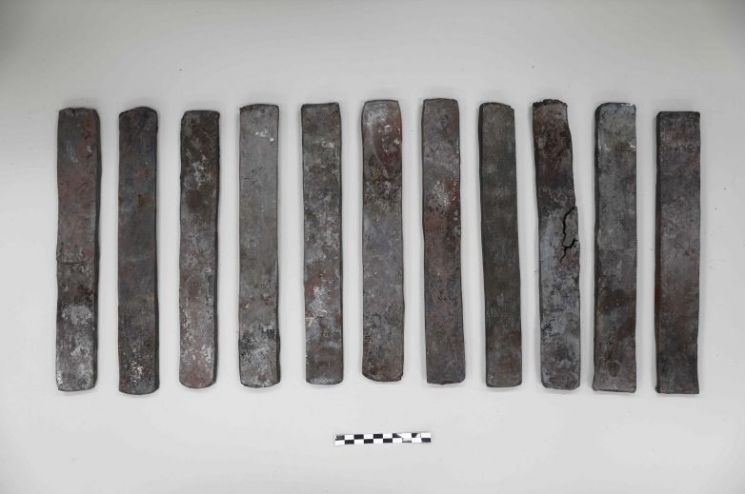
All experiments were successful. Through forging, they created a model of an iron ingot (鐵鋌, a long rectangular iron plate refined from pig iron) found near Tangeumdae Earthen Fortress in Chilgeum-dong, Chungju, and a ring-handled knife (環頭刀) from the Geumnyeong-dong site in Chungju. A research center official explained, "We were able to produce iron tools of the time using pig iron generated from the 7th smelting experiment."
In the casting experiment, a trapezoidal-shaped pouring gate was used to create the casting mold (Yongbeom). Instead of the conventional method of pouring molten iron into both pouring gates, molten iron was poured from one side to flow out from the other, completing the casting. The research center official added, "Changing the pouring method rather than the shape of the pouring gate was effective in reducing bubble formation during the casting production process."
Meanwhile, through smelting experiments, the center also confirmed how much iron is actually produced depending on the use of additives such as clay. When clay was added to Yangyang iron ore, which contains a large amount of limestone and sand, the iron recovery rate was 17.8%. This was significantly lower than the 30% recovery rate in previous experiments without additives. A research center official stated, "It should be considered that additives do not influence the promotion of iron recovery rates."
© The Asia Business Daily(www.asiae.co.kr). All rights reserved.
![Clutching a Stolen Dior Bag, Saying "I Hate Being Poor but Real"... The Grotesque Con of a "Human Knockoff" [Slate]](https://cwcontent.asiae.co.kr/asiaresize/183/2026021902243444107_1771435474.jpg)

















