Over 100 Participants from Institutions, Companies, and Researchers
Securing Liquefied Hydrogen Transport, Focusing on Commercialization
The Hydrogen Ship Technology Center at Pusan National University (Director: Jaemyung Lee, Professor of Naval Architecture and Ocean Engineering) announced on the 16th that it will officially commence the ‘Development of Commercialization Base Technology for Liquefied Hydrogen Carriers’ project, which involves designing and constructing Korea’s first liquefied hydrogen carrier and conducting maritime demonstration.
The Hydrogen Ship Technology Center, which is the overall coordinator of this project, will hold a ‘Kick-off Meeting’ for the ‘Development of Commercialization Base Technology for Liquefied Hydrogen Carriers’ project on the 17th at 2 p.m. in the Capri Room of Paradise Hotel, Haeundae, Busan, with about 100 participants including project partner institutions, company leaders, and researchers.
Following the government’s ‘K-Shipbuilding Super Gap Vision 2040’ and ‘Hydrogen Economy Activation Roadmap,’ the Hydrogen Ship Technology Center at Pusan National University was selected last October in the Ministry of Trade, Industry and Energy’s call for proposals for the ‘Development of Commercialization Base Technology for Liquefied Hydrogen Carriers’ project. The center will lead the construction of the liquefied hydrogen carrier tentatively named ‘Hydro Ocean K’ and provide a testbed for maritime demonstration of core equipment installed on the liquefied hydrogen carrier. This project is linked to a national key policy for early acquisition of liquefied hydrogen carriers, with a budget of 62.4 billion KRW and a duration of 4 years and 4 months until December 2028.
The Hydrogen Ship Technology Center at Pusan National University, as the overall coordinating institution of this project, will collaborate with 13 institutions spanning industry, academia, and research, including the Korea Research Institute of Ships and Ocean Engineering, Korean Register, Samsung Heavy Industries, Hanwha Ocean, HD Hyundai Heavy Industries, HD Korea Shipbuilding & Offshore Engineering, Korea Ship Technology, Movenna Korea, HSS, Inha University, Korea Shipbuilding & Offshore Engineering Equipment Research Institute, Gyeongnam Technopark, and Korea Gas Corporation. Together, they will undertake tasks such as ① development of cryogenic liquefied hydrogen storage and ship transportation technology at minus 253 degrees Celsius, ② demonstration and commercialization of the world’s top-level boil-off prevention insulation system, ③ development of Korea’s first advanced equipment for liquefied hydrogen, and ④ securing Korea’s first onboard demonstration track record of hydrogen fuel cells for ships.
The cargo tank installed on the liquefied hydrogen carrier will be designed with a capacity of 2,000 cubic meters and will undergo sea trials equipped with cryogenic pumps, valves, piping, sensors, and other components.
Stable supply of hydrogen is essential for expanding the use of hydrogen as a future clean energy source. Unlike fossil fuels such as petroleum or liquefied natural gas, hydrogen transportation methods vary significantly depending on the distance between production and consumption sites. Among various hydrogen transportation technologies, liquefying hydrogen at minus 253 degrees Celsius reduces its volume by 1/800, making liquefied hydrogen indispensable for long-distance transportation and large-capacity storage.
The government’s hydrogen supply strategy includes domestic production and overseas import, and operation of liquefied hydrogen carriers is required for long-distance overseas import by ship. However, no commercially operated liquefied hydrogen carriers have been constructed anywhere in the world yet.
This project not only symbolizes the development of Korea’s first liquefied hydrogen maritime transport vessel but also enables securing technological leadership in the industry and is expected to provide domestic manufacturers with global market entry opportunities in the hydrogen industry. It is also anticipated to serve as a starting point for building a hydrogen value chain through local government participation.
This project corresponds to the ‘Liquefied Hydrogen Carrier Super Gap Leading Strategy’ announced by the Ministry of Trade, Industry and Energy last month and is significant in prioritizing the ‘hydrogen transportation’ sector within Korea’s hydrogen supply chain value network.
Professor Jaemyung Lee of Pusan National University, who is in charge of overall responsibility, said, “Upon completion of the Development of Commercialization Base Technology for Liquefied Hydrogen Carriers project, Korea’s independent model liquefied hydrogen carrier ‘Hydro Ocean K’ will be secured. Through this, we expect to promote the establishment of the domestic hydrogen ecosystem, support new market entry for shipbuilding equipment companies, complete a technology development model, and secure a stable and economical hydrogen storage and transportation system base.”
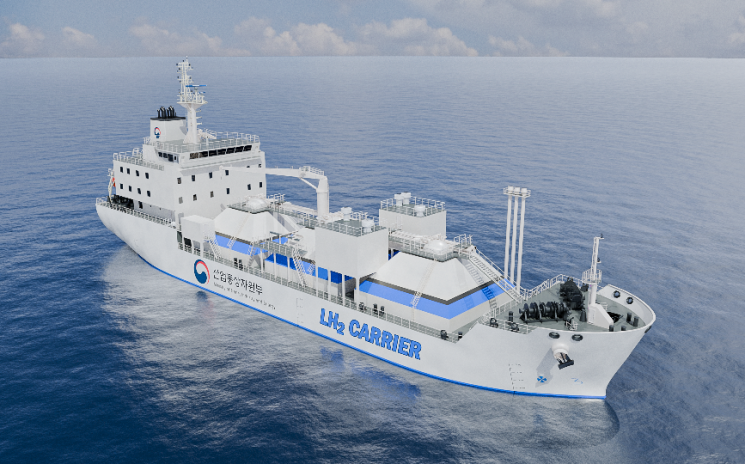 Perspective view of Busan National University Liquefied Hydrogen Carrier Hydro Ocean K (tentative name).
© The Asia Business Daily(www.asiae.co.kr). All rights reserved.
![Clutching a Stolen Dior Bag, Saying "I Hate Being Poor but Real"... The Grotesque Con of a "Human Knockoff" [Slate]](https://cwcontent.asiae.co.kr/asiaresize/183/2026021902243444107_1771435474.jpg)











