Citizen Group Hosts Exhibition of Japan's 'Forced Mobilization Records'
Until the 24th at Gwangju City Hall 1st Floor Citizen Hall
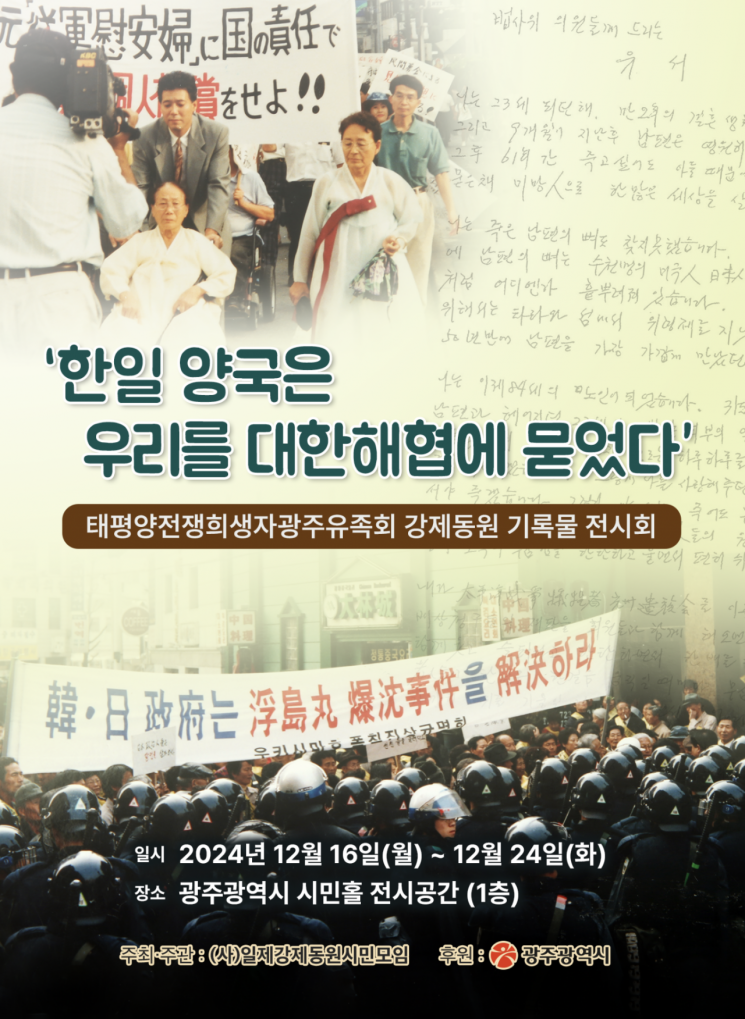 The Association of Citizens for Forced Mobilization under Japanese Rule will hold an exhibition of forced mobilization records by the Gwangju Bereaved Families Association of Pacific War Victims at the exhibition space on the first floor of Gwangju City Hall until the 24th. Provided by the Association of Citizens for Forced Mobilization under Japanese Rule
The Association of Citizens for Forced Mobilization under Japanese Rule announced on the 16th that it will hold an exhibition of forced mobilization records by the Gwangju Bereaved Families Association of Pacific War Victims in the exhibition space on the first floor of Gwangju City Hall until the 24th.
This exhibition consists of about 20 panels introducing activity photos of the Gwangju Bereaved Families Association and various documents, as well as video materials containing testimonies of the victims.
The exhibition was prepared to re-examine the footsteps of the late Lee Geum-ju, president of the Gwangju Bereaved Families Association of Pacific War Victims, who has walked the same path for the restoration of rights of Japanese colonial victims, and to share with citizens the importance of forced mobilization records in an era when the number of victims is gradually decreasing.
President Lee, who established the "Gwangju Bereaved Families Association of Pacific War Victims" in 1988, initiated the Gwangju Cheonin lawsuit in 1992 with 1,273 plaintiffs, followed by lawsuits related to the sinking of the repatriation ship Ukishima, the Kwanbu trial involving Japanese military 'comfort women' and female labor corps victims, B and C class prisoner guard lawsuits, Mitsubishi labor corps lawsuits, and a lawsuit against the Japanese Ministry of Foreign Affairs for disclosure of Korea-Japan summit documents. To date, she has filed seven compensation claims against the Japanese government and war crime companies in the Japanese judiciary.
President Lee also personally appeared as a plaintiff in the "Korea-Japan Summit Document Disclosure Lawsuit" against the Korean government and led the enactment of the "Special Act on Forced Mobilization" and the launch of the government-level "Committee for the Investigation of Forced Mobilization Damage under Japanese Colonial Rule." Notably, on December 19, 2003, she sent a will directly to the National Assembly Judiciary Committee members urging the enactment of the special law, leaving a deep impression.
She visited victims and recorded their grievances. For over 20 years, she wrote a diary daily and meticulously recorded the monthly meetings of the Gwangju Bereaved Families Association, held 227 times from January 1992 to April 2011, in her notebooks.
The various materials produced and collected during the activities of the Gwangju Bereaved Families Association, including victims’ documents, lawsuit records, statements, photos, and videos, are valuable resources that confirm the historical truth of forced mobilization under Japanese rule.
A representative of the Association of Citizens for Forced Mobilization under Japanese Rule said, "In a situation where no survivors who can testify about the forced mobilization under Japanese rule can be found anymore, the historical records of Japanese colonial victims created through tears and resentment themselves will serve as precious educational materials for generations who did not experience the Japanese colonial period and as evidence to expose Japan’s war crimes."
© The Asia Business Daily(www.asiae.co.kr). All rights reserved.

![Clutching a Stolen Dior Bag, Saying "I Hate Being Poor but Real"... The Grotesque Con of a "Human Knockoff" [Slate]](https://cwcontent.asiae.co.kr/asiaresize/183/2026021902243444107_1771435474.jpg)














