Mandatory Holiday Closure for Large Mart Loses Policy Momentum
Expected to Proceed Through Local Government Ordinance Amendments
Home Shopping Broadcast Fee Issue Also Remains Unresolved
With the suspension of President Yoon Suk-yeol's duties following the passage of his impeachment motion, the government's distribution industry policies are also expected to lose momentum. The Yoon Suk-yeol administration had prioritized key tasks for the distribution industry, such as converting mandatory closure days for large discount stores to weekdays.
According to the distribution industry on the 16th, the government held a public discussion forum earlier this year and has been pushing for deregulation measures to revitalize domestic consumption, including mandatory closure days for large discount stores and bans on early morning delivery. President Yoon also identified deregulation of large discount stores as his first regulatory reform task immediately after his inauguration in 2022 and expressed his intention to amend the Distribution Industry Development Act.
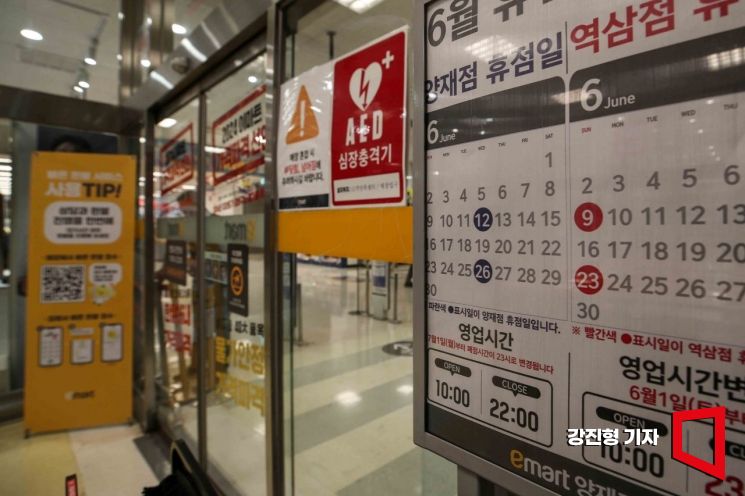 An announcement about a one-hour extension of closing time is posted at Emart Yangjae Branch in Seocho-gu, Seoul. Photo by Jinhyung Kang aymsdream@
The current Distribution Industry Development Act stipulates that large discount stores must close twice a month on mandatory closure days, which are designated as Sundays or other public holidays. However, local government heads can change the closure days to weekdays through consultation.
As a result, some local governments led by ruling party members have revised ordinances to shift mandatory closure days to weekdays. In Seoul, Seocho-gu, Dongdaemun-gu, and Jung-gu have changed their mandatory closure days to weekdays, and metropolitan governments such as Busan Metropolitan City and Daegu Metropolitan City have also amended regulations regarding mandatory closure days. According to the industry, currently 82 local governments have revised ordinances to move mandatory closure days for large discount stores to weekdays or allow voluntary closures.
However, to apply the change of mandatory closure days to weekdays nationwide, an amendment to the Distribution Industry Development Act must be passed in the National Assembly. The opposition parties are negative about abolishing the mandatory closure on public holidays, citing concerns over damage to traditional markets and small business owners, as well as the right of large discount store workers to rest. There are currently 12 amendment bills to the Distribution Industry Development Act pending in the National Assembly's Industry, Trade, Energy, Small and Medium Enterprises Committee (SanJaWi), seven of which deal with mandatory closure days or business hours of large discount stores.
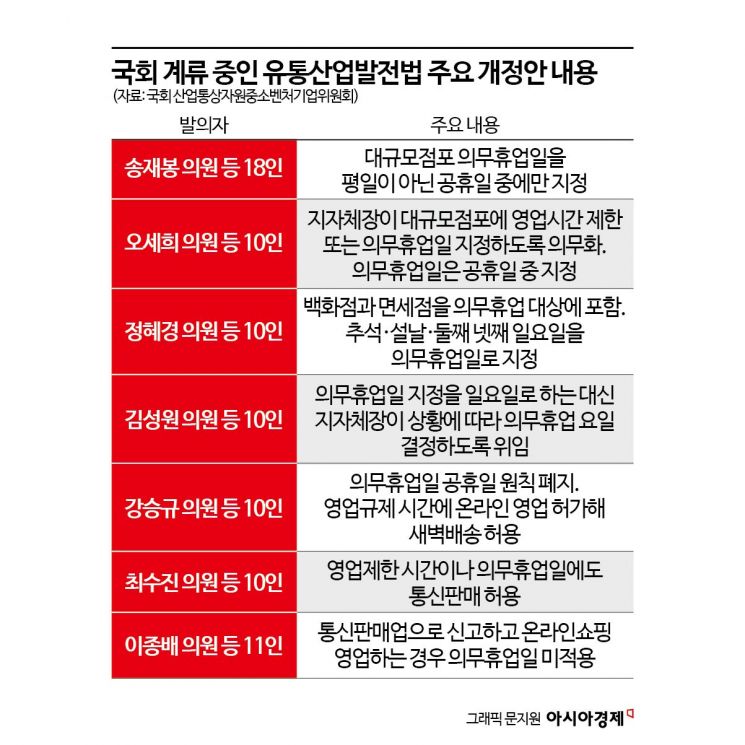
However, with President Yoon's suspension effectively bringing government policy initiatives to a halt, it seems unlikely that the abolition of mandatory closure days for large discount stores will gain momentum. A distribution industry official said, "The current political situation is chaotic, so it is not possible to predict (the status of mandatory closure days)," but cautiously added, "Since the government had strongly pushed for abolishing mandatory closure on public holidays for large discount stores, it will be difficult to maintain that momentum."
On the other hand, there is also an opinion that the shift of mandatory closure days to weekdays through local government ordinance revisions will continue as before. Since both the 21st and 22nd National Assemblies have been situations where the ruling party is in the minority, making it realistically difficult to amend the law for shifting mandatory closure days to weekdays, local governments have been negotiating with large discount stores and local small business owners to convert mandatory closure days to weekdays. Another distribution industry official said, "(The government's deregulation of large discount stores) required legal amendments, but since public holiday operations are possible through local government ordinance revisions, a situation similar to the current one is expected to continue."
Meanwhile, the issue of home shopping transmission fees is also expected to take a long time to resolve. The home shopping industry and cable TV comprehensive wired broadcasting operators (SO) have been in conflict over transmission fees. On the 5th, CJ OnStyle suspended broadcasting transmission with D'Live, Areum Broadcasting, and CCS Chungbuk Broadcasting. After negotiations over transmission fees, which began this year, broke down, they terminated contracts and implemented a so-called "blackout" by cutting off broadcasting transmission. This is the first time a home shopping company has executed a blackout.
The government is discussing institutional improvements centered on the Ministry of Science and ICT to address the transmission fee issue, but with the political situation frozen, it seems difficult to reach a conclusion soon. In June, the Ministry of Science and ICT formed a Home Shopping Industry Competitiveness Enhancement Task Force (TF) to discuss transmission fee issues, easing of home shopping reauthorization requirements, and improvements to the data home shopping system. At the National Assembly audit in October, Minister Yoo Sang-im of the Ministry of Science and ICT said, "(The TF) is seriously considering the transmission fee issue and trying to come up with a reasonable solution."
© The Asia Business Daily(www.asiae.co.kr). All rights reserved.


















