Yoon Impeachment Bill Passed, Veto Impossible
Special Prosecutor Automatically Appointed Within a Week of Enforcement
Full-Scale Investigation Expected to Begin in January Next Year
With the passage of the impeachment motion against President Yoon Suk-yeol in the National Assembly, the appointment of a 'special prosecutor for the crime of rebellion (special prosecutor)' is also expected to proceed rapidly. As early as next week, the selection of the special prosecutor will begin, followed by the full-scale organization setup, and a full-scale investigation is expected to start from January next year.
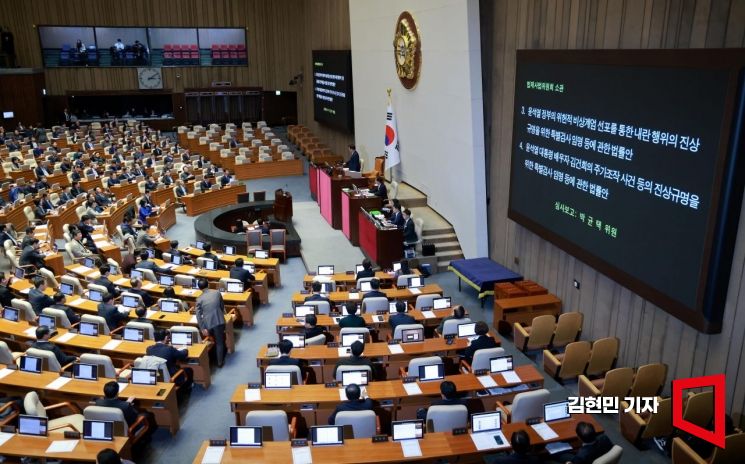 On the 12th, during the plenary session held at the National Assembly, the bills titled "Act on the Appointment of a Special Prosecutor for the Investigation of the Unconstitutional Martial Law Declaration and Treasonous Acts by the Yoon Seok-yeol Government" and "Act on the Appointment of a Special Prosecutor for the Investigation of the Stock Price Manipulation Case Involving Kim Geon-hee, Spouse of President Yoon Seok-yeol" were presented. Photo by Kim Hyun-min
According to the National Assembly's legislative information system on the 16th, the "Act on the Appointment of a Special Prosecutor for the Investigation of the Facts of Rebellion through the Unconstitutional Declaration of Martial Law by the Yoon Suk-yeol Government (Rebellion Special Prosecutor Act)" passed the plenary session of the National Assembly on the 12th but had not yet been transmitted to the government as of that morning. It is analyzed that the transmission was delayed after the vote on the impeachment motion, considering the possibility that President Yoon might exercise his right to request reconsideration (veto).
Subsequently, with the approval of the impeachment motion on the 14th, President Yoon's duties were suspended, making it impossible to exercise the veto, so the Rebellion Special Prosecutor Act is expected to be transmitted to the government soon. Prime Minister Han Duck-soo, acting as the President with a focus on national stability, is unlikely to exercise a veto on the Rebellion Special Prosecutor Act, so a swift selection of the special prosecutor is anticipated.
This Rebellion Special Prosecutor Act is designed differently from the existing special prosecutor laws, ensuring that the appointment of the special prosecutor is automatically completed within a week after the law takes effect. This fundamentally blocks any 'tricks' to delay the appointment. Within one day of the law's enforcement, the Speaker of the National Assembly must request the President to appoint one special prosecutor, and the President must, within two days, request the Chief of the Court Administration, the President of the Korean Bar Association, and the President of the Korean Law Professors Association to recommend candidates for the special prosecutor in writing. If the President does not make the request within the deadline, the Speaker of the National Assembly will make the request. The heads of the three institutions or organizations receiving the request must each recommend one candidate within three days. The President must appoint one of the three candidates as the special prosecutor within two days of receiving the recommendations. If the President does not appoint anyone, the eldest candidate among them is deemed to have been appointed.
The appointed special prosecutor will prepare for the investigation within 20 days, including securing necessary facilities and requesting the appointment of special prosecutors' assistants. Up to four special prosecutors' assistants and up to 80 special investigators can be appointed. Considering these timeframes, the selection of the special prosecutor is expected to be completed as early as next week, and the full-scale investigation is likely to begin next month after the special prosecutor's organization is fully established. If the special prosecutor is launched, the current competition among the prosecution, police, and the Corruption Investigation Office for High-ranking Officials (CIO) for investigations may also be resolved.
Once the Rebellion Special Prosecutor Act is enforced, the previously resolved standing special prosecutor system in the National Assembly will naturally be phased out. The standing special prosecutor system allowed only the opposition party to recommend four candidates, but the individual special prosecutor under the special prosecutor law will have candidates recommended by the three institutions and organizations mentioned earlier, so the legal community expects that there will be no overlap in candidates.
© The Asia Business Daily(www.asiae.co.kr). All rights reserved.

















