August 23 to September 12, Basic Data for Policy Development to Improve Quality of Life for Busan Citizens
Mayor Park Hyung-jun, "I Will Do My Best to Make Busan a City Where People Want to Live Again"
Busan City announced the results of the ‘2024 Busan Social Survey’ conducted to improve the quality of life for Busan citizens.
Starting with the first survey in 1996, the ‘Busan Social Survey’ marked its 29th edition this year. It was the first survey conducted by a local government in Busan and serves as a very useful and important study to understand citizens' awareness, living standards and conditions, and social changes. It is used as basic data for developing local community policies.
This year’s survey was conducted over 21 days from August 23 to September 12.
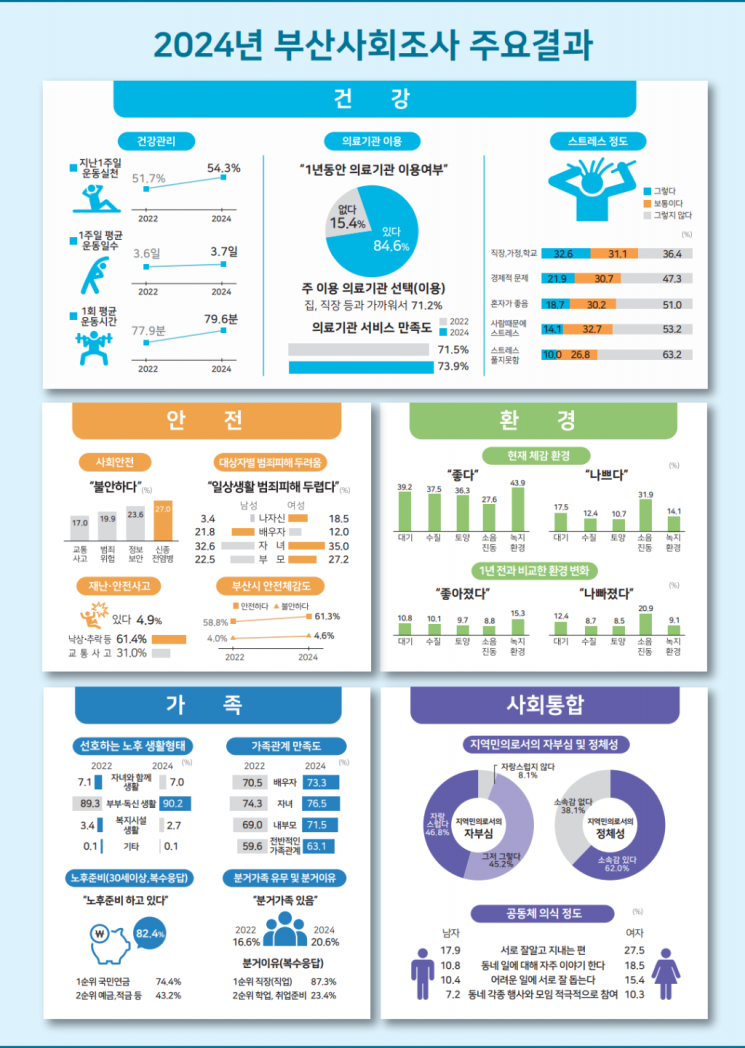
The survey targeted 31,144 Busan citizens aged 15 and older from 17,860 sample households and covered five areas (60 survey items): ▲Health ▲Safety ▲Environment ▲Family ▲Social Integration. The following are the main results by category.
The survey items alternate by year: odd years cover labor, housing & transportation, culture & leisure, education, income & consumption; even years cover health, safety, environment, family, and social integration.
▲Health
The exercise rate among Busan citizens aged 15 and older was 5.4 out of 10 people (an increase of 2.6 percentage points compared to 2022). The average number of exercise days per week was 3.7 days, and the average exercise time per session was 1 hour and 20 minutes. The preferred exercise facility was ‘nearby parks (40.9%)’. For maintaining their health, respondents answered that ‘proper meals and nutritional supplementation (49.3%)’ were important. Additionally, 8.5 out of 10 citizens reported having used medical institutions in Busan in the past year, and 73.9% (an increase of 2.4 percentage points compared to 2022) were satisfied with the services of their primary medical institution.
▲Safety
Regarding overall social safety in Busan, 46.0% of citizens responded that it is ‘safe’ (an increase of 0.7 percentage points compared to 2022), while 10.3% responded ‘anxious’ (an increase of 0.4 percentage points compared to 2022). When comparing Busan’s safety to other regions, 61.3% said it is ‘safe’ (an increase of 2.5 percentage points compared to 2022), and 4.6% said ‘anxious’ (an increase of 0.6 percentage points compared to 2022). The top priority safety projects for Busan were ‘traffic safety projects (44.8%)’ and ‘crime and violence prevention (42.0%)’.
▲Environment
Among the current perceived environmental aspects in Busan, the highest satisfaction was with ‘green spaces (43.9%)’, while the lowest satisfaction was with ‘noise and vibration (27.6%)’.
▲Family
The preferred family type was ‘couples with children living separately from parents (55.4%)’, and for old age, the preferred family type was ‘couples or single living separately from children (90.2%)’. Regarding overall family relationships, 63.1% (an increase of 3.5 percentage points compared to 2022) expressed satisfaction.
The top priority measures to increase Busan’s birth rate were ‘childcare fee support (18.6%)’, ‘household income increase (16.5%)’, and ‘improvement of working conditions for women (14.9%)’. The main childcare methods for preschool household members were ‘daycare centers (35.3%)’ and ‘self or spouse (31.7%)’, with satisfaction for these childcare methods at 75.0% and dissatisfaction at only 3.7%.
The economic activity rate of women with spouses was 47.5%, among whom 85.5% were dual-income households and 14.5% were single-income households. The main reason for working was ‘thinking it is natural to work’ at 42.8%, and the time to stop working was ‘as long as they can work’ at 92.2%.
▲Social Integration
Citizens who felt pride in being Busan residents accounted for 46.8% (an increase of 1.5 percentage points compared to 2022), while only 8.1% did not feel pride. Those who felt a sense of belonging to their current residential area accounted for 62.0% (an increase of 0.9 percentage points compared to 2022). The main channels for obtaining city (district/county) policy information were ‘social media’ for teenagers and people in their 20s, and ‘TV, radio, and other broadcasts’ for those aged 30 and above. When asked about plans to move to another region, 2 out of 10 youths (aged 15?39) responded ‘yes’, with the main reasons being ‘job search, employment, workplace’ at 66.5% (an increase of 5.0 percentage points compared to 2022).
Detailed information on the ‘2024 Busan Social Survey’ results by age group and region can be found on the city’s Big-Data Wave website under Statistics - Statistical Data Room.
Mayor Park Hyung-jun said, “To ensure that all citizens can enjoy a happy life throughout their life cycle, we will explore various policies related to housing, environment, safety, health, and leisure based on the ‘Busan Social Survey’. We will also proactively respond to changes in the local population structure, such as youth outflow and population aging, and do our best to make Busan ‘a city where people want to live again.’”
© The Asia Business Daily(www.asiae.co.kr). All rights reserved.

















