Baekho, President of Seoul Metro, to Attend Protest on 14th Ahead of National Assembly's 2nd Impeachment Vote on President Yoon, Working in Emergency Situation for Citizen Safety
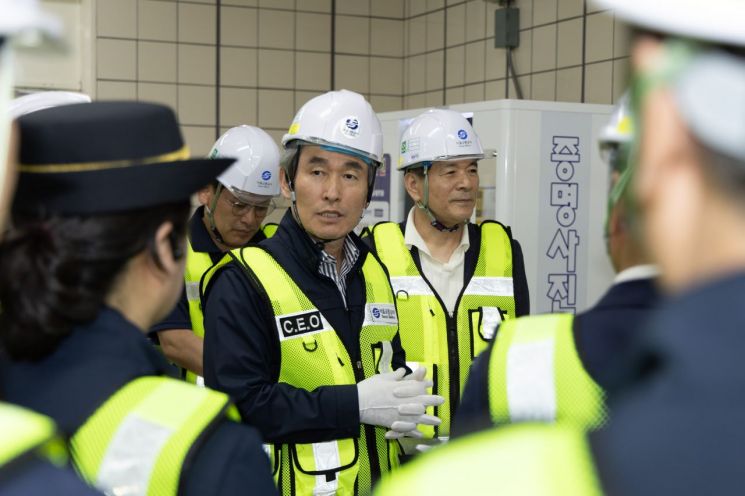
On the 14th, the second impeachment vote against President Yoon Suk-yeol is scheduled in the National Assembly. Due to this, traffic congestion is expected throughout the day around Yeouido Station and other areas of the Seoul subway.
In times like these, subway safety emerges as a top priority issue.
Amid this, Seoul Metro issued a press release the day before announcing ▲ deployment of 149 safety personnel to implement safety measures at eight major stations including Yeouido and Gwanghwamun Stations in preparation for downtown rallies on the 14th ▲ plans to pass through stations without stopping and close entrances during congestion ▲ pre-inspection of convenience facilities such as escalators and elevators, and plans to increase train operations on Line 5.
This shows that the corporation has entered a state of heightened alert to ensure the safety of Seoul subway users, the lifeline of the citizens.
The overall commander responsible for the safety of 20 million Seoul citizens and metropolitan residents is none other than Baekho, President of Seoul Metro.
President Baekho is expected to visit the company and sites throughout the day to oversee citizen safety.
◆ Demonstrating steadfastness that led to the withdrawal of union strikes after martial law declaration
Before the declaration of martial law by President Yoon, Seoul Metro was in a chaotic situation due to strike threats from unions 1, 2, and 3. In response, President Baekho engaged in negotiations with Seoul Mayor Oh Se-hoon with a single-minded determination to prevent the subway strike at all costs, ultimately securing the unions' cooperation for normalization.
An executive said, “If the Seoul subway had gone on strike during this emergency situation, the inconvenience to citizens would have been indescribable,” adding, “President Baekho successfully led negotiations in cooperation with the Seoul city government.”
Even if political circumstances cause social turmoil, the responsibility to ensure citizens’ daily lives proceed normally lies first and foremost with Seoul Metro, which operates the Seoul subway.
◆ Various innovative attempts to secure 'citizen safety' on the 50th anniversary of Seoul subway opening this year
This year marks the 50th anniversary of the Seoul subway. Since the opening of Line 1 in 1974, it has carried 80 billion passengers and traveled a distance equivalent to 50,000 laps around the Earth. Following Japan and China, Seoul subway was the fourth to open in Asia and symbolized South Korea’s modernization in the 1970s, representing a revolution in public transportation.
The corporation has designated 2024 as “a year to firmly lay the foundation for leaping into the 100-year subway” and aims to build a foundation for a new era of qualitative growth.
Facility safety is fundamental and the most important item. In particular, efforts have focused on expanding the scope of safety management to include social factors.
Recently, amid railway union strikes and political turmoil, when concerns about union strikes peaked, prioritizing citizen safety and peacefully leading collective bargaining negotiations with the unions demonstrated President Baekho’s safety-centered management approach.
President Baekho also expanded on-site management by frequently visiting company sites, stations, and train depots to establish a safety culture from the ground up. In June, he visited the Jinjeop Train Depot construction site, carefully examining potential issues based on geographic conditions and proactively identifying and addressing risk factors through Q&A sessions with on-site staff.
Additionally, the closure of the Metro Art Museum at Gyeongbokgung Station on Line 3 and its restoration to the original 1985 architecture to return it to citizens was a result of on-site verification of citizen inconvenience and comprehensive consideration.
Furthermore, by installing 112 direct emergency bells in stations and strengthening cooperation with the police, a broad safety network was established to protect citizens from illegal protests, weapon attacks, assaults, and terror threats.
Sustainable safety and service require advanced technology and solid finances. The corporation accelerated the transition to scientific safety management based on cutting-edge digital technologies such as artificial intelligence (AI) and the Internet of Things (IoT), and secured competitiveness through organizational reform that openly embraces new businesses and technologies.
A representative example is the full-scale introduction of “open innovation,” an open innovation model. By accepting private sector innovative technologies and ideas, the corporation plans to overcome financial limitations it faces with future technologies.
◆ Exploring profit-generating businesses through development of Sadang station area and others
Moreover, by actively expanding its business scope beyond transportation to areas such as logistics services, development of the Singil and Sadang station areas, diversification of commercial tenants, and private use of station names, Seoul Metro is creating new momentum for revenue generation.
In particular, the logistics business is a promising field due to the increase in single-person households and non-face-to-face transactions. Utilizing idle spaces within stations, train depots, and trains?assets owned by the corporation?could become a new future revenue source.
First, the corporation has expanded convenient living logistics services at centrally located stations for easy customer access and laid the groundwork to use stations as logistics hubs. Currently, 332 T-Lockers (parcel lockers) at 269 stations on Lines 1 to 8, 7 T-Luggage (manned storage facilities), and 24 T-Storage (unmanned storage facilities) are in operation. Once related legal grounds such as amendments to the Urban Railroad Act enforcement ordinance are secured, the plan is to build joint logistics centers at stations and train depots and transport cargo using subways (freight trains). By having the subway handle the intermediate stage excluding the first mile (seller dispatch), the corporation’s dense infrastructure is expected to shine.

◆ Service improvements for transportation vulnerable groups
This year also marked a breakthrough in service improvements for transportation vulnerable groups.
Seoul Metro is set to complete 100% achievement of “one station, one route” guaranteeing mobility rights for the disabled at all stations under its jurisdiction by the end of this year. This project, which began in 2008 and involved an enormous budget of approximately 190 billion KRW over 17 years, overcame structural challenges through persistent efforts, making Seoul subway’s mobility convenience for transportation vulnerable groups among the best in the world. Also notable is the foreign language simultaneous conversation system, the first of its kind among domestic urban railway agencies. Through a transparent OLED display capable of dual-sided display, foreign passengers and station staff can look at the display together and communicate smoothly in their native languages without language barriers, allowing foreign passengers to easily and conveniently receive subway usage information. After a successful pilot operation at Myeongdong Station last year, the system has been significantly expanded this year to 11 stations with high foreign passenger usage, including Hongdae Ipgu and Gimpo Airport Stations.
Over the past half-century, Seoul subway has grown into a central transportation means of Seoul and a world-class urban railway company based on a safe transportation system. In terms of operating lines and stations, organizational scale and revenue, and subway operation capabilities, it now stands shoulder to shoulder with leading overseas advanced companies.
Now, Seoul subway moves forward toward the 100-year subway.
President Baekho stated, “The approximately 16,000 employees of Seoul Metro quietly fulfill the mission of the 100-year subway while retying their shoelaces to respond swiftly to external environmental changes. We will calmly envision the next 50 years that will change citizens’ lives. Beyond becoming the largest and best company, we aim to be remembered as a company respected by citizens.”
President Baekho endured a difficult year. Although he passed the 34th Administrative Examination and served as Seoul city’s press officer, transportation planning officer, and director of urban transportation, he also suffered hardships from internal and external pressures this year.
However, President Baekho is recognized for doing his utmost for the “safety” of Seoul subway, the lifeline of the citizens.
© The Asia Business Daily(www.asiae.co.kr). All rights reserved.


















