Loss of Policy Momentum Leads to Prolonged Drift
Medical Community Voices Grow Louder but No Suitable Solutions
Realistically Difficult to Reduce Medical School Quotas Next Year
With the passage of the impeachment motion against President Yoon Suk-yeol in the National Assembly, medical reforms, including the expansion of medical school quotas that the government had been strongly pushing, are now at risk of coming to a complete halt for the time being. The nearly year-long conflict between the government and the medical community is also expected to continue in turmoil, intertwined with the impeachment political situation, without finding a proper resolution.
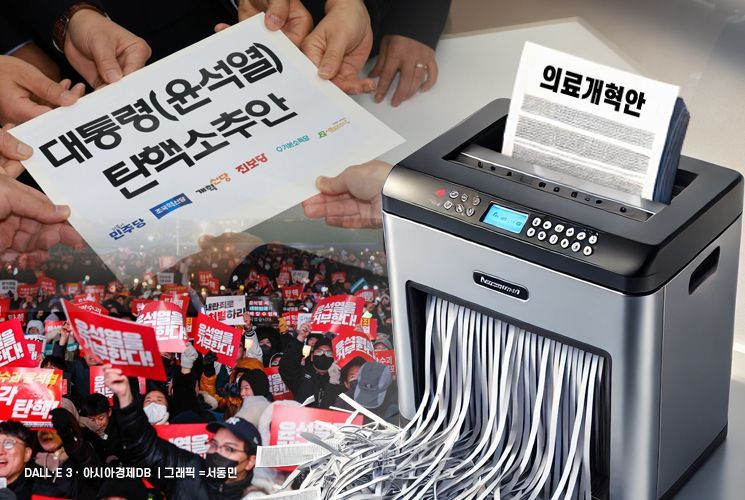
On the 14th, the Korean Medical Association Emergency Committee and the National Medical School Professors Emergency Committee (Jeon-ui-bi), among other medical groups, immediately issued a statement welcoming President Yoon's impeachment, appealing, "Since the medical dispute triggered by the government's expansion of medical school quotas is still ongoing, please pay attention to the Yoon Suk-yeol-led medical oppression and medical school oppression."
Jeon-ui-bi stated, "Medical schools and training hospitals are still being crushed under Yoon Suk-yeol's oppression, and the situation continues to worsen," adding, "Medical school professors will do their best to normalize medical care and medical school education together with the public." The Emergency Committee of Seoul National University College of Medicine and Seoul National University Hospital professors also said, "The government, which pushed through oppressive policies under the name of medical reform as if under martial law, has already lost its momentum," and urged, "Stop the flawed medical reform policies now and do not cause any more damage."
The medical community holds the position that since President Yoon abruptly announced the medical school quota expansion policy earlier this year, triggering conflicts with doctors and residents and causing a medical vacuum, all related policies should be reconsidered from scratch. They were greatly angered by the phrase in the martial law proclamation issued immediately after President Yoon's martial law declaration stating, 'Medical personnel such as residents who leave without returning will be punished,' and have insisted, "The president who declared residents and medical personnel as targets for punishment must be impeached promptly."
Since not only President Yoon but also key government officials including the Minister of Health and Welfare are expected to be replaced in large numbers, the medical reforms that have just begun to be implemented have also lost momentum. Originally, the Ministry of Health and Welfare planned to release the second phase of medical reform measures this month, including improvements to indemnity insurance, regulation of non-reimbursable medical services, and establishment of a medical accident safety net, but all meetings of the Presidential Medical Reform Special Committee to finalize these plans have been indefinitely postponed.
The bipartisan medical-government consultative body, formed to resolve the medical-government conflict, has effectively stalled after only three meetings, as the Korean Medical Association and the Korean Association of Medical Colleges and Medical Schools (KAMC) withdrew their participation. Moreover, the budget allocated for improving residents' working conditions and increasing allowances in next year's Ministry of Health and Welfare budget has been drastically cut, causing setbacks to the government's plan to encourage residents' return to medical practice through improved training environments.
Professor Jung Jae-hoon of the Department of Preventive Medicine at Korea University College of Medicine said, "The political situation is unpredictable, and policy decision-makers are virtually absent," adding, "Although the impeachment of the president has created an opportunity for change in the medical-government conflict phase, related policies are likely to be suspended for the time being, and the current situation will continue as is."
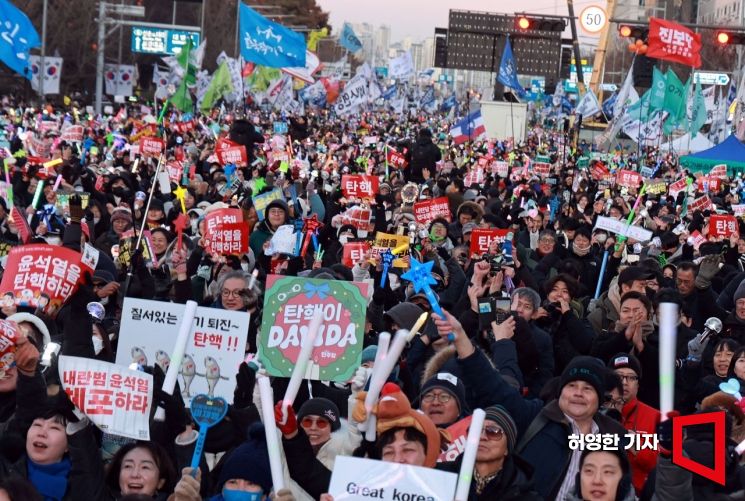 After the impeachment motion against President Yoon Suk-yeol was passed in the second impeachment vote, participants gathered in front of the National Assembly building in Yeouido, Seoul, cheered and danced. Photo by Heo Young-han
However, since medical reform was being carried out with some degree of social consensus through the collection of opinions from providers and patient groups, there are also views that it cannot be halted or completely scrapped under the pretext of the president's impeachment. Professor Jung said, "Although the current government's medical policies will lose momentum in some way, discussions on issues such as restructuring tertiary hospitals, resolving medical vacancies, and financial matters must continue," adding, "These agendas will not be discarded simply because the current government ends."
The core issue of the medical-government conflict, the expansion of medical school quotas, is also expected to face limitations in fully satisfying the medical community's demands even if the administration changes. This is because Han Duck-soo, the Prime Minister acting as the presidential authority, has strongly pushed the medical school quota expansion policy, and there is physically insufficient time to make changes to the 2025 academic year admissions.
Professor Jung Hyung-sun of Yonsei University, participating in the Medical Reform Special Committee, said, "The medical community's demand to reduce quotas even for the 2025 academic year admissions, for which early admissions have already been announced, is unrealistic." Professor Lee Eun-hye of the Department of Radiology at Soonchunhyang University Bucheon Hospital (Policy Director of the Korean Medical Association) said, "Some expect that President Yoon's impeachment will create room for negotiation and a breakthrough, but in reality, that is not the case at all," adding, "It will be difficult for the Emergency Committee to bring new demands and take action until a new leadership of the Korean Medical Association is formed."
The Ministry of Health and Welfare, whose minister Cho Kyu-hong has tendered his resignation, is extremely reserved and only issues general statements. On the 12th, Park Min-soo, the second vice minister of the Ministry of Health and Welfare, acknowledged at the Central Disaster and Safety Countermeasures Headquarters meeting on doctors' collective action, "We are currently facing difficulties in discussing medical reform measures due to the recent challenging situation," but added, "We will do our best to advance discussions and ensure smooth progress as soon as the situation stabilizes."
© The Asia Business Daily(www.asiae.co.kr). All rights reserved.
!["The Woman Who Threw Herself into the Water Clutching a Stolen Dior Bag"...A Grotesque Success Story That Shakes the Korean Psyche [Slate]](https://cwcontent.asiae.co.kr/asiaresize/183/2026021902243444107_1771435474.jpg)

















