Requires meticulous and regular management
but time is severely limited due to concurrent tasks
At around 3:30 PM on the 12th, in front of the Doksan 3-dong Community Service Center in Geumcheon-gu, Seoul, Kim Young-mi, a welfare officer from the Doksan 3-dong welfare team, and nurse Choi Jin-eun set out from the community center to visit the home of Mr. Kim, a man in his 60s who is a vulnerable household. Mr. Kim, a basic livelihood security recipient, was unable to walk due to leg edema until a few months ago, but with support from the district office, he is now able to walk without major discomfort. On this day, Officer Kim and Nurse Choi carefully inquired about any aftereffects following treatment and the condition of his wounds. Nurse Choi even took Mr. Kim’s blood pressure herself.
Officer Kim smiled and said, “It is very rewarding to see people like Mr. Kim whose health improves through continuous management.” However, she also expressed concern, saying, “In our team, each staff member is responsible for about 300 welfare households per year. There are 365 days in a year, but it is far from enough time to regularly visit each household once a year.” She added, “The number of single-person households is increasing, and lonely deaths will likely become more frequent. When lonely death cases are reported in the media, all the blame falls on us, which is really burdensome.”
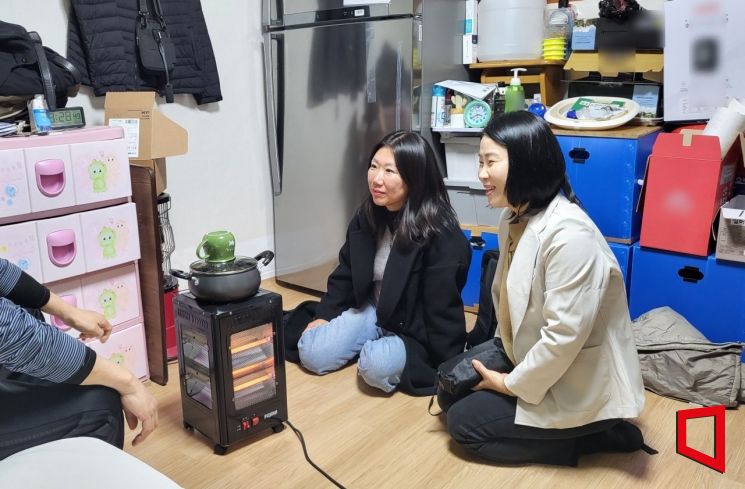 At around 3:30 PM on the 12th, Kim Young-mi, an administrative officer of the Welfare Team in Doksan 3-dong, Geumcheon-gu, Seoul, and nurse Choi Jin-eun are checking on the well-being of Mr. Kim, a man in his 60s who is a member of a vulnerable household. Photo by Shim Sung-ah
Among public officials who discover and manage vulnerable households in welfare blind spots like this, voices expressing difficulties due to manpower shortages and system limitations are continuous.
According to the Ministry of Health and Welfare on the 16th, the number of discovery targets per dedicated team member was 86.9 in 2020, 105.3 in 2021, 89.4 in 2022, and 99.4 in 2023. For this year, as of the second period (January to April), there are 14,060 dedicated personnel, while the number of discovery targets is 467,000, resulting in about 33.2 discovery targets per person.
The Ministry of Health and Welfare’s “Visiting Health and Welfare Dedicated Team” aims to promptly discover vulnerable households in welfare blind spots, expand linkage and support of local welfare resources for vulnerable households, and strengthen infrastructure for discovering vulnerable households. The dedicated team checks for issues such as power or water disconnections and health insurance fee arrears within local households, requests police investigations for those whose whereabouts are unknown, and provides customized services by linking various health and welfare programs needed by each vulnerable household.
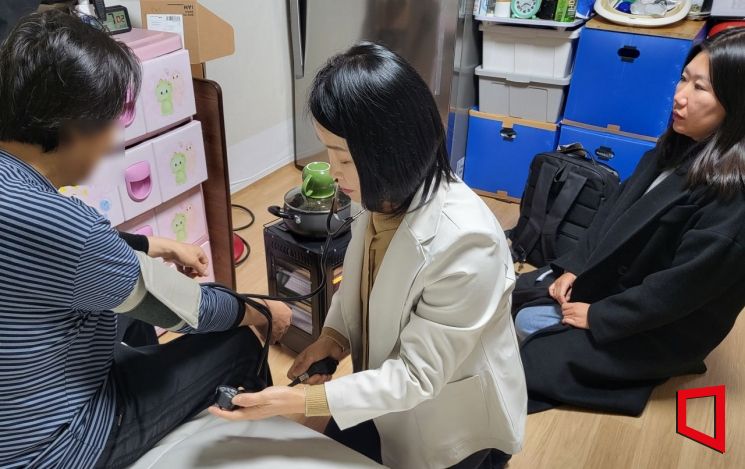 Choi Jin-eun, a nurse, is measuring the blood pressure of a vulnerable household member. Photo by Shim Sung-ah
Because the work requires meticulous support and attention, the psychological and work-related burden felt by the dedicated team is considerable. A Geumcheon-gu official in Seoul explained, “The dedicated team staff visiting and monitoring households directly accounts for only 30-40% of their total work. They must also handle other tasks such as events according to the welfare plan of the neighborhood, so the workload and psychological burden are heavy.” The official added, “During special situations like election seasons, heatwaves, or heavy snow, all staff are deployed, making home visits practically impossible.”
Experts advise that comprehensive support for such vulnerable households is necessary. Professor Jung Soon-dul of Ewha Womans University’s Department of Social Welfare said, “In the long term, finding reclusive and lonely people will be an important mission in Korea.” She emphasized, “In that regard, it is not only the responsible public officials who should conduct discovery, but all resources in the local community must work together. Help from retired public officials, women’s associations, and various community members is needed.”
© The Asia Business Daily(www.asiae.co.kr). All rights reserved.


















