National Health Insurance Service Announces 'Regional Medical Usage Statistics'
Region with Highest Population Over 65: Jeonnam, Lowest: Sejong
Jeonnam Also Tops Monthly Average Medical Expense per Person at 256,000 KRW
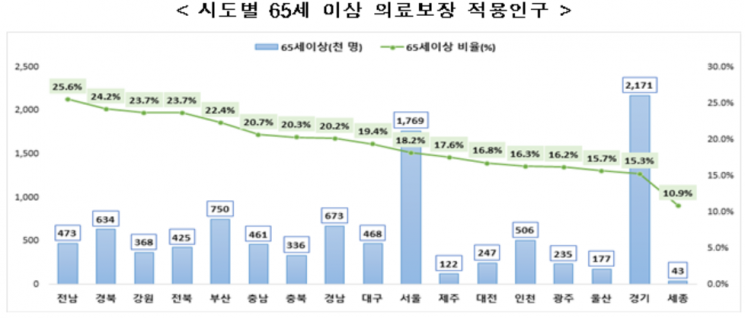
Last year, the total number of health insurance subscribers and medical aid beneficiaries (population covered by medical security) in South Korea increased by 0.1%, with the elderly population aged 65 and over rising by 5.1%. The region with the highest proportion of the population aged 65 and over covered by medical security was Jeonnam, reaching 25.6%, and the average monthly medical expenses per capita also exceeded 250,000 KRW, the highest in the country.
According to the "2023 Regional Medical Utilization Statistical Yearbook" published by the National Health Insurance Service on the 12th, as of the end of last year, the total population covered by medical security (health insurance subscribers and medical aid beneficiaries) was 52.97 million, an increase of 0.1% (about 38,000 people) compared to 2022 (481,000 people).
Among them, about 19%, or 9.858 million people, were aged 65 and over. The population aged 65 and over covered by medical security has rapidly increased by 5-6% annually, from 8.003 million in 2019 to 8.48 million in 2020, 8.913 million in 2021, and 9.377 million in 2022, approaching 10 million.
By region, the area with the highest population aged 65 and over covered by medical security was Jeonnam at 25.6%, followed by Gyeongbuk at 24.2%, while Sejong was only 10.9%.
Last year, the total amount of insurance premiums imposed increased by 6.8% from the previous year to 81.5381 trillion KRW. Workplace insurance premiums accounted for 87.8% at 71.6065 trillion KRW, and regional insurance premiums accounted for 12.2% at 9.9316 trillion KRW. The average insurance premium per household (subscriber) was 127,493 KRW, with workplace subscribers paying an average of 144,713 KRW and regional subscribers paying an average of 92,144 KRW.
By region, the average insurance premium for workplace subscribers was highest in Seoul at 165,336 KRW, followed by Sejong at 160,985 KRW, and Ulsan at 159,675 KRW. For regional subscribers, Seoul also had the highest average at 121,065 KRW, followed by Gyeonggi at 104,601 KRW and Sejong at 103,833 KRW.
The region with the highest number of doctors per 100,000 population covered by medical security was Seoul, with 479 doctors. About 28% of the nation's doctors were concentrated there. This was followed by Gwangju with 383 doctors and Daegu with 373 doctors. The lowest was Sejong City with 206 doctors. The number of nurses was highest in Gwangju with 754, followed by Daegu with 678 and Busan with 670. The lowest was again Sejong with 277 nurses.
Looking at the overall medical workforce by region, the total number of doctors nationwide was 166,197, with 28% (46,624) located in Seoul. The total number of nurses nationwide was 269,434, with 24% (63,480) in Seoul. There were 101,762 medical institutions, including hospitals, clinics, public health centers, and pharmacies, registered across 17 regions, with 24% (24,364) located in Seoul.
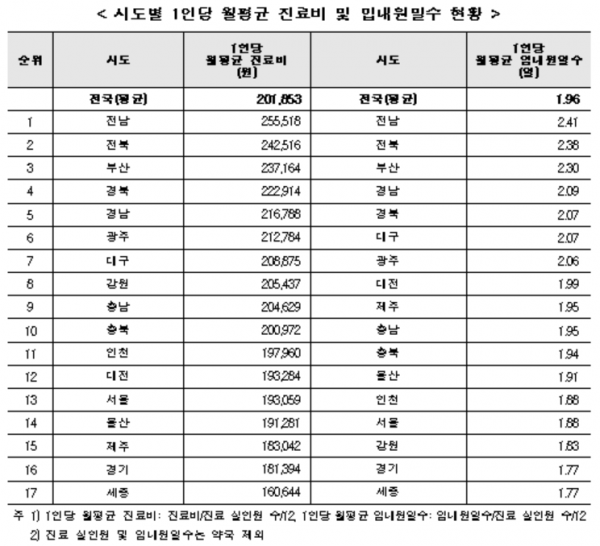
Last year, the total medical expenses covered by medical security amounted to 121.8276 trillion KRW, and the national average monthly medical expenses per capita were 201,853 KRW. By region, Jeonnam, which has a large elderly population aged 65 and over, had the highest medical expenses at 255,518 KRW, while Sejong had the lowest at 160,644 KRW. The average monthly inpatient and outpatient days per capita were also highest in Jeonnam at 2.41 days and lowest in Sejong at 1.77 days.
Among major cancer diseases, breast cancer had the highest incidence with 495 cases per 100,000 population covered by medical security. Periodontal disease patients numbered 43,738 per 100,000, infectious disease patients 20,934, and hypertension patients 14,770 per 100,000.
© The Asia Business Daily(www.asiae.co.kr). All rights reserved.



















