Tokyo Kantei Announces Annual Income Multiples for New Mansions
Attention from Wealthy and Overseas Buyers... Increase in Investment Purpose Transactions
Recently, a Korean media outlet drew attention to a luxury Tokyo mansion (apartment in Korea) owned by a celebrity residing in Japan, valued at around 5 billion yen. Meanwhile, statistics have shown that newly built mansion prices are sharply rising in Tokyo, the capital of Japan. This phenomenon appears to be driven by demand from the wealthy class and the influx of investment funds expecting further price increases.
On the 12th, Nihon Keizai Shimbun (Nikkei) cited data from the real estate appraisal company Tokyo Kantei, reporting that the "annual income multiple," which indicates how many times the average salary the price of a new mansion is, reached 10.09 times the national average in Japan in 2023. This marks a 0.43 percentage point increase compared to 2022 and is the first time since the survey began in 2006 that the multiple has exceeded 10 times.
Looking at the data by prefecture, polarization is more pronounced. The highest multiple was in Tokyo Metropolis at 17.78 times. Based on an average annual salary of 5.92 million yen (55.76 million KRW), the apartment price was 105.26 million yen (991.58 million KRW), meaning a worker earning around 50 million KRW annually would need to save every penny without spending for about 18 years to afford a home. In 2022, the average annual income was 5.78 million yen (54.43 million KRW), and the mansion price was 85.61 million yen (860.3 million KRW), resulting in an annual income multiple of 14.81 times. This phenomenon occurred as mansion prices rose significantly beyond salary growth.
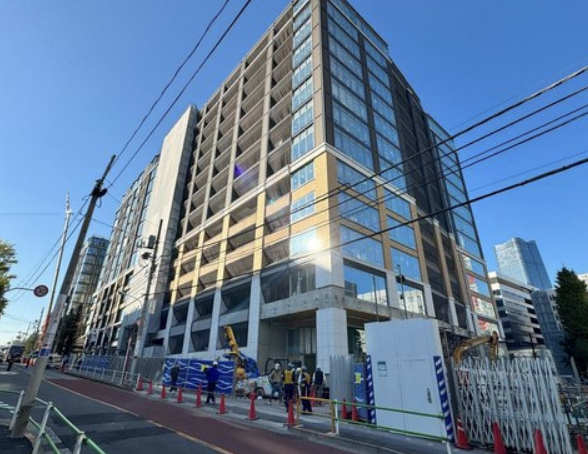 Mita Garden Hills, a luxury mansion in Minato Ward, Tokyo, scheduled for completion next year. It is listed on a real estate website for 798 million yen (7.5 billion won). Sumo homepage.
Nikkei analyzed that "the rise in land prices and construction costs has been reflected in apartment prices," but also noted that "the influx of investment funds expecting further price increases in high-priced properties popular among the wealthy in city centers has had a significant impact."
In fact, in Tokyo alone, 4,039 mansions priced in the tens of billions of yen, known as 'Okushon,' were supplied last year. This is a 1.5 times increase compared to 2022. It is reported that 80% of the nationwide 'Okushon' are concentrated in Tokyo. For example, the current real estate listing price for Mita Garden Hills in Minato Ward reaches 798 million yen (7.5 billion KRW), while Park Tower Nishi-Shinjuku is traded at a lower range of 120 million to 170 million yen (1.13 billion to 1.6 billion KRW).
The prefecture with the second-highest annual income multiple after Tokyo was Nagano Prefecture at 15.58 times. Nagano is accessible by the Shinkansen high-speed train in just over an hour from Tokyo and includes Karuizawa, an area known for villas owned by wealthy Japanese. Because of this, many luxury mansions targeting the wealthy, such as second homes or relocations for education, have been built, which seems to have influenced the rise in the annual income multiple.
Additionally, prices have risen in Kyoto and Okinawa, both famous tourist destinations. The limited supply of mansions, due to regulations such as scenic ordinances preventing the construction of high-rise mansions or the fact that most available construction sites are developed into hotels, appears to have affected prices.
However, the annual income multiple sharply decreases the farther one moves away from central Tokyo, indicating a deepening polarization of housing prices within Japan. The lowest multiple was recorded in Yamaguchi Prefecture at 6.46 times, followed by Kagawa Prefecture at 6.79 times. Hiroshima Prefecture (8.14 times) and Okayama Prefecture (8.25 times) also fell below the national average.
A Tokyo Kantei official explained, "This is because there is less investment demand due to reasons such as distance from Tokyo, and relatively more supply that meets the needs of local residents."
There are concerns that it has become even more difficult for actual homebuyers to purchase homes centered around Tokyo. Nikkei stated, "In Tokyo, mansions have shifted from being traded as residences to investment assets," adding, "Real estate agents also tend to focus on securing properties for wealthy clients with abundant funds."
© The Asia Business Daily(www.asiae.co.kr). All rights reserved.

















