Press Conference for Korean Media by Stockholm Publisher
"'The Boy Who Came' Covers Real Incident, So We Are More Careful"
"I Don't Think Writing Will Become More Difficult in the Future"
"'Boy Goes On' might serve as some kind of entry point to understanding Gwangju," Han Kang, the novelist who won the Nobel Prize in Literature, expressed this hope during a press conference for Korean media held locally in Sweden regarding her 2014 novel 'Boy Goes On.' According to Yonhap News, Han Kang's press conference took place on the 11th (local time) at a publishing house in Stockholm.
Earlier, on the 7th, during a commemorative lecture for the Nobel Prize in Literature held at the Swedish Academy, Han Kang said that until the spring of 2012, she had no intention of writing a novel about the Gwangju 5·18 incident. After publishing 'Greek Lessons,' in the spring of 2012, she wanted to write a brilliantly bright novel that embraces life and the world. However, when the novel she had written about 20 pages of made no progress, she realized, "How can I embrace the world when I have lost fundamental trust in humanity?" She recalled discovering a 5·18 photo album on a bookshelf by chance when she was 12 and secretly reading it without adults knowing. She then decided to write a novel about Gwangju, saying, "I obtained a book compiling testimonies from about 900 people and read it thoroughly over about a month, nine hours a day, and also read materials dealing with other cases of state violence, broadening the scope in terms of place and time to books about massacres repeated by humans worldwide over long histories."
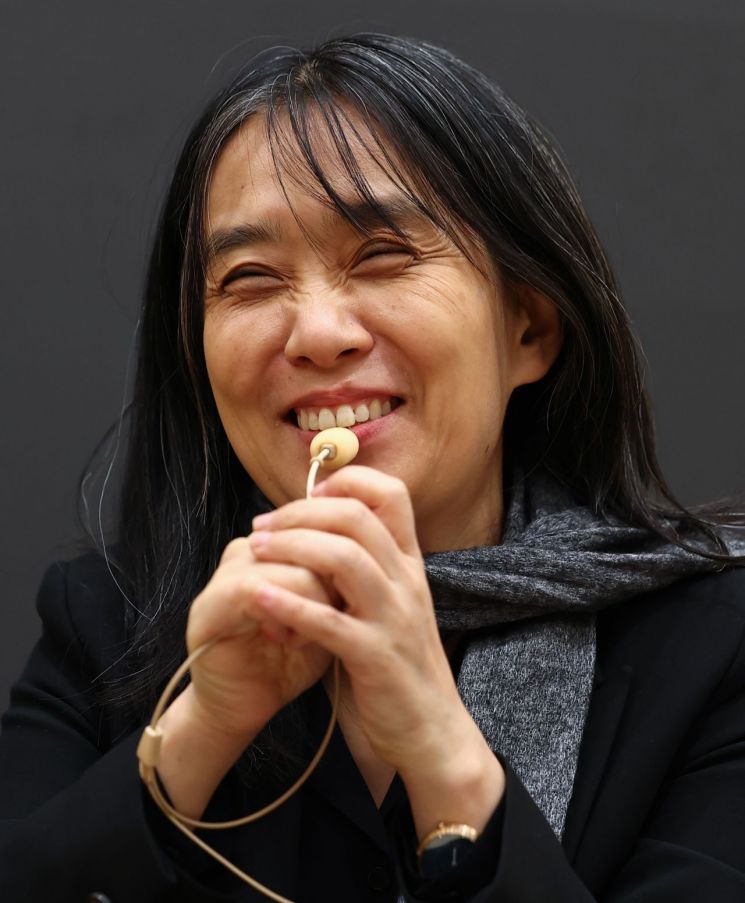 Han Kang is holding a press conference at a publishing company in Stockholm, Sweden, on the 11th (local time).
 Photo by Yonhap News
At the press conference, Han Kang said, "'Boy Goes On' was more cautious because it deals with actual events."
When asked which works readers should read first, Han Kang replied, "For Korean readers, it would be good if 'Boy Goes On' is the first, and then they read 'Do Not Say Goodbye,' which is connected to this book." She added, "If you want a slightly lighter book rather than a very intense one, it would be good to read 'White' or 'Greek Lessons,'" and further said, "'The Vegetarian' might be easier to understand if read after other books rather than from the beginning."
Regarding the meaning of winning the Nobel Prize in Literature, she said, "While writing the lecture, I reflected a lot on my past and figured out my 'coordinates'?where I am and where I started to come this far." She continued, "I have always been writing, and I don't think there will be any reason for writing to become difficult in the future, so I plan to keep writing as I have been," adding, "Having these various thoughts was very meaningful to me."
About her future plans, Han Kang explained, "There is a trilogy that seems like it will never end, and the last piece I started writing had a different tone and became the novel 'Do Not Say Goodbye.' So, I intended to finish the trilogy by this winter, but (due to the Nobel Prize award) preparations have delayed it." Originally, she planned to complete the trilogy with a third work following 'While One Snowflake Melts,' which won the Hwang Sun-won Literary Award in 2015, and 'Farewell,' which won the Kim Yu-jeong Literary Award in 2018, but the direction changed during the writing process, resulting in the publication of 'Do Not Say Goodbye.'
Han Kang also said, "I need to write the book that is formally connected to the novel 'White' next." She had revealed during the lecture on the 7th that she is working on a novel about her older sister who passed away early.
Questions about the chaotic domestic political situation due to the emergency martial law were also raised. However, Han Kang replied, "Until the 5th, before leaving Korea, I followed the news about the situation, but since arriving here, I have been so busy that I haven't been able to look into it properly," adding, "I haven't grasped enough to say anything about it."
She also said that writing is connected to hope.
"The process of speaking, writing, reading, and listening attentively itself is, I think, a testament to the hope we have. I believe that writing always requires at least a minimum of trust. Without the belief that this language will connect, I don't think I could write a single line. Even if the writing does not deal with social issues, even if it seems very personal, I think it is because of a very small, minimal trust in language that one can start writing."
Han Kang also shared her impressions of attending the Nobel Prize award ceremony and banquet, which lasted six hours the previous day.
She recalled, "I heard that they prepare for this event for a very long time. For example, flowers are ordered from a specific city in Italy," adding, "I thought it was an event prepared with great care by many people, and I attended with a heart of watching it."
Han Kang also introduced an anecdote about receiving a lifetime free pass to 'Junibacken,' a children's tourist attraction in Sweden. Junibacken is a museum and children's theme park that recreates works and characters related to Astrid Lindgren, a world-renowned Swedish fairy tale author.
"While traveling by train, there is a place where you pass through the 'world of works.' I had about three hours of free time and was wondering where to go, and I was recommended to go there. I wonder if Junibacken heard that story because they gave me a lifetime free pass. It was such a fun and touching gift."
Lindgren is a world-famous fairy tale author known for works such as the 'Pippi Longstocking' series and 'The Wonderful Adventures of Nils.' Han Kang had previously said she liked Lindgren's 'The Brothers Lionheart.' On the 8th, she also visited Lindgren's apartment in the Dalagatan area of Stockholm. Lindgren's apartment is where she lived and wrote her works for over 60 years, from 1941 until her death in 2002.
Han Kang said, "Lindgren's great-grandchild personally guided me and shared personal memories, which I remember well," adding, "She seemed to have lived a very modest life, and everything in the house was simple and humble, which moved me."
 Writer Hangang is talking with students from a local multicultural school at the Nobel Literature Prize commemorative booklet reading event held on the 11th (local time) at the Linkeby Library located on the outskirts of Stockholm, Sweden.
 Photo by Yonhap News
Han Kang also expressed gratitude to the translators who translated her works. She said that when she gave her acceptance speech at the banquet, she initially included thanks to the translators but had to cut it due to length.
"After writing the banquet acceptance speech and reading it, it was about 10 minutes long. I thought it would be too much of a burden," she said, "The Nobel Foundation requested about 2 minutes, and customarily it is about 4 to 5 minutes, so I drastically shortened it from the draft." The part that was cut included thanks to the translators, and she took this opportunity to express her gratitude.
Han Kang also shared her views on the so-called various 'commemorative projects' being promoted following her award.
She emphasized, "I am someone who believes everything is in the book," adding, "If you want to do something (a project), I think it is better to find something in the book." She continued, "If you want to create some meaning or space to reach people, that is a very visible method, but the really important thing is that I have written diligently in the book, so reading it seems to be the most essential. I have no other expectations."
© The Asia Business Daily(www.asiae.co.kr). All rights reserved.
![Clutching a Stolen Dior Bag, Saying "I Hate Being Poor but Real"... The Grotesque Con of a "Human Knockoff" [Slate]](https://cwcontent.asiae.co.kr/asiaresize/183/2026021902243444107_1771435474.jpg)

















