Xi Jinping Orders Expansion of Standard Language and Unified Textbook Use
Atmosphere Encouraging Minority Cultures Disappearing
Acceleration of 'Sinicization' in Border Areas like Tibet and Neimenggu
Recently, Chinese President Xi Jinping has ordered the expansion of the use of Putonghua (Mandarin), the standard Chinese language, and the increased use of a unified national textbook, raising concerns that this may be an attempt to erase ethnic minorities.
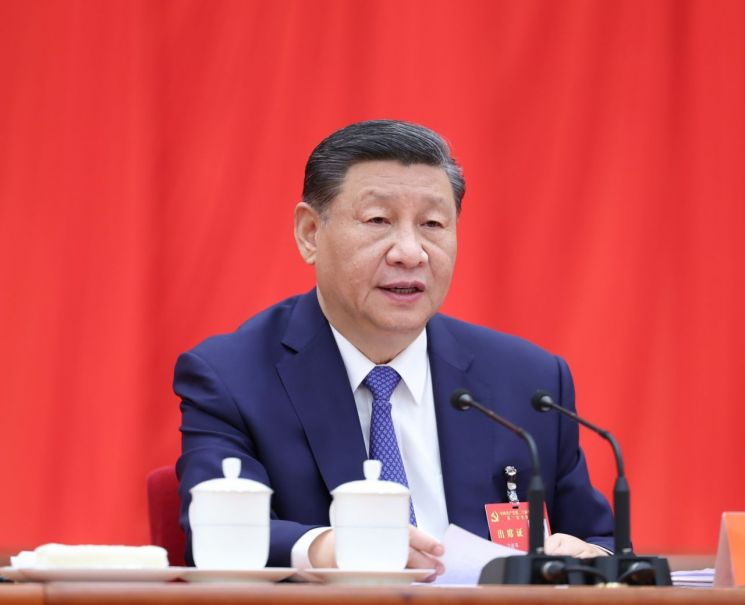
According to China Central Television (CCTV) on the 11th, President Xi stated on the 9th during a collective study session on border issues at the Political Bureau of the Communist Party of China Central Committee, "We must comprehensively promote the dissemination of the national common language and script, and the adoption of national common textbooks." Xi emphasized, "Building the Chinese national community should become the main task in border areas where ethnic minorities mainly reside," and stressed, "We must continuously deepen ethnic unity and development so that all ethnic groups hold tightly to each other like pomegranate seeds."
China, composed of 55 ethnic minorities including the Han and Korean ethnic groups, historically respected and encouraged the customs and cultures of ethnic minorities. However, since Xi Jinping came to power in 2012, there has been a trend of neglect toward ethnic minorities, with the proportion of Han Chinese steadily increasing. The current Han Chinese ratio is known to exceed 92%. The Chinese government has continued to strengthen the consciousness of the Chinese national community following large-scale anti-government protests in Hong Kong in 2019 and conflicts with Taiwan, which has strengthened its independence stance after the Democratic Progressive Party took power.
In August 2021, President Xi Jinping stated at the Central Ethnic Work Conference, "We must firmly establish the consciousness of the Chinese national community and build an ideological Great Wall to achieve national unity and ethnic solidarity," adding, "We must eradicate the poison of ethnic division." Subsequently, the bonus points system for college entrance exams granted to ethnic minority high school students was abolished, and ethnic minority language education has gradually been reduced. Furthermore, classes in ethnic minority regions have been unified in Putonghua (Mandarin), and textbooks standardized, rapidly spreading "Sinicization" even in border autonomous regions such as Tibet, Xinjiang Uyghur, and Inner Mongolia.
As Donald Trump is expected to take office as U.S. President next month, concerns are rising that issues regarding the human rights of China's ethnic minorities will become more prominent. Analysts suggest that the Chinese government is attempting to erase the identity of ethnic minorities, including their languages. Meanwhile, there are also observations of disciplinary actions against officials from ethnic minority autonomous regions, such as the expulsion of a former Party Secretary of the Tibet Autonomous Region from the Communist Party.
© The Asia Business Daily(www.asiae.co.kr). All rights reserved.

















