Major Public Transportation Policies in Gyeonggi-do
'Ddokbus' Resolves Transportation Blind Spots with 5.37 Million Users
'The Gyeonggi Pass' Reaches 1 Million Subscribers in 5 Months
'City Bus Public Management System' Converts 2,200 Buses in First Year
The year 2024 in Gyeonggi-do is notable as the year when new transportation policies were launched to guarantee a swift and comfortable commute.
Since January this year, the province has implemented the Gyeonggi-do type quasi-public operation system called the ‘City Bus Public Management System.’ In May, The Gyeonggi Pass, which drastically reduces the burden of using public transportation through exceptional refunds, was launched and gained great popularity. The ‘Ddokbus,’ introduced at the end of last year to address public transportation blind spots, continued to expand its service areas this year, becoming a vital means of transportation for residents. Let’s take a look at the major transportation policies in Gyeonggi-do that have become even more innovative this year.
■ Surpassing 1 million subscribers in just over 5 months since launch: The Gyeonggi Pass
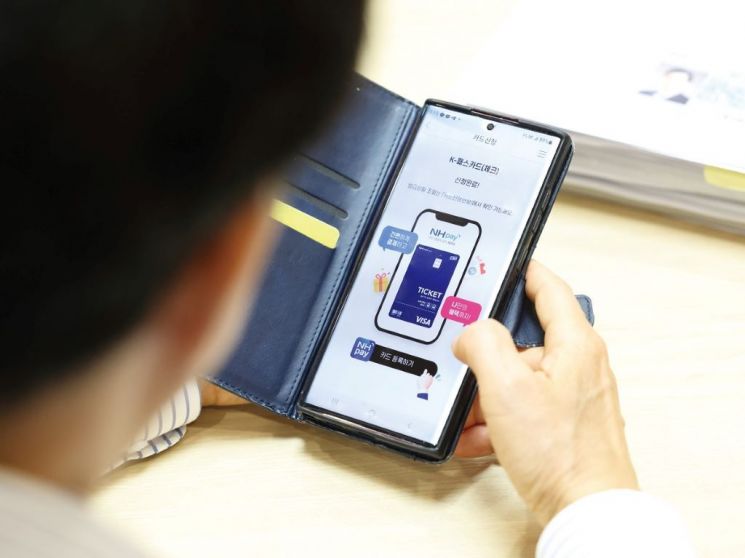
The Gyeonggi Pass is a public transportation promotion policy and climate crisis response initiative by Gyeonggi-do, based on the Ministry of Land, Infrastructure and Transport’s public transportation fare refund support project (K-Pass), with additional benefits exclusively for Gyeonggi residents.
The Gyeonggi Pass refunds 20% of fares (30% for youth in their 20s and 30s, 20% for general users aged 40 and above, and 53% for low-income groups) when public transportation is used 15 times or more per month. While the K-Pass limits refunds to 60 rides per month, The Gyeonggi Pass has expanded this limit to unlimited rides beyond 60 per month. Refunds apply to all public transportation nationwide, including expensive modes such as metropolitan buses, the Shinbundang Line, and the GTX (Great Train Express) which opened in March this year. The age range for youth eligible for the 30% refund has also been expanded from 19-34 years to 19-39 years.
Thanks to these advantages, The Gyeonggi Pass has received explosive support from Gyeonggi residents. According to Gyeonggi-do’s data, since the service started on May 1, the number of subscribers surpassed 1 million on October 16, just five months after launch, and as of December, the number of subscribers reached 1.07 million. Among new subscribers during the same period, out of 1.69 million new K-Pass subscribers, 770,000 were new subscribers to The Gyeonggi Pass, the highest number recorded.
Analysis of The Gyeonggi Pass usage data by Gyeonggi-do revealed that about 80% (800,000) of the 1 million subscribers used public transportation 15 times or more per month and were eligible for refunds, receiving an average refund of about 20,000 KRW per person.
The average monthly public transportation usage per refund recipient also increased from 29 rides in May to 40 rides in October, an increase of about 10 rides per month, indicating that The Gyeonggi Pass is effective in both promoting public transportation use and reducing transportation fare burdens.
Meanwhile, to reduce transportation costs for children and adolescents aged 6 to 18 who cannot use The Gyeonggi Pass, Gyeonggi-do is promoting the ‘Gyeonggi-do Children and Youth Transportation Cost Support Project,’ which provides an annual support of 240,000 KRW. As of December, 440,000 people have applied.
Adding the 1.07 million Gyeonggi Pass subscribers and the 440,000 participants in the Children and Youth Transportation Cost Support Project results in 1.51 million people, which accounts for more than half of the average daily 2.71 million public transportation users in Gyeonggi-do receiving transportation cost support benefits.
The province plans to expand benefits so that more residents can use The Gyeonggi Pass and strengthen connections with other policies within the province.
■ Smart bus usage: Gyeonggi-do’s ‘Ddokbus’
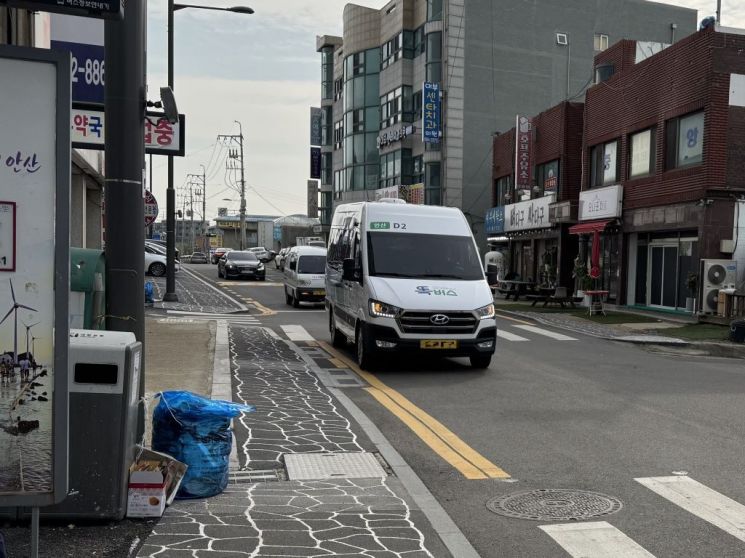
‘Ddokbus’ is Gyeonggi-do’s unique brand of demand-responsive transport (DRT) system, operating without fixed routes or schedules and running according to passenger requests.
Passengers can board at their desired time and place and travel to their desired destination, earning the nickname ‘smartly moving bus.’ Gyeonggi-do focuses Ddokbus deployment in areas with weak public transportation infrastructure, such as rural and fishing villages and newly developed towns.
Starting as a pilot in December 2021 in Paju-si’s Unjeong New Town and Gyoha District, as of the end of November, a total of 224 Ddokbuses operate across 16 cities and counties in the province. The cumulative number of users has reached 5.37 million. According to a satisfaction survey conducted by Gyeonggi-do in August with 5,887 Ddokbus users, 83% of respondents expressed satisfaction.
In October, the province conducted a service evaluation for Ddokbus operators to monitor and inspect service quality, and plans to expand the service to 19 cities and counties by the end of the year, adding about 40 more Ddokbuses.
■ Implementation of the City Bus Public Management System
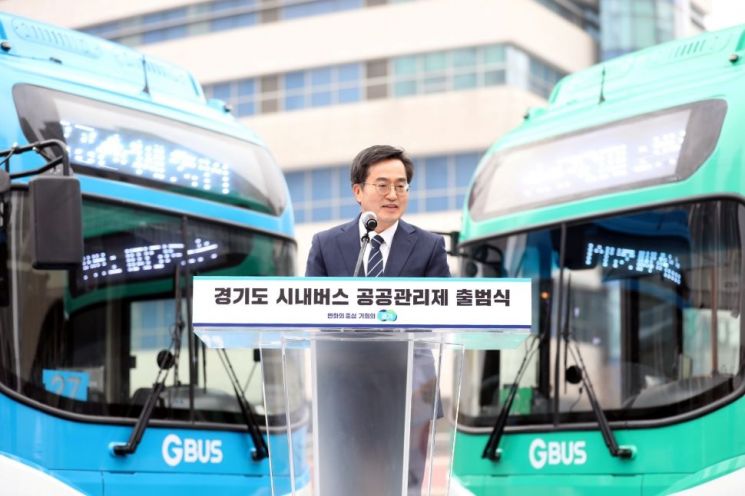 Gyeonggi-do Model Semi-Public Operation System 'City Bus Public Management System' Launch Ceremony. Provided by Gyeonggi-do
The Gyeonggi-do type quasi-public operation system, the ‘City Bus Public Management System,’ was implemented on January 1.
The core of the ‘City Bus Public Management System’ is strengthening public management of city buses. It conducts annual comprehensive evaluations by route, focusing on safety management and improving user services, and decides on renewal of the public management system every three years to enhance public interest and transparency. With the implementation of this system, bus companies’ management stabilizes, working conditions for transportation workers improve, and residents can use friendlier, safer, and more punctual bus services. Gyeonggi-do is the first in the nation to operate this type of city bus quasi-public operation system.
Gyeonggi-do plans to convert all approximately 6,100 city buses in the province to the public management system by 2027, starting with 2,200 buses in 2024. By management entity, this includes about 3,100 buses (approximately 500 routes) operating between two or more cities/counties managed by Gyeonggi-do, and about 3,000 buses (approximately 1,100 routes) operating within a single city/county managed by each city/county.
Accordingly, the province has prepared a ‘City Bus Public Management System Roadmap (Comprehensive Plan)’ focusing on service improvement, financial savings, route reorganization, and securing public interest to improve the shortcomings of the existing Gyeonggi-do city buses and promote a sustainable public management system.
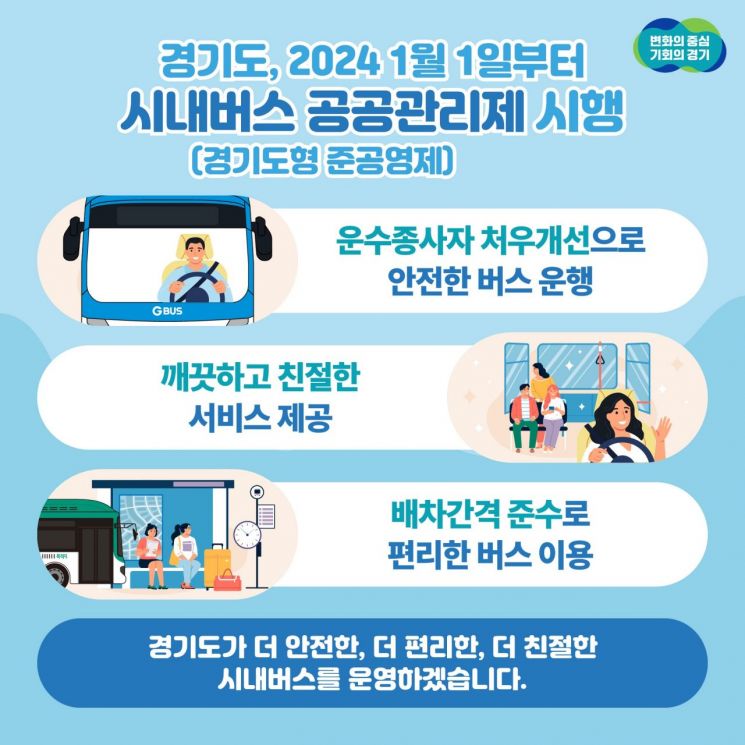
First, to improve the quality of transportation services and resolve inconveniences for bus users, in October, the province announced measures to reduce four major complaints about city buses: non-stop passing, unfriendliness, reckless driving, and violation of dispatch plans. To prevent non-stop operation, buses will be required to slow down to about 30 km/h when passing bus stops, and administrative penalties will be strengthened by imposing fines with a zero-tolerance policy for violations of regulations.
As a measure against unfriendliness by transportation workers, mandatory friendliness training for city bus drivers will be implemented, and a Friendly Driver Certification System will be introduced to provide incentives to excellent companies and drivers.
Additionally, to alleviate the financial burden on the province and cities/counties caused by the implementation of the public management system, the province plans to encourage bus companies to reduce transportation costs such as fuel and insurance by reflecting fuel efficiency performance by route in the public management system evaluation and linking insurance premiums to traffic accident indices for differential payment.
Furthermore, by the end of the year, Gyeonggi-do will complete a research project on city bus route reorganization under the public management system and, based on the results, establish plans for reorganizing city bus routes, including establishing trunk and feeder bus systems and creating new bus routes linked to subways and GTX railways.
© The Asia Business Daily(www.asiae.co.kr). All rights reserved.



















