Foreign Visitors to Korea Decline After Martial Law, Local Businesses Shrink
Damage to Korean Economy Expected to Worsen Significantly
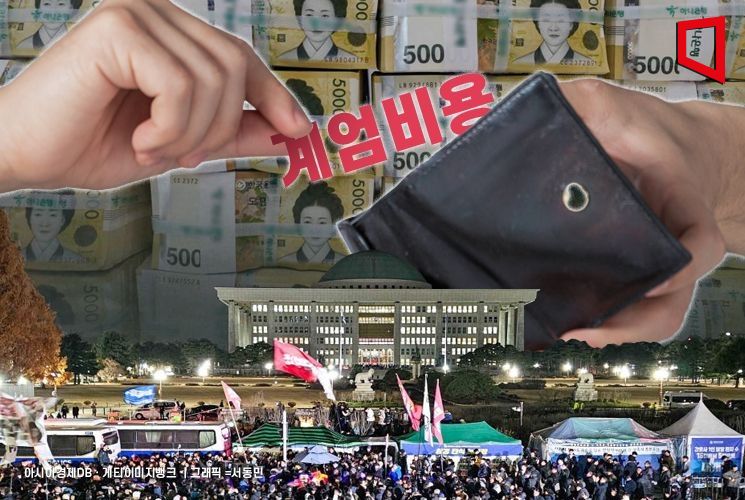
President Yoon Suk-yeol's declaration of martial law has led to a contraction in neighborhood businesses and a decrease in foreign tourists visiting Korea, resulting in a weakened domestic economy and an inevitable decline in the country's economic growth rate, according to an analysis.
According to the report titled "The Impact of Political Instability on Growth Rate in Korea," released by NH Investment & Securities on the 12th, the martial law situation is expected to reduce year-end consumer spending and decrease the number of foreign tourists visiting Korea, causing this year's Gross Domestic Product (GDP) growth rate to shrink by 0.04 percentage points.
The report states that some countries have classified Korea as a "travel risk country" following the martial law incident, which is expected to negatively impact service sales in tourist hotspots frequented by foreigners. The UK, the US, Japan, Israel, and Russia have advised against traveling to Korea except for essential business. This travel advisory from major countries could lead to a contraction in year-end consumption.
Food and accommodation, as well as leisure and culture, account for 9% of Korea's GDP, while foreign domestic consumption accounts for 0.8%. Jeong Yeogyeong, an economist at NH Investment & Securities who authored the report, explained, "The estimated damage to the growth rate was based on the assumption that sales in neighborhood businesses and foreign domestic consumption declined by 5% in December due to the impeachment crisis." The Bank of Korea's forecast for this year's economic growth rate is 2.2%, but it may be difficult to achieve this target due to the martial law situation.
The rise in the won-dollar exchange rate is also expected to negatively affect economic growth by reducing profit margins for domestic companies. The increase in costs due to the exchange rate rise (higher import raw material costs) offsets the increase in sales (improved export price competitiveness), potentially causing a slight decrease in operating profits mainly for domestic companies.
This year, the exchange rate increase is diagnosed to have mainly pressured domestic service sectors such as wholesale, retail, and dining by raising import material costs and squeezing profit margins. Export companies can offset cost increases with higher sales, but domestic companies are only exposed to rising costs. Domestic companies account for 75% of Korean businesses.
However, the passage of next year's budget bill in the National Assembly on the 10th was evaluated as a relief. Economist Jeong said, "Although some budget items were cut, budgets supporting domestic demand recovery, such as livelihood benefits, senior job programs, and small business debt adjustments, remained largely unchanged," adding, "Therefore, concerns about a government consumption gap in the first half of next year have diminished."
Earlier, the foreign investment bank Goldman Sachs also released an analysis stating that the downside risks to Korea's economic growth rate next year have increased due to the impeachment crisis. Goldman Sachs warned, "Past political turmoil, such as the impeachment of former President Roh Moo-hyun in 2004 and former President Park Geun-hye in 2016, did not have a significant impact on growth rates, but this time is different," adding, "We maintain our forecast for Korea's growth rate next year at 1.8%, below the market average, but risks are increasingly skewed to the downside."
© The Asia Business Daily(www.asiae.co.kr). All rights reserved.
![Clutching a Stolen Dior Bag, Saying "I Hate Being Poor but Real"... The Grotesque Con of a "Human Knockoff" [Slate]](https://cwcontent.asiae.co.kr/asiaresize/183/2026021902243444107_1771435474.jpg)











