Economic Uncertainty in Korea Intensifies Due to Emergency Martial Law
Political Turmoil Makes Expansionary Fiscal Policy Difficult
Expectations Rise for Monetary Policy to Stimulate Economy
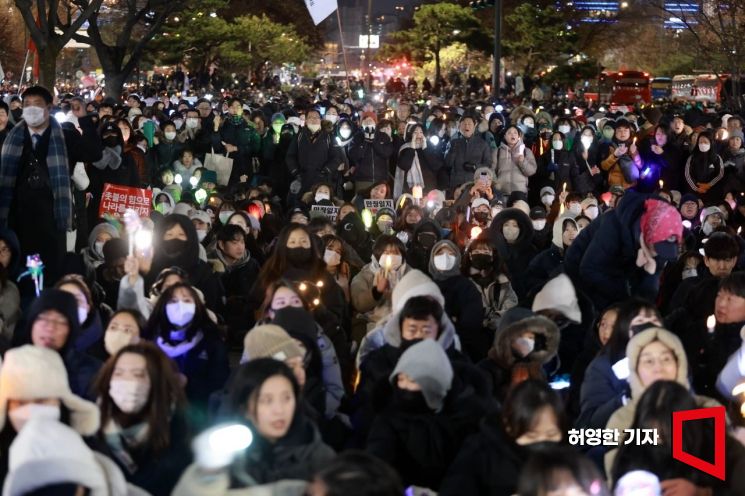 On the evening of the 7th, when the impeachment vote against President Yoon Seok-yeol was underway, citizens gathered at Yeouido Park in Seoul shouted impeachment slogans. Photo by Heo Young-han
As concerns about the South Korean economy grow following the emergency martial law situation, the burden on the Bank of Korea (BOK) is also increasing. With fears of an economic slowdown expanding, the possibility of government fiscal spending discussions for economic stimulus being delayed is rising, leading to analyses that the importance of the BOK's monetary policy could become even greater. There are also forecasts that the pace of the BOK's base interest rate cuts to revive the economy could accelerate as economic uncertainty intensifies.
On the 12th, domestic and international economic experts assessed that the South Korean economy faces greater downside risks due to the recent martial law situation. Even before the martial law, many analyses predicted that the economy would enter a long-term low-growth phase below the potential growth rate of 2% starting next year, and most concerns now are that the economic downside risks have increased further because of this incident.
Foreign investment bank (IB) Goldman Sachs stated in a recent report, "Political turmoil in the past, such as the impeachment of former President Roh Moo-hyun in 2004 and former President Park Geun-hye in 2016, did not have a significant impact on growth rates, but this time it is different." Kwon Gu-hoon, Senior Economist at Goldman Sachs, warned, "In 2025, South Korea faces external headwinds due to China's economic slowdown and uncertainties in U.S. trade policies," adding, "We maintain our growth forecast for South Korea next year at 1.8%, which is below the market average, but risks are increasingly skewed to the downside."
Some research institutions expect South Korea's economic growth rate next year to fall significantly below the BOK's forecast of 1.9%. Foreign IB Citi projects 1.6%, while Nomura and JP Morgan forecast 1.7%. Domestically, Hyundai Research Institute sharply lowered its economic growth forecast for next year from 2.2% to 1.7% in a revised economic outlook released on the 8th. The institute expressed concerns that without a definite economic stimulus policy, the South Korean economy is likely to deviate from its growth path and continue in a low-growth phase.
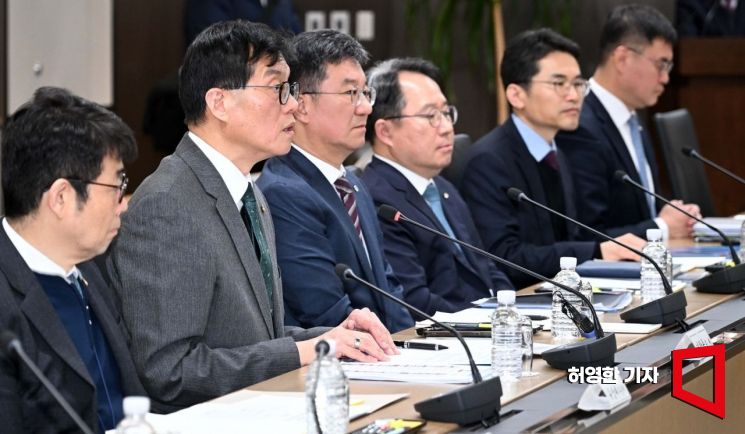 On the 10th, at the Bank of Korea headquarters in Jung-gu, Seoul, Lee Chang-yong, Governor of the Bank of Korea, is delivering opening remarks at the emergency economic situation on-site inspection meeting held by the three opposition parties. Photo by Heo Young-han
Political Turmoil Makes Government Stimulus Difficult, Raising Expectations for Monetary Policy
The market is concerned that political uncertainty caused by the recent martial law situation may delay government discussions on expansionary fiscal policy. While the government's capacity for economic stimulus weakens due to the presidential impeachment, the importance of the BOK's monetary policy for economic stimulus could relatively increase. The BOK already lowered the base interest rate last month, expressing the view that with increasing downside pressure on economic growth, it is appropriate to mitigate economic downside risks through interest rate cuts.
Seungwon Kang, a researcher at NH Investment & Securities, emphasized, "Given the high likelihood that expectations for government expansionary fiscal policy will weaken due to political uncertainty, the BOK's responsibility for economic stimulus will become heavier," adding, "The speed and intensity of future monetary policy could be strengthened."
As expectations for monetary policy to revive the economy rise, there are forecasts that the BOK could further cut the base interest rate as soon as next month. If the BOK lowers rates next month, it would mark three consecutive cuts. The BOK has been cautious about consecutive rate cuts, having never done so since the 2008 global financial crisis, which can be interpreted as a sign of the growing difficulties facing the South Korean economy.
Myeongsil Kim, a researcher at iM Securities, said, "In a situation where low growth in the 1% range is feared for two consecutive years starting next year, the expansion of political risk is very unfortunate," and predicted, "With limited fiscal capacity, expectations for monetary policy will rise." Kim added, "Ultimately, the BOK's active easing policy will be inevitable," forecasting, "An additional rate cut by the BOK is expected as early as January or at the latest February next year, with the base interest rate reaching the 2% range within the first half of the year."
The BOK is also on high alert for the possibility that political instability could spread to the economy. The domestic economy is already showing signs of sluggishness, such as widespread cancellations of year-end and New Year gatherings due to political unrest. On the 10th, BOK Governor Lee Chang-yong expressed his view to opposition lawmakers visiting the BOK that "prolonged political uncertainty could cause significant damage to our economy."
© The Asia Business Daily(www.asiae.co.kr). All rights reserved.
!["The Woman Who Threw Herself into the Water Clutching a Stolen Dior Bag"...A Grotesque Success Story That Shakes the Korean Psyche [Slate]](https://cwcontent.asiae.co.kr/asiaresize/183/2026021902243444107_1771435474.jpg)

















