Survey of 2,145 Middle and High School Students
89% of Youth Say "Deepfake Is a Crime"
'Prank' Ranked First as Cause
More Girls Concerned About Becoming Victims
Regarding incidents of 'deepfake sexual exploitation materials' within schools, 89% of adolescents responded that it is a crime and should be punished. However, when asked about the causes of deepfake crimes, most cited 'pranks,' indicating a gap in perception. Additionally, female students showed greater concern than male students about the possibility of becoming victims themselves and about the distribution and spread of such materials.
On the 12th, the Ministry of Education announced the results of the 'Youth Awareness Survey on Illegal Deepfake Videos in Schools.' The survey was conducted over three weeks from the 5th to the 27th of last month, targeting 2,145 first- and second-year middle and high school students.
The survey found that 97.2% of respondents were aware of deepfake sexual crime incidents in schools. The reasons for feeling anxious after such incidents were identified as 'I could unknowingly become a victim' (76.0%), 'Someone around me could be the perpetrator' (45.4%), and 'I do not know how to respond if victimized' (29.7%).
Notably, in the category 'I could unknowingly become a victim,' 81.7% of female students and 67.7% of male students responded, showing a significant gender difference.
Regarding incidents related to illegal deepfake videos, 89.4% of respondents answered that it is 'a crime and should be punished,' indicating that most respondents recognize illegal deepfake videos as a serious crime. Female students (95.1%) held this perception more strongly than male students (83.3%). The reserved response of 'I don't know' was 9.8% overall, with male students (15.5%) responding much higher than female students (4.4%), revealing a gender gap in awareness.
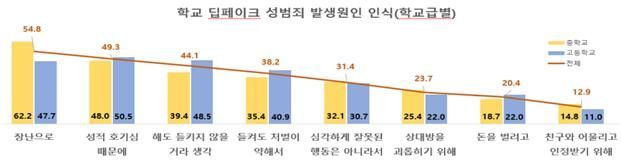
However, the most common cause cited for deepfake sexual crimes occurring in schools was 'pranks' (54.8%). Other responses included 'sexual curiosity' (49.3%), 'thinking they would not get caught' (44.1%), 'weak punishment even if caught' (38.2%), and 'thinking it is not a seriously wrong act' (31.4%).
Regarding how respondents dealt with incidents they encountered, 'switching account to private' (34.9%) was the most common, followed by 'deleting personal photos' (32.1%) and 'withdrawing from the platform' (4.1%).
When asked who is responsible for the spread of illegal deepfake videos, 92.0% of respondents said 'the person who stole photos to create fake photos or videos is at fault,' and 75.9% pointed to 'weak punishment' as a problem. However, 13.6% responded that 'the victim is responsible,' confirming the need for awareness improvement education, according to the Ministry of Education.
When asked if they had ever seen sexually false videos or photos created by deepfakes, 95.3% of all respondents said they had 'never' seen such materials, while 4.7% said they had. The experience of having one's own photos or videos stolen and suffering damage from illegal deepfake videos was 2.8%.
The greatest fear related to damage from illegal deepfake videos was 'photos and videos continuously spreading on the internet,' according to 72.2% of respondents. In particular, concern about such distribution and spread was higher among female students (81.0%) than male students (62.8%).
Regarding whom they would tell and seek help from if they became victims of deepfake sexual crimes, 70.1% of respondents said they would tell their parents (caregivers). Following that, 69.1% would tell the police, 55.3% would tell school teachers, and 47.9% would tell digital sexual crime victim support organizations. Only 2.8% said they would not report it.
Awareness of institutions that can provide help in cases of deepfake sexual crime victimization was highest for the National Police Agency (87.6%) and the School Violence Reporting Center 117 (73.4%). In contrast, awareness of specialized digital sexual crime victim support institutions such as the Korea Communications Commission and the Korea Communications Standards Commission (26.9%), the Digital Sexual Crime Victim Support Center (20.9%), the Digital Sexual Crime Specialized Counseling Center (15.6%), and De4You (14.3%) was relatively low.
Regarding necessary support when deepfake sexual crime victimization occurs, 85.0% of respondents said 'support for deleting victim videos' is needed. Additionally, 74.2% said 'prompt investigation and resolution of cases' and 71.9% said 'support for deletion and protection of personal information' are necessary.
When asked whether they had received education related to the proper use of deepfakes at school, 51.6% responded that they had received such education, while 22.8% said they had not, indicating that more than half had educational experience. For preventing illegal deepfake videos in schools, respondents said 'prevention education and awareness improvement' (85.5%), 'quick and certain punishment' (79.8%), and 'technical countermeasures such as detection software' (55.5%) are necessary.
The Ministry of Education plans to respond to the prevention of deepfake sexual crimes and awareness improvement by reflecting the results of this survey and operating a special education week for two weeks (from the 9th to the 20th) in cooperation with metropolitan and provincial offices of education and school sites. In addition, during this month, teaching and learning materials for elementary and secondary schools, educational video content, and card news that schools need will be produced and distributed for use. Customized educational materials and response manuals for students, teachers, and parents will also be created to guide initial response, victim protection and support, and strengthened punishment, and a public awareness campaign will be launched.
Park Seong-min, Director of Planning and Coordination, stated, "In this survey, students cited 'pranks and curiosity' as the main reasons for deepfake sexual crimes, so it is necessary to focus more on prevention education and awareness improvement to help them recognize these as serious crimes. Especially, since the majority of students said they would inform their parents if they became victims of deepfake sexual crimes, we plan to expand educational opportunities for parents so that families and schools can cooperate."
© The Asia Business Daily(www.asiae.co.kr). All rights reserved.


















