GM "Market Competition Intense" Cruise Funding Support Halted
Global Facility Restructuring Amid China Business Slump
General Motors (GM) in the United States announced on the 10th (local time) that it will no longer make additional investments in Cruise, its autonomous driving technology development subsidiary's robo-taxi business. The company cited the intensifying market competition as the reason. This shows that while autonomous driving is regarded as an important technology in the future mobility industry, the commercialization process is not easy. The automotive industry appears to be adjusting the pace of autonomous driving technology development.
In a statement released that day, GM said, "Considering the time and resources required to expand the (robo-taxi) business according to capital allocation priorities and the increasingly competitive market, we will no longer fund Cruise's development work." Instead of the robo-taxi business, GM decided to focus on developing advanced driver-assistance systems such as lane-keeping and vehicle distance control during driving. These technologies have been developed to a level where driver intervention is not necessary under certain conditions such as highways.
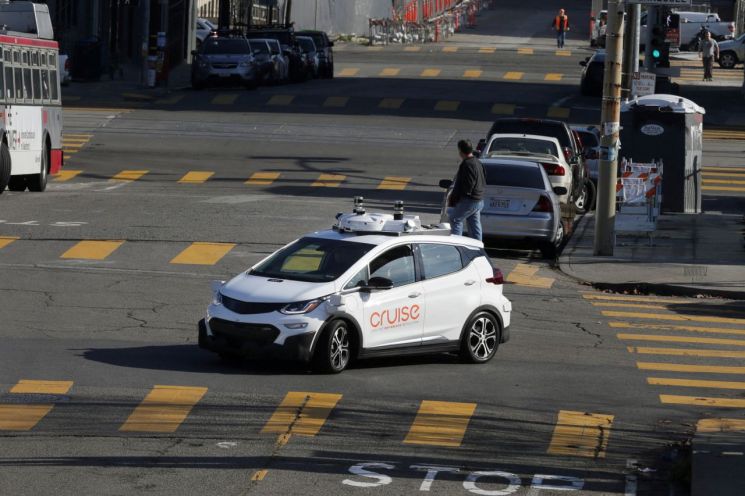
GM officially entered autonomous driving technology development by acquiring Cruise in 2016. It also received several external investments from SoftBank, Honda, and others. So far, GM has spent more than 10 trillion won developing Cruise's robo-taxi service but has yet to escape losses. Last year alone, the loss reached $3.48 billion (about 5 trillion won). The problem is that it remains uncertain whether the business can generate profits in the future.
Last year, there was a fatal accident in San Francisco, and there were controversies during the aftermath. Cruise began its robo-taxi business in August last year after receiving a business license from local authorities but suspended operations due to an accident just over two months later. At that time, a pedestrian who was hit and pinned by another vehicle was dragged several meters by a Cruise vehicle. Cruise faced lawsuits and was fined for failing to properly explain the incident during the authorities' investigation. The company also conducted large-scale layoffs, including executives, last year.
This decision came amid a process of adjusting investment strategies across global operations due to sluggish business in China. GM recently disclosed that it expects accounting costs exceeding $5 billion (about 7 trillion won) due to restructuring, including the closure of joint factories in China. These costs will be reflected in this year's performance. GM sold more than 2 million vehicles in China in the past, but this year sales have dropped to about 370,000 units as of last month.
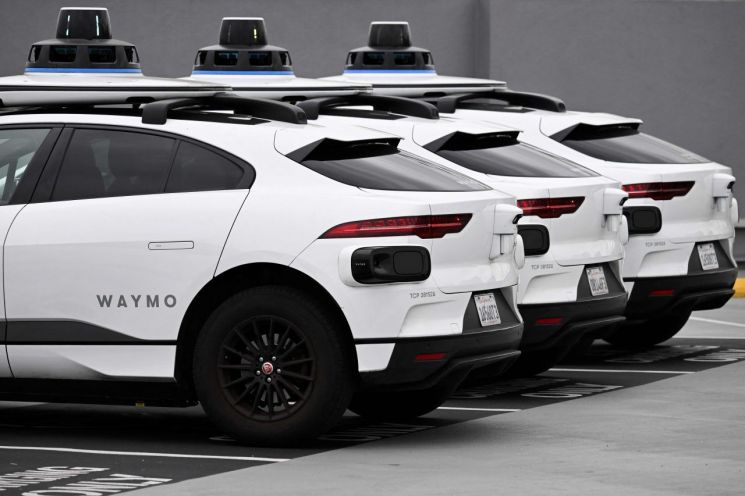 A Waymo autonomous vehicle at a charging station in Los Angeles, California, USA. It is the only robo-taxi company operating commercially in the United States. Photo by Yonhap News
Autonomous driving has been evaluated as a core technology for realizing future mobility. The industry expected commercialization to be possible through robo-taxis applying this technology. Google's subsidiary Waymo is gradually expanding its robo-taxi service areas in Phoenix, Austin, and other locations, and it is currently the only company authorized locally. In China, IT company Baidu started services several years ago in Beijing and Wuhan and recently expanded to Hong Kong.
More companies have failed to show proper results. Argo AI, a joint venture established by Ford and Volkswagen to develop autonomous driving technology, was liquidated in 2022. Aptiv, which formed a joint venture called Motional with Hyundai Motor, decided to stop investments and divest its shares earlier this year. Hyundai Motor Group initially planned to introduce a level 3 autonomous driving assistance system that does not require driver intervention on certain sections but has indefinitely postponed it. Tesla, which is considered to be leading in autonomous driving technology, is also involved in several lawsuits related to its driver assistance system Autopilot. Tesla unveiled a dedicated model for the robo-taxi business in October this year, but the market reaction at the time was mostly skeptical.
© The Asia Business Daily(www.asiae.co.kr). All rights reserved.
![Clutching a Stolen Dior Bag, Saying "I Hate Being Poor but Real"... The Grotesque Con of a "Human Knockoff" [Slate]](https://cwcontent.asiae.co.kr/asiaresize/183/2026021902243444107_1771435474.jpg)
















