Last Week's Stock Prices Rose Alongside Kakao Bank
Rise Attributed to Group Stock Surge for Kakao Bank
"BNK's Low Foreign Currency Assets Reduce Forex Risk Impact"
Minimal Impact on CET1 Ratio and Profit/Loss
Foreign Long Money Inflows Continue Net Buying
Following President Yoon Suk-yeol's declaration of martial law, bank-related stocks took a direct hit, but BNK Financial Group's stock price is being praised for its strong 'defense.' This is because it has less foreign exchange risk compared to other financial holding companies, which has led to continued foreign buying.
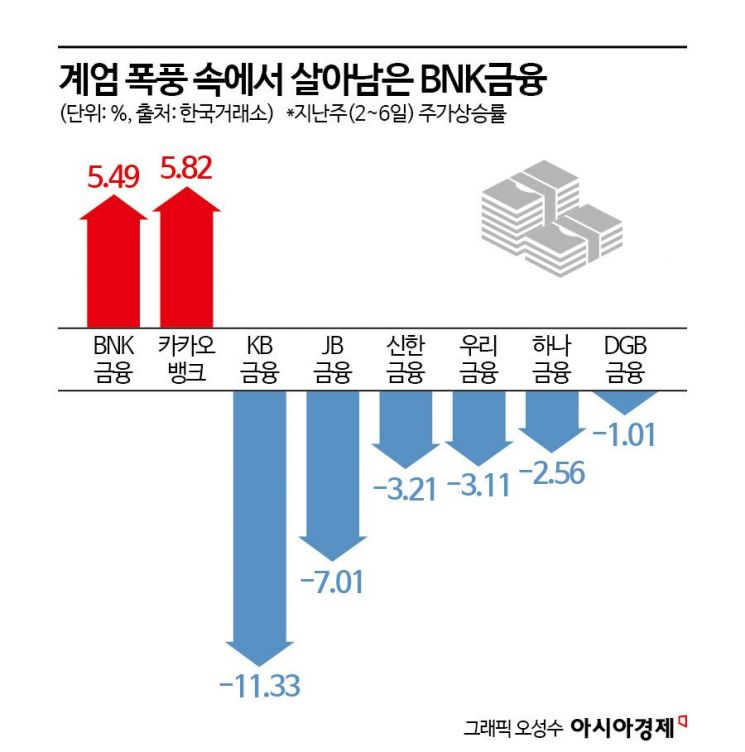
According to the Korea Exchange on the 11th, BNK Financial Group's stock price rose 5.49% last week. Among bank stocks (KB, Shinhan, Hana, Woori, DGB, JB, KakaoBank), it was one of the only two to increase, along with KakaoBank (5.82%). In the case of KakaoBank, the industry views that its stock price defense was partly due to the sharp rise in related Kakao Group stocks such as KakaoPay and Kakao. After President Yoon declared martial law on the 3rd, the other bank stocks fell until the 6th. KB Financial Group recorded the largest drop at -11.33%, followed by JB Financial Group at -7.01%, which had seen significant stock price gains this year. A BNK Financial Group official stated, "The stock price, which had been on the rise since early this year, seems to have resilience because it was initially undervalued."
The closing price of BNK Financial Group's stock on the 10th was 10,830 won. This represents an 8.8% decline from 11,880 won on the 3rd, before the martial law declaration. It fell less than DGB Financial (7.4%). The other financial holding companies (excluding KakaoBank) fell by an average of -13.1%. Despite large-scale net selling by foreigners centered on bank stocks, BNK Financial Group has held firm. According to Hana Securities, foreigners net sold 369 billion won worth of bank stocks last week, accounting for about 65% of the total KOSPI net selling volume of 574 billion won. In particular, in the three trading days immediately following the martial law declaration, foreigners net sold about 505 billion won of bank stocks, which accounted for half of the total KOSPI net selling volume (1 trillion won) during the same period.
The reason BNK Financial Group was able to perform well is that its proportion of foreign currency assets is low, resulting in less risk from exchange rate increases. Choi Jung-wook, an analyst at Hana Securities, said, "When political uncertainty increases, volatility in indicators such as exchange rates also rises, which dampens investment sentiment toward bank stocks, which are system industries." As of the third quarter of this year, BNK Financial Group's total foreign currency assets amounted to 3.064 billion dollars (approximately 4.3968 trillion won). This is lower than similar regional financial holding companies such as DGB (4.124 billion dollars) and KB, Shinhan, Hana, and Woori (average 7.266 billion dollars).
Also, a sharp rise in exchange rates can negatively affect the Common Equity Tier 1 (CET1) ratio, which is the benchmark for shareholder returns, and the bank's profits and losses. Investors consider these figures as one of the criteria for judgment, and BNK Financial Group's figures remain stable. BNK Financial Group's CET1 ratio in the third quarter was 12.3%, continuing an upward trend since achieving 12% in the first quarter.
Foreigners' net buying also had a positive impact on stock price defense. BNK Financial Group's stock has seen increased foreign net buying since early this year, and especially from April 4 to 10, foreign net buying ranked 15th in trading volume and 27th in trading value, both the highest among bank stocks. In contrast, KB Financial Group ranked 2nd in net selling by trading volume, Shinhan Financial Group 3rd, and Industrial Bank of Korea 4th. It is estimated that this large-scale net buying is driven by long money (long-term investment funds) among foreigners, who have re-entered the stock due to a positive evaluation of BNK Financial Group's improved fundamentals and management strategy direction. Analyst Choi said, "This re-entry will not only improve supply and demand but also serve as an opportunity to re-evaluate BNK Financial Group's low fair value, which has been excessively discounted relative to profitability."
© The Asia Business Daily(www.asiae.co.kr). All rights reserved.


















