People's Party Calls for Shortening Martial Law Parliament Approval Period
Minjin Party: "People's Party, Which Enforced Martial Dictatorship, Suddenly Proposes This"
"Martial Law Political Struggle Ahead of Budget Review"
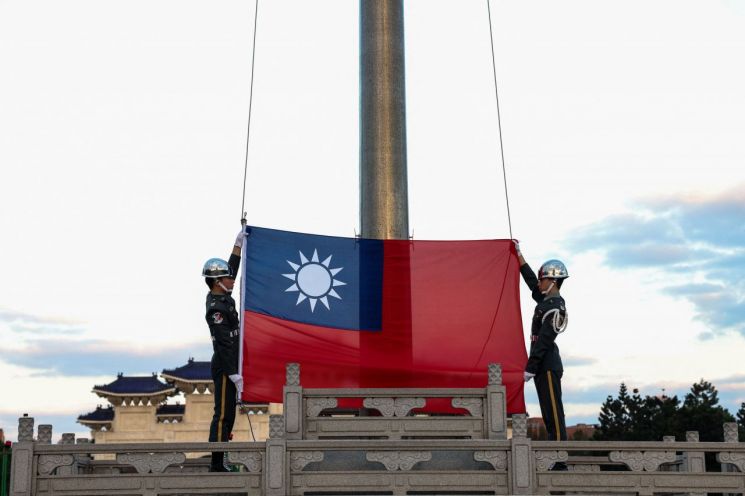 On the 29th of last month, soldiers held a flag-raising ceremony in front of the Chiang Kai-shek Memorial Hall in Taipei, Taiwan. Photo by AFP and Yonhap News.
Taiwan's main opposition party, the Kuomintang (KMT), has sparked controversy over martial law in Taiwan after proposing amendments to the martial law act following the martial law incident in South Korea. The KMT argues that the current martial law act could threaten Taiwan's democracy and calls for swift amendments based on South Korea's case. However, the ruling Democratic Progressive Party (DPP) has opposed this, accusing the KMT, which once ruled under long-term martial law, of suddenly using martial law as a political tool. Analysts also suggest that this is an attempt to divert attention ahead of next year's budget review by exploiting the South Korean martial law incident as a pretext.
One-month parliamentary ratification period after martial law declaration... "Could be abused for power misuse"
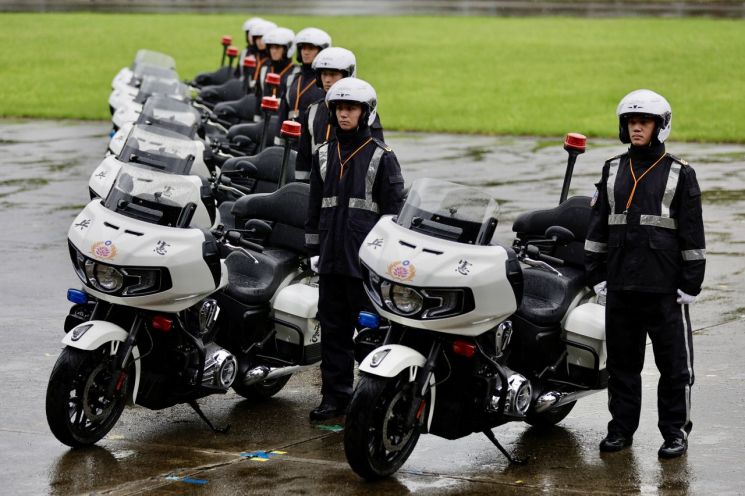 On the 19th of last month, members of the Rapid Response Company of the Taiwan Military Police showcased their training. Photo by EPA and Yonhap News Agency
According to the Taipei Times, on the 9th, the KMT submitted amendments to the Legislative Yuan (parliament) regarding the martial law ordinance and the Legislative Yuan power exercise act. Referring to South Korea's case, the proposal requires the president to report the martial law declaration to the Legislative Yuan within 8 hours and significantly reduce the review and decision period by the legislature to 24 hours.
Xu Yuzhen, a KMT legislator who proposed the bill, explained the background by saying, "Taiwan's martial law, which has never been amended until now, has a major loophole. The president declares martial law and then has up to one month to get parliamentary ratification." He added, "In other words, the president has a whole month during which power could be abused and political opponents arrested." He further argued, "Since Taiwan's democracy was hard-won, we must ensure there are no gaps that allow the abuse of martial law."
Earlier, Taiwan's second opposition party, the Taiwan People's Party, also voiced the need to amend martial law. Wu Chun-cheng, deputy caucus whip of the Taiwan People's Party, pointed out, "According to Article 1, Paragraph 2 of the current martial law act, the president must obtain Legislative Yuan approval within one month, but if the legislature is in recess, approval is required upon resumption of the session." He warned, "If the president unilaterally declares martial law, the Legislative Yuan could face a one-month approval period during sessions and a gap of up to three months during recess."
The ruling DPP's posting on March 3rd praising South Korea's emergency martial law declaration, which was later deleted, fueled the opposition's calls for martial law amendments. The DPP had posted on its official SNS account, "With the South Korean National Assembly controlled by pro-North forces, President Yoon Suk-yeol urgently declared martial law to protect the free constitutional order," and added, "Taiwan's Legislative Yuan is also facing budget cuts by the Blue (KMT) and White (Taiwan People's Party) camps, violating the constitution and expanding parliamentary powers. We must stand against these dark forces eroding the country," but deleted the post amid controversy.
Conflict between ruling and opposition over martial law amendments... "KMT, the former martial law ruler, using it as a political tool"
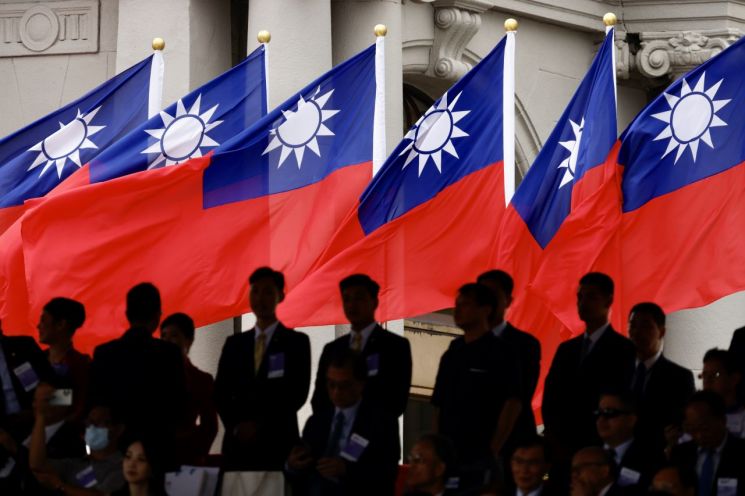 Agents attending the Double Ten Day event, the National Day of the Republic of China, on October 10th, are waiting in front of the national flag. Photo by EPA and Yonhap News.
However, the DPP criticizes the KMT's demands as untimely, even considering the South Korean martial law incident. The KMT, which maintained Taiwan's 38-year-long martial law dictatorship, is accused of deliberately turning the martial law amendment into a political tool to divert attention ahead of next year's budget review.
At a press conference following the KMT's martial law amendment proposal, DPP legislator Wu Tsyao said, "The KMT was the main perpetrator of the 38 years of martial law in Taiwan. The main purpose of the current Legislative Yuan session is to pass next year's government budget, but the KMT is exaggerating and politicizing martial law. We must question whether martial law issues are more urgent and necessary than the budget."
Taiwanese President Lai Ching-te also emphasized at the World Human Rights Day event on the 8th, "Taiwan suffered great wounds in its economy, rule of law, and human rights during 38 years of martial law, and society still feels its impact," and stressed, "We will forever uphold the democratic and free constitutional system and will never return to the past."
Meanwhile, Taiwan maintained martial law for 38 years from May 20, 1949, to July 15, 1987, under the KMT dictatorship. The DPP played a leading role in lifting martial law. In September 1986, after its founding, the DPP abolished Article 100 of the Criminal Code, which banned party formation, newspaper establishment, and acts inciting independence from mainland China, and allied with opposition parties to spearhead the end of KMT's martial law.
© The Asia Business Daily(www.asiae.co.kr). All rights reserved.



















