National Assembly Passes Budget Reflecting Only Unprecedented Cuts
Woo Won-sik: "Discussion Impossible Due to Unconstitutional Martial Law"
Speaker of the National Assembly Woo Won-sik mentioned the "government responsibility theory" during the negotiation process immediately after handling the budget bill that reflected only the 'reduction opinions' for the first time in constitutional history. He stated, "It is very regrettable to process the reduced budget," but also said, "The government's attitude during the budget processing was very disappointing."
On the afternoon of the 10th, Speaker Woo presented and passed the revised 2025 budget bill at the plenary session held at the National Assembly. The revised bill, which was passed with 183 votes in favor and 94 against, was a proposal forcibly processed by the Democratic Party of Korea at the National Assembly Budget and Accounts Special Committee on the 29th of last month. The revision included a reduction of 4.1 trillion won from the total expenditure budget of 677.4 trillion won, including 2.4 trillion won in contingency funds from the government-submitted budget.
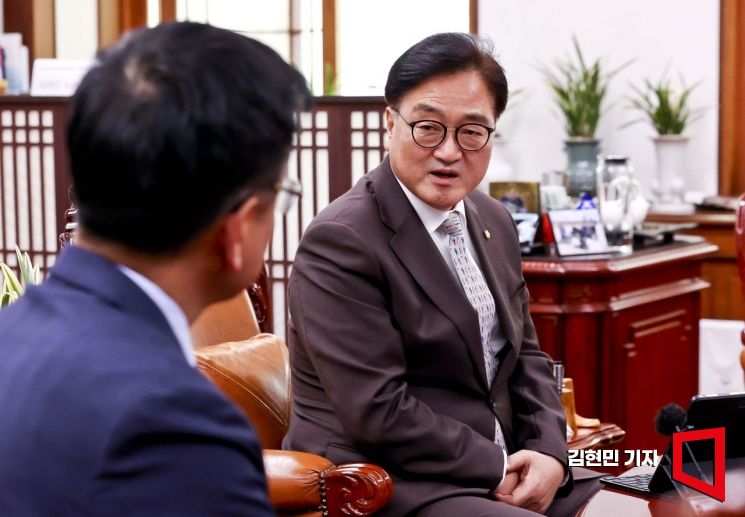 Speaker Woo Won-shik and Deputy Prime Minister and Minister of Economy and Finance Choi Sang-mok are seen meeting and conversing at the National Assembly on the 2nd. Photo by Kim Hyun-min
Speaker Woo opened by saying, "As you know, the National Assembly's budget review starts with the budget submitted by the government," and added, "The government's submitted budget itself included significant cuts to livelihood budgets such as rental housing support, energy vouchers for vulnerable groups, and local education finances." He continued, "As the Speaker, I judged that the drastically cut livelihood budgets must be restored, and thus requested additional negotiations even beyond the legal deadline." The Democratic Party had requested Speaker Woo on the 2nd to submit the reduced budget passed by the Budget Committee to the plenary session, but Speaker Woo had withheld submission to the plenary session until that day to continue negotiations with the ruling party.
Referring to the December 3 emergency martial law incident, Speaker Woo claimed, "The unconstitutional declaration of emergency martial law banning National Assembly activities made budget discussions impossible, and the government tried to shift the responsibility for the budget delay to the National Assembly." He also said, "The government maintained a lukewarm attitude toward increasing livelihood budgets," and mentioned, "Budget negotiations originally involve first cutting unnecessary budgets and then increasing necessary budgets within the created space."
The Ministry of Economy and Finance and the ruling and opposition parties continued budget negotiations from the afternoon of the previous day until the morning of this day but failed to reach a last-minute agreement. Consequently, Speaker Woo submitted the revised bill reflecting the Democratic Party's opinions to the plenary session for processing. He pointed out, "The current problem fundamentally results from the government's failure to sufficiently consult with the National Assembly during the preparation of next year's government budget," and added, "It can only be seen as disregarding the National Assembly's budget review authority by relying on the budget review confirmation procedure under the National Assembly Act, which favors the government." He further stated, "Areas requiring increases should be expanded through supplementary budgets for livelihood expenses."
© The Asia Business Daily(www.asiae.co.kr). All rights reserved.
![Clutching a Stolen Dior Bag, Saying "I Hate Being Poor but Real"... The Grotesque Con of a "Human Knockoff" [Slate]](https://cwcontent.asiae.co.kr/asiaresize/183/2026021902243444107_1771435474.jpg)
















