Handonghun Keeps Promise to Private Hong Jeonggi's Mother
Amendments to Basic Military Service Act and Military Welfare Act
Bereaved Soldiers Can Receive Pension with Posthumous Promotion
On the 10th, the National Assembly held a plenary session and passed an amendment to the State Compensation Act allowing the bereaved families of soldiers and police officers who died in action or on duty to claim compensation from the state. Under the current law, based on the principle of prohibition of double compensation, bereaved families cannot claim damages if they receive disaster compensation or survivor pensions under other laws.
During the plenary session held that afternoon, the National Assembly passed the partial amendment to the State Compensation Act with 286 members present, 284 in favor, and 2 opposed. Previously, when Han Dong-hoon, the leader of the People Power Party, was Minister of Justice, the Ministry of Justice proposed an amendment to the State Compensation Act last year to abolish the prohibition of double compensation, but it was discarded due to the expiration of the 21st National Assembly's term. On the 26th of last month, Han promised again to pass the amendment after the mother of the late Private Hong Jeong-gi, who died from acute leukemia contracted during military service and did not receive timely treatment, appealed for the law's revision.
The current Military Disaster Compensation Act, which grants a one-rank promotion to soldiers who died in action or on duty and those who served with distinction during national emergencies such as battles, wartime, or incidents, but bases survivor pensions and allowances on the rank before promotion, will also be amended. Accordingly, in the future, pensions and various benefits for those posthumously promoted, such as the deceased in action or on duty, will be paid according to the promoted rank.
A partial amendment to the Military Welfare Basic Act was also passed, establishing a legal basis to prioritize the sale of general property, which has been decommissioned due to the relocation of defense and military facilities, to corporations established for the purpose of stabilizing soldiers' lives and promoting welfare. For houses supplied through such sales procedures, a price ceiling system will be applied, and the selection process for residents can be stipulated by presidential decree.
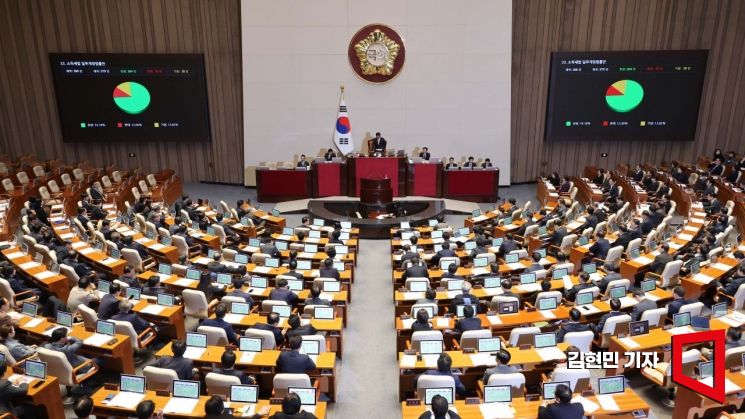 On the 10th, the amendment to the Income Tax Act, which focuses on the abolition of the financial investment tax and the postponement of virtual asset taxation, is being passed in the plenary session of the National Assembly. Photo by Kim Hyun-min
An amendment to the Basic Act on the Status and Service of Soldiers was also approved, establishing compensation regulations so that the state can compensate for losses incurred during lawful military duties, and allowing mitigation or exemption of criminal liability for soldiers if damage to others occurs without intent or gross negligence during duty. Additionally, an amendment to the Military Pay Act passed the National Assembly, allowing active-duty officers selected as military officer candidates to receive the pay amount prior to their transfer of military status, and retroactively applying this regulation to those who have already had their status changed and received only the candidate pay.
A partial amendment to the Military Personnel Act was passed, setting the review and resolution period of the Central Military Service Award Review Committee to 120 days from the date of re-examination request, and allowing a one-time extension of up to 30 days in unavoidable circumstances, so that bereaved families of the deceased can receive appropriate compensation promptly. The amendment also includes provisions allowing officers, warrant officers, and non-commissioned officers who reach retirement age to apply to serve in the reserves for a certain period if they wish.
Legislation related to the welfare of general public officials also passed. Similar to the amendment to the Military Disaster Compensation Act, the amendment to the Public Officials Disaster Compensation Act stipulates that if a public official dies or is killed in the line of duty and is posthumously promoted or appointed to a higher rank, position, or office (including senior executive service positions), the calculation of survivor pensions and other benefits will be based on the deemed service in the higher rank as prescribed by presidential decree. The Public Officials Pension Act was also amended to calculate retirement survivor pensions and lump-sum payments based on the deemed service in the higher rank as stipulated by presidential decree.
Amendments to the State Public Officials Act and Local Public Officials Act were passed, specifying in the appointment criteria that parents with multiple children can be given preferential treatment in personnel management. Reflecting the Constitutional Court's rulings on unconstitutionality and constitutional incompatibility, the amendments revise the grounds for automatic retirement of wards under adult guardianship and the disqualification period for appointment of sex offenders against minors, and clearly stipulate the provision of investigation and prosecution materials for disciplinary procedures.
© The Asia Business Daily(www.asiae.co.kr). All rights reserved.
![Clutching a Stolen Dior Bag, Saying "I Hate Being Poor but Real"... The Grotesque Con of a "Human Knockoff" [Slate]](https://cwcontent.asiae.co.kr/asiaresize/183/2026021902243444107_1771435474.jpg)











