Inadequate Water and Sewage Facilities on Java Island
Rapid Subsidence of Sedimentary Terrain
Constructing a Large Embankment to Prevent Sinking
Multipurpose 'Karian Dam' Also Under Construction
Designed and Supervised by Korea Rural Community Corporation
Reducing Groundwater Use by Supplying Drinking Water
Java Island, where Jakarta, the capital of Indonesia, is located, is sinking every year. Due to inadequate water supply and sewage facilities, residents heavily rely on groundwater, and because it is a sedimentary terrain, ground subsidence is progressing rapidly. Climate change has also caused sea level rise, resulting in seawater intrusion. This is why the Indonesian government is actively pursuing various projects, such as constructing large coastal dikes and building multipurpose dams on rivers, to prevent the land from sinking.
Korean technology is at the center of these projects. The Indonesian government has been promoting the 'Jakarta Metropolitan Coastal Integrated Development Project (NCICD)' over the past few years to build large coastal dikes along the northern coast of Jakarta, and the Korea Rural Community Corporation (KRC) was assigned the feasibility study and basic design for the offshore dike (21 km) in 2016. Although the Indonesian government initially planned the project with the Netherlands, it became a trilateral cooperative project after KRC actively promoted Korea’s abundant experience from the Saemangeum project.
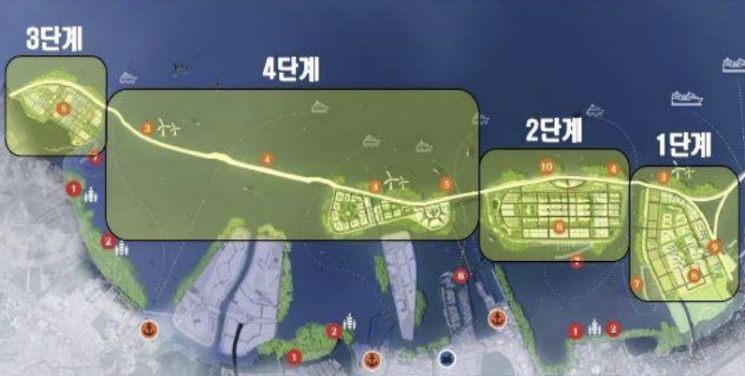 A bird's-eye view of the Indonesia Jakarta Metropolitan Coastal Integrated Development Project (NCICD). Korea Rural Community Corporation was responsible for the design of the main dyke based on Saemangeum technology. Photo by Korea Rural Community Corporation
On the 26th of last month, visiting Pluit Village on the northern coast of Jakarta, where the large coastal dike will be constructed, one could strongly feel the necessity of the project. Along the long road by the coast, a dike over 1 meter high was installed. It was originally lower but had many traces of being repeatedly reinforced. Beyond the dike, the seawater was surging as if it would soon overflow. Nam Hoseong, head of the Global Business Division at KRC, who accompanied the press corps visiting the site, said, "Five years ago, it was possible to cross to the other side beyond the dike," and added, "Every time I come here, I feel the water level rising rapidly."
The large coastal dike is planned to stretch 33 km long and 20 meters high along the coast. The currently estimated project cost reaches 20 trillion won. Additional urban development is expected on the reclaimed land created by constructing the dike. Although the official project start date has not been confirmed, KRC explains that there is significant local development will. Recently, the project has been described locally as a "40-year survival issue for the nation." The newly inaugurated Indonesian President Prabowo Subianto in October is also showing interest in the project, making the situation hopeful.
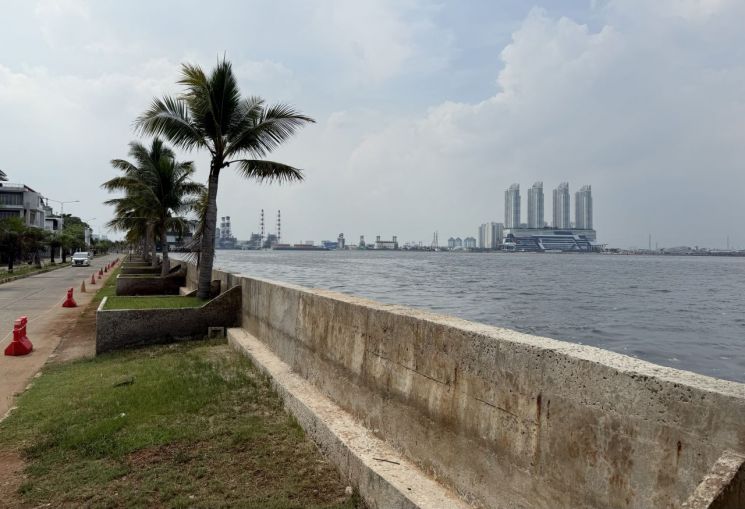 The area around the coastal village in North Jakarta where the Daebang embankment will be constructed, as of the 26th of last month. A long embankment has been installed along the coastal road to prevent seawater from flooding. Photo by Kim Pyeonghwa
Moreover, it is projected that by 2030, 90% of northern Jakarta’s area (12,500 hectares) will be below sea level. This is why the Indonesian government plans to expand the project area to the northern coast of Java Island in addition to the existing plan to build the large coastal dike. In this case, the project cost is expected to grow to about 100 trillion won. Currently, a report containing the basic design of the large coastal dike has been submitted to the Indonesian president, and if the project proceeds in earnest, not only KRC but also Korean private companies will be able to participate in the reclamation development business, increasing business opportunities. Nam added, "From Indonesia’s perspective, building the large coastal dike and developing the reclaimed land will help alleviate traffic congestion and disperse the population."
Multipurpose 'Karian Dam' Supplying Drinking Water to Jakarta
The Karian Dam, a multipurpose dam nearing completion in Indonesia, is also expected to be a key facility to prevent ground subsidence in Jakarta. On the 25th of last month, after a three-hour drive from Jakarta, we visited the Karian Dam located in Banten Province on Java Island. Upon arrival near the dam, driving along a road lined densely with palm trees on both sides, we reached the dam site, which was so vast that the view opened widely. The dam was filled with water, and looking beyond it, one could see the lush forests characteristic of Southeast Asia.
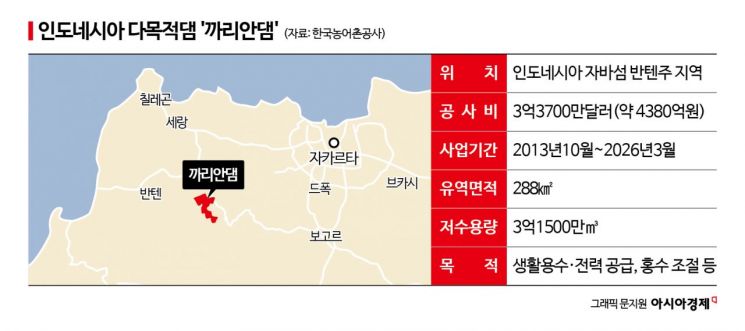
Karian Dam is located on a tributary of the Cijung River running through Banten Province, about 100 km southwest of Jakarta. It is the third-largest dam facility in Indonesia. The dam is 516 meters long and 63 meters high, with a storage capacity of 315 million cubic meters, similar in scale to Korea’s Paldang Dam. Karian Dam consists of the main dam, auxiliary dam, support towers, and intake tunnels. Construction began in 2013, and the main facilities are now completed, with finishing landscaping works underway. Water impoundment started in September last year, and as of last month, the reservoir was 79% full.
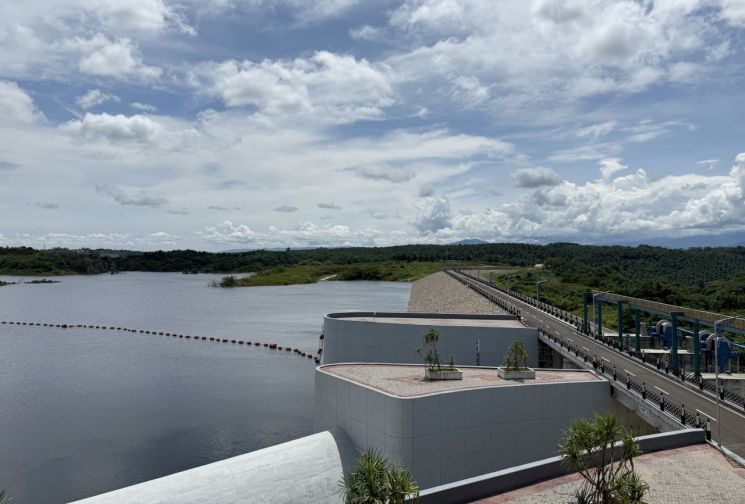 The area around Karian Dam in Banten Province, Java Island, Indonesia, on the 25th of last month. Photo by Kim Pyeonghwa
Karian Dam has attracted attention both locally and in Korea because Korean technology and capital were invested. The Korea Rural Community Corporation won the contract for Karian Dam in 2014 based on over 100 years of Korean dam technology and was responsible for design and supervision, while DL E&C joined the dam construction by forming a consortium with a local state-owned company. Unlike Korea, where dams were built on narrow and deep river terrains, Karian Dam is characterized by a wide and shallow river. KRC designed Karian Dam reflecting Indonesia’s geographical features, where rivers are not as large as in Korea.
Karian Dam will play a crucial role in supplying various water needs to Jakarta and Banten Province. It will provide drinking water to the western part of Jakarta, home to 4 million people, and supply agricultural water near the dam. For Indonesia, which worries about ground subsidence due to excessive groundwater use, this project is essential. Choi Nakwon, head of the Karian Dam project at KRC’s Global Business Division, said on-site, "60-70% of Jakarta residents use groundwater," adding, "Excessive use causes repeated ground subsidence and seawater intrusion." He explained, "By supplying multipurpose water through this project, ground subsidence can be mitigated. That is the purpose of our project."
Karian Dam can also help prevent disasters by controlling floods. Additionally, a small hydropower plant with a capacity of 1.8 MW is planned. Through landscaping facilities around the dam, it can also be developed into a local tourist attraction. KRC explained that nearby residents already visit by motorcycle to enjoy the surroundings and rest. The elevation is higher than nearby areas, resulting in lower temperatures, and the dam area becomes cool in the afternoon. For local residents, who have rarely seen large dams, the dam itself can be a sightseeing spot.
Of course, there are remaining challenges to realize these plans. Even if Karian Dam is ready for operation, a water conveyance channel must be constructed to supply drinking water to Jakarta, which is 50 km away. Currently, Korea Water Resources Corporation (K-water) is promoting a public-private partnership (PPP) project, but it is expected to take considerable time. However, once the water conveyance channel is completed, Karian Dam will be able to fulfill its role immediately.
KRC plans to successfully promote various projects, including the large coastal dike in northern Jakarta and Karian Dam, to enhance the status of Korean technology (K-technology) locally. Oh Youngin, head of the KRC Indonesia Office, whom we met locally, said, "We will discover many projects where KRC’s technology (K-Rural Community Technology) can be applied in Indonesia," adding, "By creating many projects and leading with KRC’s flag, gathering private engineering companies, and discovering many Official Development Assistance (ODA) projects, there will be more opportunities for domestic companies to participate."
© The Asia Business Daily(www.asiae.co.kr). All rights reserved.
![Clutching a Stolen Dior Bag, Saying "I Hate Being Poor but Real"... The Grotesque Con of a "Human Knockoff" [Slate]](https://cwcontent.asiae.co.kr/asiaresize/183/2026021902243444107_1771435474.jpg)


















