Korea Institute for Health and Social Affairs, "Workload Heavier Than in the US and Japan"
Institutional Support Needed for Team-Based Care Expansion and Flexible Work Hours
It has been revealed that the working hours of residents in South Korea are still higher than those in major advanced countries, prompting calls to reduce their workload by shortening working hours and adjusting the number of patients. To minimize the gaps caused by the reduction in residents' training hours, institutional support such as expanding team-based care and introducing flexible working systems within medical institutions appears necessary.
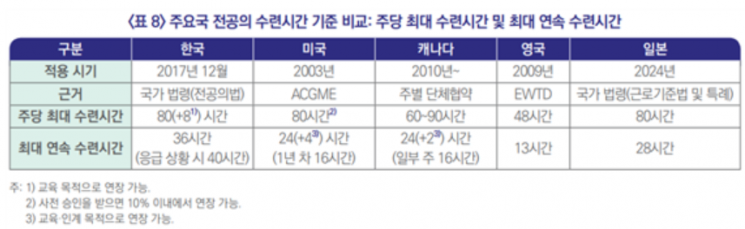
According to the report titled "Issues of Limiting Residents' Training Hours and Implications from Major Countries," published by the Korea Institute for Health and Social Affairs on the 10th, although the actual training hours of residents in South Korea have decreased since the enforcement of the "Resident Act" in December 2017, they remain longer compared to major overseas countries such as the United States, Canada, the United Kingdom, and Japan.
The maximum weekly training hours for residents are generally set at around 80 hours per week in most countries, with continuous training hours limited to 24?28 hours, and extensions of 2?4 hours allowed for educational and handover purposes.
However, in South Korea, the maximum weekly training hours can be extended by up to 8 hours for educational purposes, effectively allowing up to 88 hours, the maximum continuous training hours are 36 hours, and in emergency situations, up to 40 hours are permitted, which is significantly higher than in other countries.
A 2022 survey showed that 53.0% of residents had experienced training exceeding 80 hours per week on a 4-week average, and 65.8% had undergone continuous training exceeding 24 hours within a week. Additionally, 33.9% of surveyed residents reported not receiving guaranteed rest time according to standards, and 57.1% said they were not given any break time at all. The main reasons residents did not take vacations were cited as "increased workload burden on colleagues (57.9%)" and "the atmosphere of the training institution (26.9%)."
Accordingly, the government is currently working to institutionalize a reduction in residents' maximum weekly training hours to 72 (+8) hours and maximum continuous training hours to 24 (+4) hours, as part of the "First Medical Reform Implementation Plan" announced last August.
Gordon Sol, a senior researcher at the Korea Institute for Health and Social Affairs, emphasized, "Residents are both trainees receiving training and education at training hospitals and wage workers with a dual status. Excessive workload should be reduced by limiting residents' training hours and applying appropriate patient number standards to improve working conditions, ensure the quality of training, and secure patient safety."
However, since residents' training hours include time for education and training to develop their expertise as specialists, any reduction or limitation of training hours should be implemented without hindering necessary training and educational opportunities. Researcher Ko stated, "To minimize the gaps caused by the reduction in residents' training hours, it is necessary to adjust personnel and tasks within medical institutions. Measures such as team-based care, new forms of care delivery, and flexible working systems should be introduced, or efficient personnel management methods should be reviewed and support plans prepared."
© The Asia Business Daily(www.asiae.co.kr). All rights reserved.


















