The Younger the Age, the Higher the Competency Level
'Below Level 1' Also Higher than OECD Average
The language, numeracy, and adaptive problem-solving skills of Korean adults were found to be lower than the average of the Organization for Economic Cooperation and Development (OECD).
According to the results of the second cycle of the Programme for the International Assessment of Adult Competencies (PIAAC) announced by the OECD at 11 a.m. local time on the 10th, the average language proficiency score of Koreans aged 16 to 65 was 249 points, numeracy was 253 points, and adaptive problem-solving was 238 points, all of which were lower than the OECD averages (260, 263, and 251 points, respectively).
The PIAAC survey compares the core information processing skill levels of language proficiency, numeracy, and adaptive problem-solving among adults aged 16 to 65 across countries and assesses the extent to which these competencies are utilized in daily and workplace life. Conducted every 10 years, the first cycle took place in 2011?2012. Due to COVID-19, the announcement of this survey was delayed, and approximately 160,000 adults from 31 countries participated in 2022?2023.
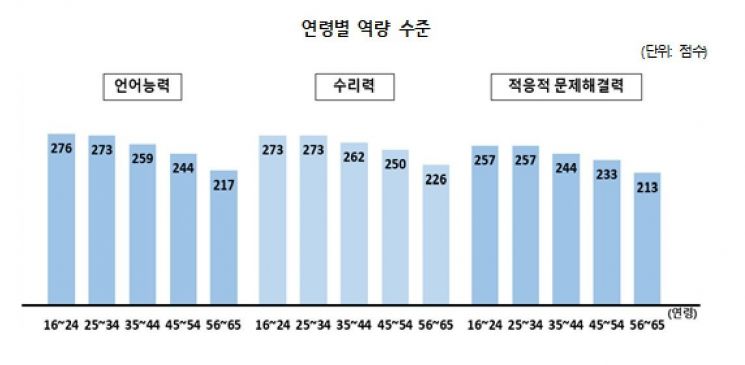
When limiting the analysis to those aged 16 to 24, language proficiency and numeracy scored 276 and 273 points respectively, which were at the OECD average levels (273 and 272 points). Overall, there was a tendency for competency levels to be higher among younger age groups.
In contrast, for those aged 56 to 65, language proficiency and numeracy were significantly lower than average, scoring 217 and 226 points respectively.
Regarding the proportion of individuals with low competency levels at or below level 1, the OECD average for language proficiency was 26%, while Korea’s was 30.8%. For numeracy, the OECD average was 24.9%, and Korea’s was 27.6%. For adaptive problem-solving, the OECD average was 29.2%, whereas Korea’s was 37.3%.
Additionally, among Korean adults aged 16 to 65, 65.0% had an educational attainment level appropriate to the requirements of their jobs. Those whose actual education level exceeded job requirements accounted for 31.3%, while 3.7% had education levels below job requirements.
According to the skill mismatch survey, 65.1% of Korean adults aged 16 to 65 had skill levels appropriate to the demands of their work. Those whose actual skill levels were higher than job requirements accounted for 23.9%, while about 11.0% had skill levels below what their jobs required.
© The Asia Business Daily(www.asiae.co.kr). All rights reserved.

















