Publication of Paper in Naker Communications
Application of Inorganic-Based High-Strength Separation Membrane
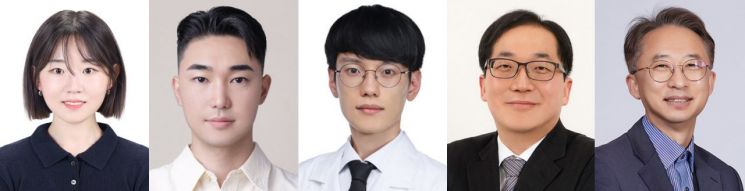 (From left) Seo Ji-young, Researcher at Yonsei University; Kim Jung-hwi, Researcher; Kim Su-hwan, Researcher at Daegu Gyeongbuk Institute of Science and Technology (DGIST); Lee Yong-min, Professor at Yonsei University; Lee Sang-young, Professor.
Yonsei University and LG Energy Solution have jointly developed a core technology in the field of silicon anode materials, which is regarded as a key technology in the next-generation battery market.
The research team led by Professors Lee Sang-young and Lee Yong-min from Yonsei University's Department of Chemical and Biological Engineering announced on the 10th that through joint research with LG Energy Solution, they have found a clue to solving the technical challenges of silicon anode materials that expand in volume during charging and discharging.
This research achievement was recently published in one of the world's leading scientific journals, Nature Communications, under the title "Mechanical shutdown of battery separators: Silicon anode failure."
Silicon is currently attracting attention as a representative next-generation material in the anode market. Compared to graphite, the widely used anode material, it improves energy density by more than 10 times, which not only extends the driving range of electric vehicles but also is advantageous for fast charging designs. Additionally, it has the benefits of cost-effectiveness and environmental friendliness.
However, volume expansion during battery charging and discharging has posed significant challenges for practical application. Due to volume changes, the cell structure can collapse or adversely affect the separator, causing difficulties in securing battery lifespan and capacity.
The Yonsei University-LG Energy Solution research team found a solution by designing a high-strength inorganic separator, among other methods.
Previously, efforts focused on improving the silicon anode material itself to mitigate degradation, but the Yonsei University-LG Energy Solution team found a clue to the solution from the perspective of the entire battery system by combining other materials such as separators.
In fact, batteries applying this improved material technology showed an excellent capacity retention rate of over 88% even after 400 cycles of high-speed charging and discharging.
Professor Lee Sang-young of Yonsei University said, "The greatest significance of this research is that it proposed an innovative approach that looks beyond the material itself to the entire battery system to solve the long-standing lifespan issue of silicon anode materials in the battery field. Through this, it is expected to provide a new direction for future battery research and development."
Kim Je-young, Chief Technology Officer (CTO) of LG Energy Solution, said, "We will continue to lead the global market with differentiated technology in the next-generation battery field through an active open innovation strategy. Based on this, we will do our best to diversify our product portfolio and create customer value."
© The Asia Business Daily(www.asiae.co.kr). All rights reserved.

















