Gyeonggi Province investigated illegal distribution of seasoning products during the kimchi-making season and uncovered 34 cases of illegal activities.
The Gyeonggi Province Special Judicial Police announced on the 10th that they investigated illegal distribution and sales of kimchi and seasoning products during the kimchi-making season, confirming a total of 34 violations including business operators’ non-compliance and illegal expansion of business premises at kimchi manufacturing and processing facilities.
Earlier, the Special Judicial Police of the province conducted an intensive investigation over two weeks from November 11 to 22 targeting more than 360 locations related to kimchi, including food manufacturing and processing facilities, instant sales manufacturing and processing facilities, and food service establishments, to create a safe food environment and establish fairness in the agricultural and marine products market.
Among the major cases uncovered, Company H in Gimpo City was caught storing instant kimchi stew products for sale that were about four months past their expiration date. Company B in Yangju City was found to have illegally expanded its business premises and stored napa cabbage kimchi in an unregistered storage warehouse.
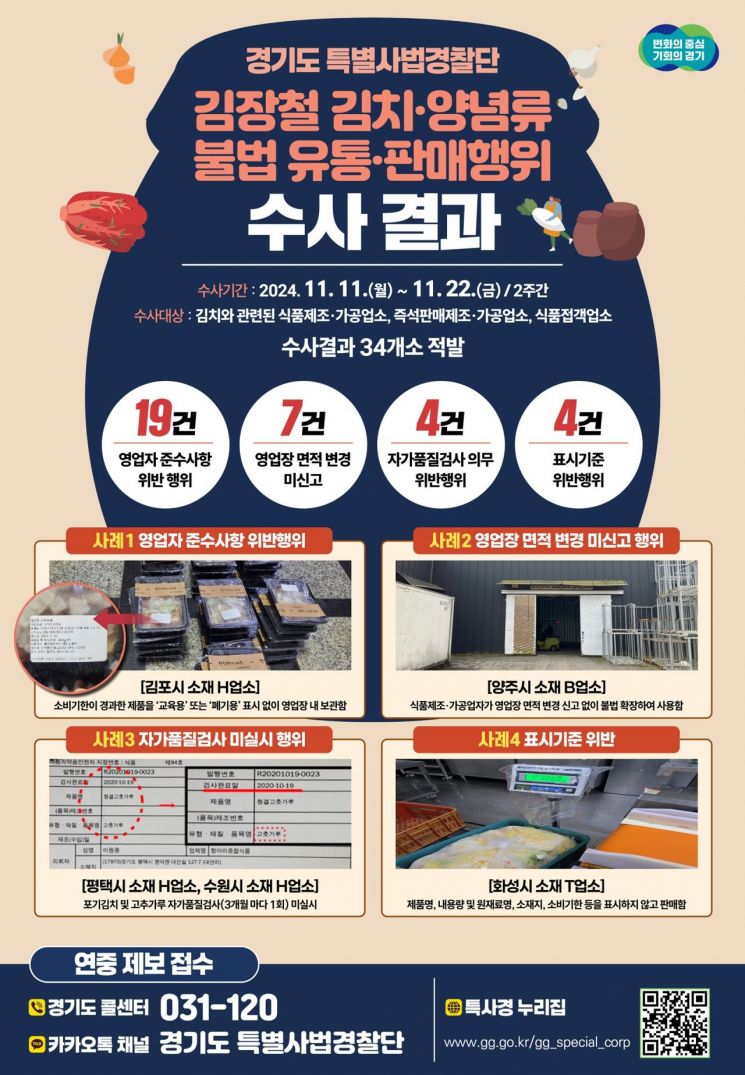 The Special Judicial Police Unit of Gyeonggi Province has uncovered 34 cases of illegal distribution of seasoning products during the kimchi-making season. The graph shows the cases detected. Provided by Gyeonggi Provincial Government.
Company H in Pyeongtaek City produced red pepper powder and sold it for about four years without conducting self-quality inspections, while Company T in Hwaseong City was caught during the investigation for selling white kimchi without complying with food labeling standards such as manufacturing date and location.
Under the current Food Sanitation Act, storing or selling products past their expiration date, illegally changing business premises area without notifying the competent authority, or violating the obligation of self-quality inspection can result in imprisonment of up to three years or a fine of up to 30 million KRW. Additionally, the Food Labeling and Advertising Act stipulates that selling food without proper labeling can lead to imprisonment of up to three years or a fine of up to 30 million KRW.
Gi Do, head of the Special Judicial Police of the province, stated, "We will do our best to proactively block the sale and distribution of hazardous food to create a safe food environment for residents," adding, "We provide guidance documents on legal compliance to prevent violations caused by minor negligence such as lack of awareness or carelessness by business owners."
© The Asia Business Daily(www.asiae.co.kr). All rights reserved.
![Clutching a Stolen Dior Bag, Saying "I Hate Being Poor but Real"... The Grotesque Con of a "Human Knockoff" [Slate]](https://cwcontent.asiae.co.kr/asiaresize/183/2026021902243444107_1771435474.jpg)
















