50 Years of Iron Fist Rule Ended in 11 Days
Russian Military and Economic Support Cut Off Due to Ukraine War
Hezbollah Also at Collapse Level... Surge in Desertions
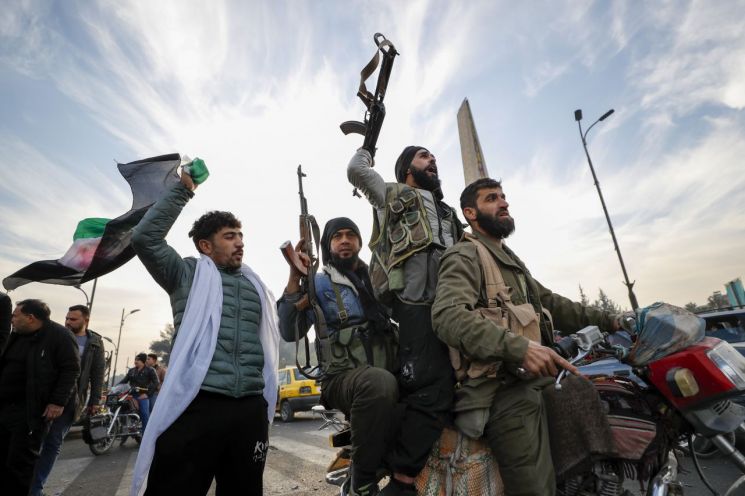 On the 8th (local time), the Bashar al-Assad Syrian dictatorship collapsed due to the rebels. Rebels entering the capital Damascus celebrate the end of the dictatorship. AP·Yonhap News
The Syrian civil war ended with a victory for the rebel forces after 13 years. The regime of Bashar al-Assad, which had maintained iron-fisted rule for 50 years, collapsed in less than two weeks after the rebels launched a counteroffensive, drawing intense international attention. The dominant analysis is that the government forces, which had relied on Russian fighter jet support during the civil war, lost their military advantage as that support drastically decreased due to the war in Ukraine, ultimately leading to their defeat by the rebels.
Syrian Rebels Reverse 13-Year-Long Civil War in Just 11 Days
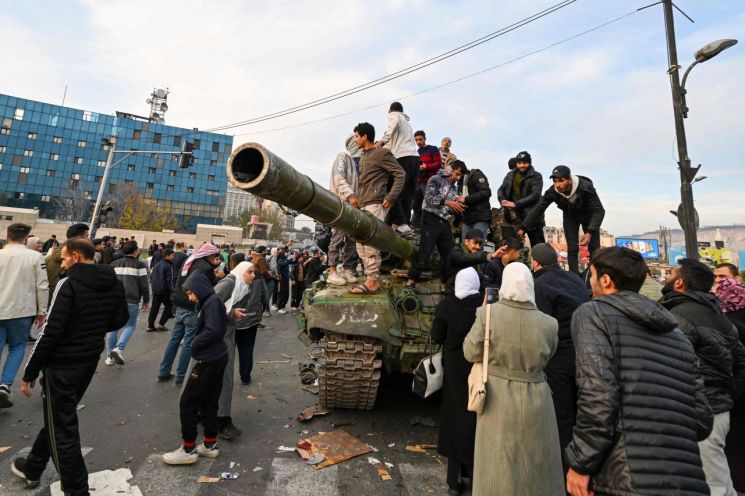 On the 8th (local time), citizens of Damascus climbed onto an old government tank to celebrate the collapse of Bashar al-Assad's Syrian dictatorship. Photo by AFP and Yonhap News.
On the 8th (local time), Syrian rebels took control of Damascus and declared an end to the civil war that had lasted 13 years since 2011. The Syrian dictator, President Assad, fled to Russia. Thus, the Syrian rebels succeeded in toppling the Assad regime and achieving victory in just 11 days after launching their counteroffensive against government forces on the 27th of last month.
The Assad family had ruled Syria for an astonishing 53 years, starting with former President Hafez al-Assad’s rise to power in 1971. They controlled politics, economy, and society at large, employing secret police to enforce oppressive rule and intervening in presidential elections through force, maintaining a dictatorship. However, in 2010, amid the wave of social reform movements across the Middle East known as the "Arab Spring," large-scale rebel uprisings erupted in Syria, plunging the country into a prolonged civil war.
In 2020, the Assad regime and Syrian rebels signed a ceasefire agreement citing the COVID-19 pandemic and economic hardships caused by the prolonged civil war, leading to a temporary lull in fighting. While small-scale local conflicts continued, a major rebel counteroffensive began at the end of last month, resulting in the government forces’ helpless defeat and the fall of key cities to the rebels, swiftly ending the civil war.
Weakened Russian Air Support Due to Ukraine War... Syrian Government Forces Lose Advantage
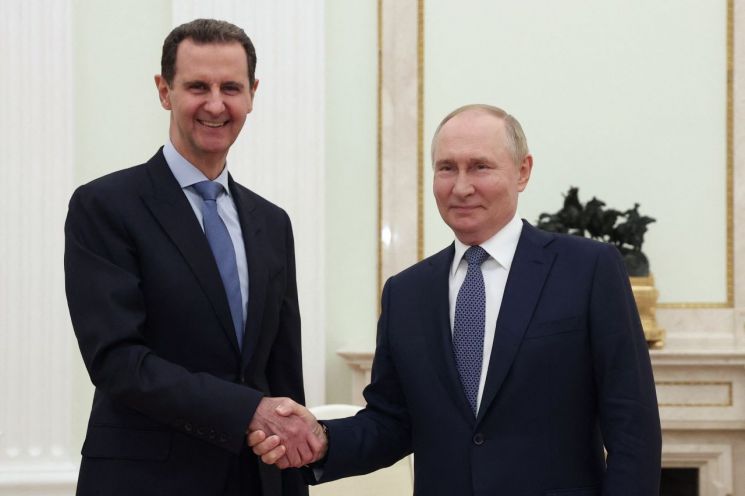 Syrian President Bashar al-Assad (left) and Russian President Vladimir Putin (right) shake hands during a visit to Moscow, Russia, last July. Photo by AFP·Yonhap News
The main reason the Assad regime, which had ruled Syria dictatorially for over half a century, collapsed so quickly is the weakening of Russian military support due to the prolonged war in Ukraine. According to The New York Times (NYT), despite being an oil-producing country, Syria suffered fuel shortages because all its refining facilities were destroyed during the long civil war. The Syrian army had relied entirely on Russian forces for heavy weapons and fighter jet bombings.
The Syrian rebels mainly received support from the Turkish government, including limited supplies of food, energy, and small arms. Consequently, during the 13-year civil war, the rebels rarely defeated the government forces and were repeatedly pushed back in major city sieges. The government forces maintained air superiority with Russian close air support, bombing key rebel strongholds and continuously cutting off their supply routes.
However, as the war in Ukraine dragged on, Russian fighter jet support noticeably decreased, and the Syrian government forces could no longer maintain military superiority over the rebels. The weakening of Russian food and energy support also worsened supply conditions for combat troops, leading to large-scale desertions. The Syrian government forces maintained a strength of about 320,000 soldiers until the 2020 ceasefire, but by early this year, their numbers had dropped to 170,000, nearly halving in just four years.
Israel-Hezbollah Clashes Also Impact... Concerns Over Prolonged Political Instability
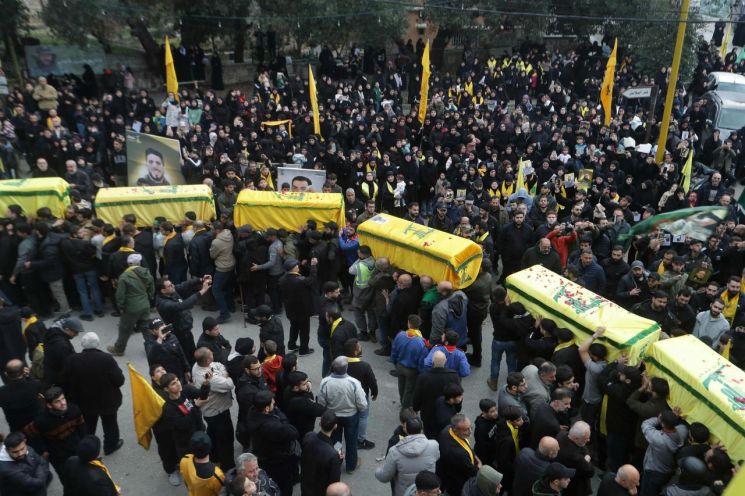 On the 4th (local time), a funeral for Hezbollah fighters who died in clashes with Israel was held in a village in southern Lebanon. Photo by AFP and Yonhap News Agency
Along with the weakening of Russian support, the significant weakening of Hezbollah, which had been providing ground combat personnel, due to prolonged clashes with Israel, is also cited as a factor in the Syrian government forces’ defeat. Through Hezbollah, the Syrian government had received Iranian weapons, training instructors, and special combat personnel support from behind the scenes, but as Hezbollah’s organization was nearly destroyed in clashes with Israel, support was almost completely cut off starting last month.
However, with President Assad’s exile to Russia, the embers of the civil war remain. According to Russia’s TASS news agency, President Assad arrived in Moscow with his family on the 9th and was granted asylum in Russia. There are concerns that Turkey and Russia, which had supported the Syrian rebels, will continue to use these forces to wage proxy wars.
International concerns are also growing because the leading faction of the Syrian rebels was once an organization affiliated with al-Qaeda. The group 'Hayat Tahrir al-Sham (HTS),' which has represented and led rebel groups, was established in 2011 and operated as an al-Qaeda affiliate until 2016. The United States designated HTS as a terrorist organization during that period.
The Israeli military also fears that HTS may attack Israel in the future. The Israel Defense Forces (IDF) deployed troops on the 8th to the border areas including the Golan Heights, which borders Israel and Syria. They also announced that they conducted airstrikes on dozens of targets such as security facilities across Syria to prevent Syrian government weapons from falling into HTS hands.
© The Asia Business Daily(www.asiae.co.kr). All rights reserved.
![Clutching a Stolen Dior Bag, Saying "I Hate Being Poor but Real"... The Grotesque Con of a "Human Knockoff" [Slate]](https://cwcontent.asiae.co.kr/asiaresize/183/2026021902243444107_1771435474.jpg)













