Advance Child Support Payment System to be Implemented from July Next Year
Ministry of Gender Equality and Family "Preparing System Including Enforcement Decree"
Expansion of Payment Recipients with Introduction of Advance Payment System
Financial Information Inquiry, Sanctions Without Detention Order, etc.
Starting from July next year, with the introduction of the ‘Advance Child Support Payment System,’ approximately 19,000 single-parent families will receive child support payments in advance from the government. The Ministry of Gender Equality and Family is currently building a system to establish the policy. After field implementation, the system will be supplemented through performance analysis and evaluation over the next three years.
A Ministry of Gender Equality and Family official said in a phone interview with Asia Economy on the 10th, "We are preparing to implement the advance child support payment system," adding, "We are preparing and discussing enforcement ordinances and rules to clearly define the application requirements and payment criteria for advance payments."
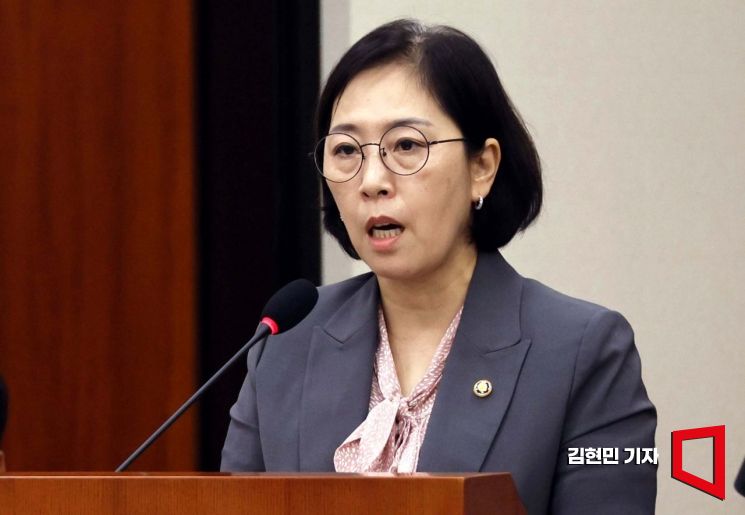 Shin Young-sook, Vice Minister of Gender Equality and Family, is reporting on the status of responses to deepfake sex crimes at the plenary meeting of the Gender Equality and Family Committee held at the National Assembly on September 4. Photo by Hyunmin Kim kimhyun81@
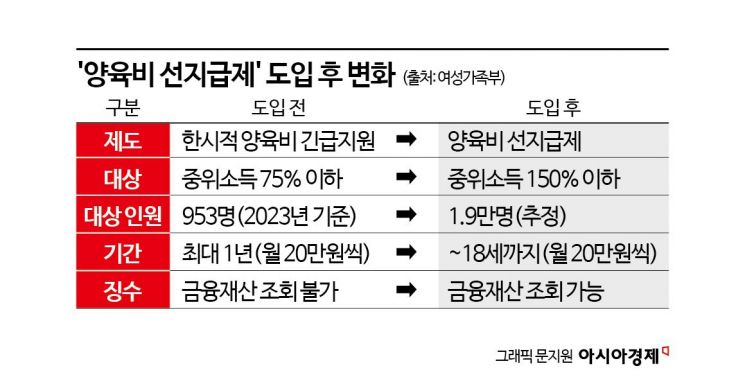
According to the amendment to the ‘Child Support Enforcement Act’ passed by the National Assembly on September 26, the government will provide advance child support payments of 200,000 KRW per month per child up to the age of 18 to single-parent families (creditor basis) who have not received child support and whose income is below 150% of the median income. According to estimates by the Ministry of Gender Equality and Family, the number of eligible recipients is about 19,000.
This expands both the target and duration of support compared to the existing ‘Temporary Emergency Child Support Assistance.’ The current temporary emergency child support assistance system provides 200,000 KRW per month per child for up to one year to single-parent families with unpaid child support whose income is below 75% of the median income. As of last year, only 953 people were eligible for this support.
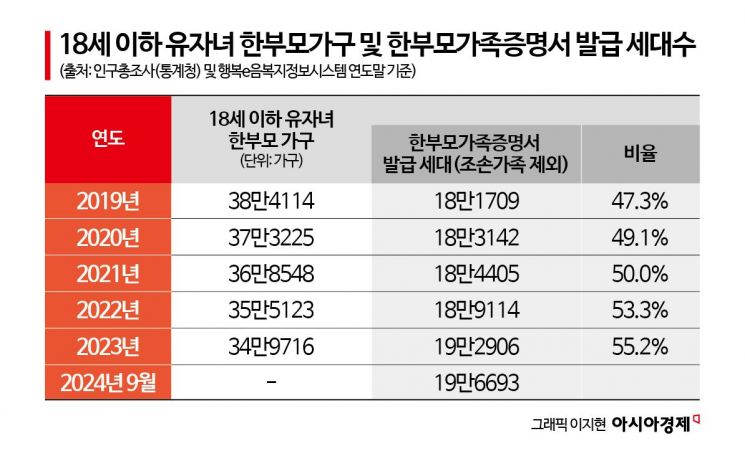
The economic situation of single parents who bear the sole responsibility for livelihood and child-rearing is poor. According to a Statistics Korea survey last year, there are about 350,000 single-parent households raising children under 18. More than half of these single-parent families with children under 18 are identified as recipients of the ‘Single-Parent Family Certificate,’ which targets low-income households. Until last year, the certificate was issued to households with income below 60% of the median income, and this year it applies to households below 63%.
Additionally, the amendment allows for requests for financial, credit, and insurance information without the consent of the child support debtor to increase the recovery rate of child support payments. Furthermore, when disclosing the list of child support debt defaulters, the period for the debtor’s explanation is shortened from more than three months to at least 10 days, strengthening sanction measures.
Moreover, since September, sanction measures against child support debt defaulters have become smoother as penalties can be imposed without detention orders. The Child Support Enforcement Agency, which manages child support enforcement, has been separated into an independent corporation, enabling it to strengthen support tasks such as subrogation lawsuits for payment and recovery of child support. The related budget has also nearly doubled from 11.06 billion KRW this year to 28.73 billion KRW next year.
Single parents who have not received child support payments welcomed the news of the system’s introduction. A beneficiary of the temporary emergency child support assistance said, "Since my divorce in 2013, I have been raising two children and have received great help from the temporary emergency child support assistance," adding, "However, the one-year period felt insufficient." They also expressed happiness about the upcoming implementation of the advance payment system.
Since February, Shin Young-sook, the acting minister of the Ministry of Gender Equality and Family, has been dedicated to introducing the advance child support payment system. In March, she visited the Seodaemun-gu Family Center and the Child Support Enforcement Agency to hear opinions from the field. At the National Assembly’s Women and Family Committee audit in October, Deputy Minister Shin stated, "We will establish an organizational structure and system to ensure smooth operations before the full-scale implementation of the advance child support payment system in July next year."
Recently, as the Ministry of Gender Equality and Family has provided comprehensive services such as legal support for child support claims and enforcement, assistance in collecting child support debts, and temporary emergency child support assistance, the child support enforcement rate has gradually increased. The enforcement rate was 21.2% (514 cases) in 2015 and doubled to 42.8% (11,064 cases) last year.
The Ministry of Gender Equality and Family plans to implement the advance child support payment system starting July 1 next year and improve the system through performance evaluations over the next three years. A ministry official said, "We are at the stage of observing the system’s implementation and application in the field," adding, "We also plan to specify in the enforcement ordinance measures such as collecting recovered child support payments and returning them to the national treasury."
© The Asia Business Daily(www.asiae.co.kr). All rights reserved.



















