KCTU Metalworkers' Union Announces Indefinite Strike from the 11th
Hyundai Motor and Korea GM Unions Under Metalworkers' Union on Alert
Strike Participation Decision to Be Made at Central Committee Meeting on the 10th
Concerns Over Suspension of Export Car Plant Operations Amid Domestic Political Variables
The Metalworkers' Union of the Korean Confederation of Trade Unions (KCTU), the umbrella organization for labor unions in domestic automobile companies, has announced an indefinite strike starting from the 11th, demanding the resignation of the Yoon Seok-yeol administration. Due to this political variable, even the automobile factories supporting South Korea's export economy are at risk of coming to a halt.
On the afternoon of the 10th, the Metalworkers' Union under the KCTU will hold a Central Executive Committee meeting at its office in Jung-gu, Seoul, to discuss detailed guidelines for a full-scale strike. The Metalworkers' Union has been conducting sporadic partial strikes since the 5th, demanding President Yoon's resignation, and has announced an indefinite full strike starting from the 11th.
A Metalworkers' Union official stated, "If the Yoon Seok-yeol administration does not step down, we will launch a full strike from the 11th based on this plan, and the Central Executive Committee will decide the detailed strike guidelines on the 10th. The participation of industrial unions in the strike will also be discussed."
Under the KCTU Metalworkers' Union are not only finished car manufacturers such as Hyundai Motor, Kia, and Korea GM but also parts suppliers like Hyundai Mobis and Mando. As the Metalworkers' Union maintains a hardline stance demanding the resignation of the Yoon Seok-yeol administration, the automobile industry faces the risk that unions could initiate strikes at any time.
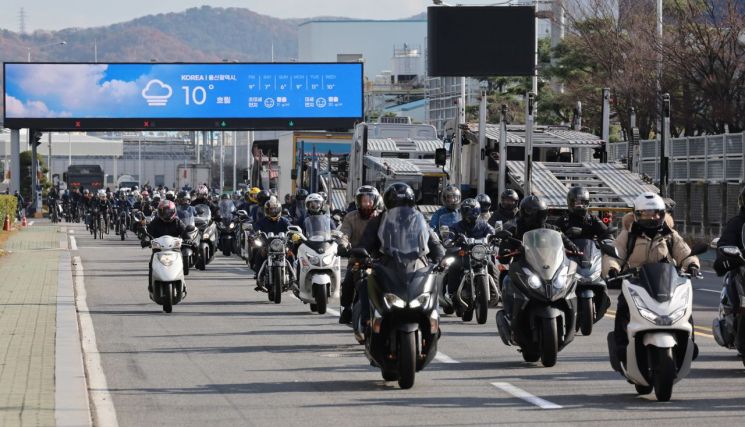 The Hyundai Motor Union, demanding the resignation of the Yoon Seok-yeol administration, carried out a two-hour strike for both morning and afternoon shifts over two days starting from the 5th. On the afternoon of the 5th, morning shift workers at Hyundai Motor's Myeongchon Main Gate in Buk-gu, Ulsan, left work two hours early. Photo by Yonhap News
The Hyundai Motor union already conducted partial strikes for two hours each during the morning and afternoon shifts on the 5th and 6th, and the Korea GM union also enforced two-hour strikes during both the first and second halves of the day on the same dates. They stopped factory operations under the pretext of participating in the Metalworkers' Union's rallies demanding the administration's resignation.
However, there are recent criticisms within the labor community that the Metalworkers' Union strike may be illegal. For a strike to be lawful, the union must undergo labor commission mediation procedures and hold a member vote, and the strike's purpose must be justified as 'improving working conditions.'
More significant than the illegality of the strike is the potential impact on the domestic economy if the strike prolongs. If the political turmoil continues and the strike becomes prolonged, the export engine, which is the driving force of South Korea's economy centered on automobiles, could shut down. Hyundai Motor and Korea GM, which participated in last week's strike, are the leading companies accounting for more than half of South Korea's automobile exports. From January to November this year, domestic automobile exports totaled approximately 2.535 million units, with Hyundai Motor and Korea GM accounting for 42% and 16%, respectively.
Recently, Hyundai Motor has faced production disruptions until last month due to a strike at its affiliate Hyundai Transys and has been compensating for contracted volumes through overtime work. Additionally, since the end of last month, parts supplier Keyang Electric, which supplies power seat motors, has struggled with supply due to heavy snowfall, forcing finished car production to slow down. With the addition of political strikes by the union, disruptions to year-end production plans seem inevitable.
Korea GM, which planned full factory operation until the end of the year, is also in a difficult situation. Prolonged wage and collective bargaining negotiations this year have already resulted in losses exceeding 40,000 units due to strikes. Even running the factory non-stop until the end of the year would be insufficient to make up for this, and the unexpected variable of a political strike raises concerns that the factory may have to stop again.
The business community and related industries have urged restraint on strikes. The Korea Employers Federation stated, "A general strike by the Metalworkers' Union could exacerbate social unrest and difficulties in the livelihood economy, so it should be restrained. We ask the labor community, as responsible economic actors, to join forces for social stability and overcoming the crisis rather than striking." An industry insider added, "If production is disrupted due to political external variables rather than internal corporate issues, it will significantly damage not only the international credibility of Korean companies but also the export economy."
© The Asia Business Daily(www.asiae.co.kr). All rights reserved.
![Clutching a Stolen Dior Bag, Saying "I Hate Being Poor but Real"... The Grotesque Con of a "Human Knockoff" [Slate]](https://cwcontent.asiae.co.kr/asiaresize/183/2026021902243444107_1771435474.jpg)
















