Major Cement Plants Including Beckum Factory in Germany Face Burden from SCR Side Effects
Concerns Over Trillions in 'Sunk Costs' Due to Incomplete Technology Verification
The cement industry has encountered difficulties ahead of the government's strengthened nitrogen oxide (NOx) emission regulations. To comply with the government's environmental standards, the industry must introduce the Selective Catalytic Reduction (SCR) method, but due to the large-scale investment required and the unverified reduction effects, there are concerns that the massive investment could become a sunk cost, leading to repeated deliberations.
In September, the government announced a legislative notice for the partial amendment of the Enforcement Rules of the Special Act on Air Quality Improvement in Air Quality Control Zones (Special Act on Air Quality Control Zones), which gradually reduces NOx emissions from cement companies in the Chungbuk region from 135 ppm in 2025 to 110 ppm in 2029, and plans to implement it next year.
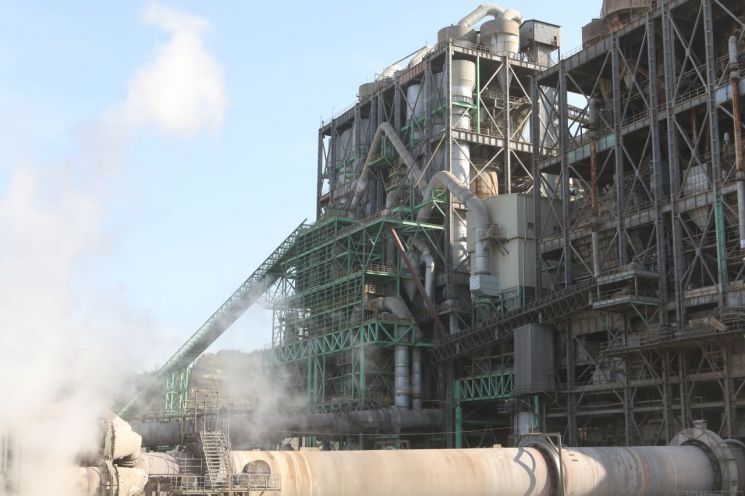
Cement generates a large amount of NOx during the process of heating raw materials such as limestone to over 1500℃ to produce clinker, a semi-finished cement product. To reduce NOx, cement companies use the Selective Non-Catalytic Reduction (SNCR) method, which sprays urea into the exhaust gas to convert nitrogen oxides into nitrogen and water.
However, meeting the government's strengthened environmental standards is impossible with the current SNCR system. The SCR system is a technology that sends exhaust gases to a separate built-in facility to remove NOx. While the SNCR system removes about 50% of NOx, the SCR system is known to remove about 80-85% of NOx.
The SCR system's catalytic reaction varies with temperature, and since it requires separate facilities, the technology is complex. Installing SCR systems on all 36 kilns in the industry is expected to cost at least 1 trillion KRW, with annual operating costs exceeding 700 billion KRW even after installation. The cement industry states, "Since the technology verification of the SCR system is not complete, even if we invest trillions of won, this cost could become a sunk cost." Therefore, the industry has requested that the NOx emission standard be relaxed from the final 110 ppm to 120 ppm until the technical verification of the SCR system is confirmed.
Regarding the technical maturity of the SCR system, the global cement magazine World Cement reported several times in August 2020 and October 2023 that various issues such as dust accumulation and catalyst performance degradation were revealed at major German cement plants that installed and operated SCR facilities between 2018 and 2019.
According to the World Cement report, the Karlsdorf plant operated by Holcim in Germany frequently had to stop SCR operation and perform maintenance due to dust accumulation and catalyst performance degradation, which caused the SCR to malfunction. Although the catalyst cleaning system and dust accumulation prevention system were reinforced and redesigned, difficulties integrating with existing facilities led to additional process adjustments and continuous maintenance, resulting in numerous additional costs.
The Holcim Beckum plant near Frankfurt also faced issues such as catalyst blockage due to dust accumulation and exhaust gas temperature control deviating from the optimal range, reducing NOx removal performance. This led to a redesign and reinstallation. Despite investing 14.2 million euros (approximately 21.35 billion KRW) in SCR introduction, the plant faced economic difficulties due to additional maintenance costs.
The Deuna plant in Thuringia, owned by the Dickerhoff brand of the Italian Buzzi Unicem Group, had to revise its design several times due to the narrow space for installing the SCR system. After SCR operation began, frequent shutdowns due to dust load problems led to multiple design revisions and reinstallations for catalyst and cleaning system placement, extending downtime and imposing a heavy burden on the company.
World Cement analyzed through these cases that "these problems frequently occur at other German cement plants as well, indicating that SCR system operation in challenging environments requires special maintenance and technical improvements."
German cement companies introduced SCR systems to comply with stringent environmental regulations, but even though their plants are much smaller (around 1 million tons annual production) than domestic cement plants operated by Korean companies (over 3 million tons annual production), they have experienced such side effects. The cement industry argues that applying the SCR system as is to large-scale domestic production facilities could cause side effects and doubts whether the government’s proposed regulations can be met. An industry official said, "The government’s regulation of 110 ppm is achievable only under the assumption that side effects like those in German cement plants do not occur and that the SCR system achieves optimal efficiency," adding, "There is a huge gap in perception between the government and the cement industry."
A representative from the Korea Cement Association stated, "The cement industry is currently continuing various efforts such as optimizing the efficiency of existing reduction facilities, converting to NOx generation reduction-type production facilities, and researching new high-efficiency reduction technologies," and appealed, "It is essential to relax regulatory standards considering industry realities until the technical stability of the SCR system is secured."
In response, an official from the Ministry of Environment said, "We are comprehensively reviewing the cement industry's request for regulatory relaxation and will proceed according to procedures."
© The Asia Business Daily(www.asiae.co.kr). All rights reserved.
!["The Woman Who Threw Herself into the Water Clutching a Stolen Dior Bag"...A Grotesque Success Story That Shakes the Korean Psyche [Slate]](https://cwcontent.asiae.co.kr/asiaresize/183/2026021902243444107_1771435474.jpg)
















