"Mass protests demanding the resignation of President Yoon Suk-yeol will intensify. A majority of South Koreans support the president's impeachment, according to polls. (Associated Press)"
"Leadership uncertainty has prolonged in one of America's most important allies. (The New York Times (NYT))"
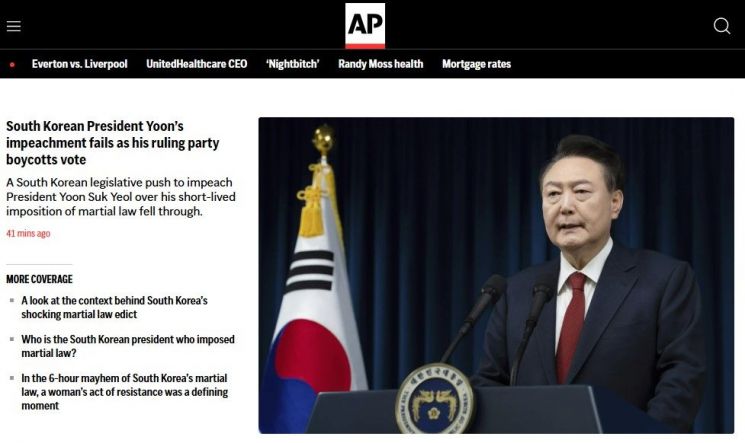
Major foreign media outlets reported in real-time on the evening of the 7th that the impeachment motion against President Yoon Suk-yeol was defeated in the National Assembly plenary session due to a lack of quorum. Numerous foreign news agencies such as Bloomberg, Reuters, NYT, and BBC operated live broadcast sections on their homepage main screens, delivering breaking news every few minutes from President Yoon’s national address in the morning to the voting results in the afternoon. Typically, foreign media operate such live sections for highly significant issues. The Associated Press, CNN, The Wall Street Journal (WSJ), and Nihon Keizai Shimbun also covered the situation in the Korean National Assembly as top news, showing intense interest.
The Associated Press reported from Seoul after the announcement of the failed vote, stating, "The parliament's attempt to impeach President Yoon over the short-lived martial law was thwarted," attributing this to "most conservative ruling party (People Power Party) lawmakers abstaining from the vote." The agency noted that only 195 out of 300 total members participated in the vote, with only three from the ruling People Power Party. It also mentioned that the opposition plans to resubmit the impeachment motion at a special session on the 11th, adding, "If public demand grows stronger, some ruling party members may eventually join the impeachment." The AP emphasized that "the rejection of the impeachment motion will deepen mass protests demanding President Yoon’s resignation and political turmoil in South Korea," highlighting the high public support for impeachment in polls.
Bloomberg reported, "The ruling party boycotted the vote, and the impeachment motion failed to surpass the 200-vote threshold needed to suspend the president’s duties," adding, "The opposition waited for ruling party lawmakers to change their minds and vote, leading to a prolonged standoff." The agency noted, "Only eight votes from the ruling People Power Party were needed to impeach President Yoon, but his conservative supporters refused to vote," diagnosing that "what happened in the National Assembly today signals heightened political tension in the coming days and weeks."
The NYT stated, "With the impeachment attempt failing, the political upheaval and uncertainty that shook the country after the brief martial law declaration have prolonged," and assessed, "Leadership uncertainty has prolonged in one of America’s most important allies." It also highlighted the protesters outside the National Assembly chanting "Impeach Yoon Suk-yeol," reporting, "Protests demanding President Yoon’s resignation are intensifying nationwide. This rally was the largest so far."
US CNN reported, "After ruling party lawmakers boycotted the National Assembly, President Yoon survived the impeachment vote." The outlet noted, "Although the martial law was brief, it caused nationwide shock and anger," and pointed out, "South Korea suffered deep wounds under decades of military dictatorship and martial law brutality until it won a long and bloody fight for democracy in the 1980s."
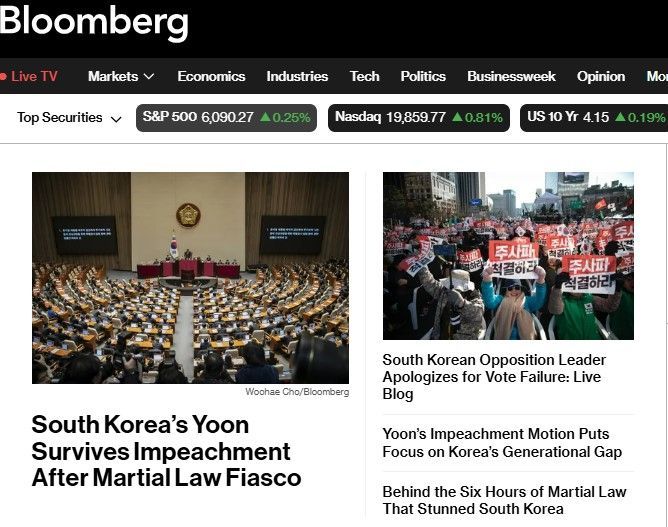
UK’s BBC, immediately after the announcement of the failed impeachment vote, highlighted in a live window from Seoul, "A protest organizer on stage asked, 'Will you join our fight until President Yoon is impeached?' and many in the crowd shouted 'Yes' with cheers."
Alongside this, BBC cited Sydney Seiler, a senior advisor at the think tank Center for Strategic and International Studies (CSIS), in an analysis article titled "Political situation has gone beyond the martial law controversy." Seiler told BBC, "President Yoon’s martial law declaration seemed unacceptable to all lawmakers, but the impeachment vote was not straightforward," explaining, "This issue involves a complex standoff between ruling and opposition parties that existed even before the martial law." Ultimately, the impeachment vote failed due to political conflict between parties, separate from the democratic threat posed by the martial law declaration.
The Guardian also reported through a live news window titled "South Korea’s crisis: Ruling party lawmakers left before impeachment vote," describing, "Many protesters turned cold upon hearing the impeachment failure news." The outlet noted, "The main opposition party, the Democratic Party of Korea, stated it will not give up on the impeachment attempt," indicating a resubmission is expected. It also added that the special prosecution law concerning First Lady Kim Geon-hee failed to pass by just two votes. Earlier, The Guardian’s live window showed National Assembly Speaker Woo Won-shik appealing to ruling party lawmakers who had left to participate in the vote, quoting him saying, "How will the people and the world see this? Aren’t you afraid of history’s judgment?"
The Financial Times (FT) described it as "a turbulent week showing both the resilience and fragility of South Korean democracy," reporting, "The cries of 'Impeach Yoon Suk-yeol' and 'Participate in the vote' from protesters will further deepen political turmoil in South Korea, Asia’s fourth-largest economy." The outlet noted that President Yoon avoided impeachment through last-minute agreement with the conservative ruling People Power Party, attributing the boycott to trauma from former President Park Geun-hye’s 2017 impeachment. Citing political commentator Seo Bok-kyung, FT conveyed that the People Power Party’s belief that they can soothe public anger through an agreement with President Yoon is "arrogance." The article also included a citizen’s remark: "So many people sacrificed their lives for the country’s democratization, yet now there is an attempt to turn back the clock and allow dictatorship."
Asian media including Japan and China also closely followed the situation. Japan’s public broadcaster NHK interrupted regular programming at 6 p.m. to live broadcast the National Assembly impeachment vote after President Yoon’s emergency martial law address earlier that morning. Victor Cha, Korea Chair at the US think tank CSIS, told NHK in an interview that President Yoon’s national address seemed "an attempt to express regret for the rash decision to declare martial law," and "to atone for the mistake and maintain political influence in South Korea to remain in the presidential position."
Nihon Keizai Shimbun evaluated, "The ruling party left the chamber, causing the vote to fail. The opposition plans to resubmit the impeachment motion next week," adding, "The political deadlock caused by the impeachment dispute will be unavoidable." Mainichi Shimbun predicted, "Although President Yoon avoided suspension, the opposition plans to resubmit the impeachment motion, and strong public backlash will continue, leading to ongoing political instability."
Chinese state media such as Xinhua News Agency and China Central Television (CCTV) also reported the failed impeachment vote against President Yoon in breaking news. CCTV reported, "Ruling party lawmakers collectively left the chamber," and "Opposition lawmakers stood up en masse urging the ruling party members to return."
© The Asia Business Daily(www.asiae.co.kr). All rights reserved.
![Clutching a Stolen Dior Bag, Saying "I Hate Being Poor but Real"... The Grotesque Con of a "Human Knockoff" [Slate]](https://cwcontent.asiae.co.kr/asiaresize/183/2026021902243444107_1771435474.jpg)

















