April Agreement on 'Busan Coastal Sea Ecological Forest Creation Practice Agreement' First ESG Collaboration Project
Creating Habitats and Spawning Grounds for Marine Life to Address Climate Crisis... Establishing a Healthy Marine Ecosystem Virtuous Cycle System
Busan City, together with Shinsegae, completed the creation of a marine protected species Zostera (eelgrass) habitat in the Gijang Woljeon Port area on the 6th.
The "Zostera (eelgrass) Colony Creation Project" is a project to establish habitats for the marine protected species Zostera to conserve and increase biodiversity along the Busan coast.
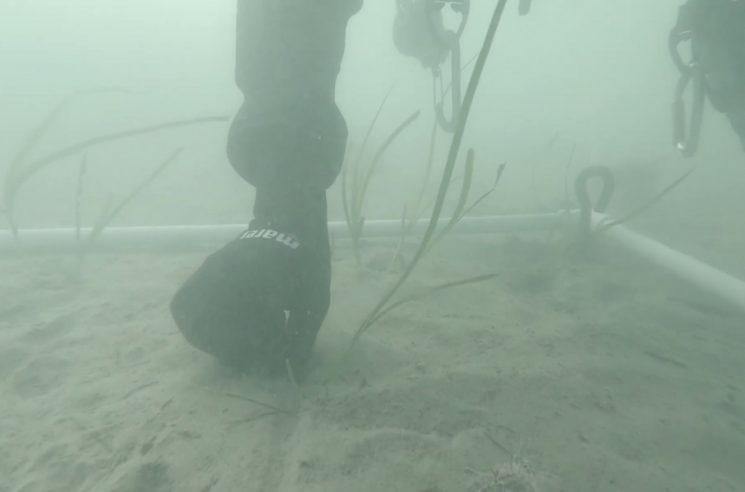 Busan City, together with Shinsegae, created a salt marsh forest through social value management (ESG). Photo by Busan City
As the first cooperative project of the "Busan Coastal Sea Ecological Forest Creation ESG Practice Agreement" signed between the city and Shinsegae in April, Shinsegae supported the project with 100 million KRW from the Rural and Fisheries Mutual Growth Cooperation Fund of the Foundation for Large, Small, and Medium Enterprises and Agriculture and Fisheries Cooperation. An additional 100 million KRW is planned to be invested and supported by 2026.
From December 2 to 6 last year, the city sowed 6,000 Zostera (eelgrass) individuals collected from Gijang Imrang Port and 5,000 Zostera (eelgrass) seeds collected from Woljeon Port along the coast of Gijang Woljeon Port.
Residents of Woljeon Port and environmental groups participated together, and especially, local residents directly handled the transplanted Zostera they collected, making it an occasion to share the importance of creating habitats for the marine protected species Zostera.
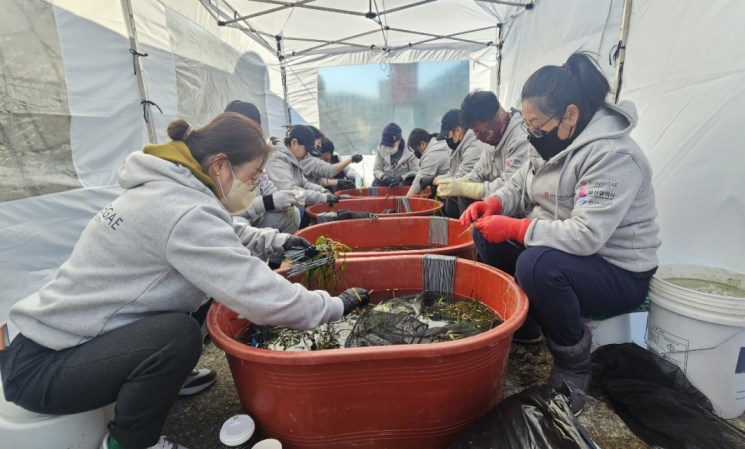
This Zostera habitat was created in connection with the existing Zostera habitat space in the Woljeon Port area. It is expected to become a Busan-type marine protected species colony model where people and nature coexist by resolving the risks of fishing activities for Imrang Port fishermen and providing a safe habitat for Zostera.
Imrang Port had significant safety risks for fishermen when entering and leaving the port due to difficulties such as dredging of sedimented sand caused by Zostera habitats within the port, and there were also challenges in preserving Zostera due to damage from ship navigation.
Woljeon Port is currently an area where small Zostera colonies are scattered. Based on field surveys and status investigations, it was judged to be suitable for transplantation. It was selected as the target site following requests from local fishermen who pledged to restore the disappearing Zostera forest and lead the creation of spawning grounds for fishery resources.
Residents of Woljeon Port further expressed their will and hope to develop into an ecological environment village by additionally expanding the Zostera forest and designating marine protected areas to create a stable habitat environment for Zostera as well as improve the surrounding environment.
The marine protected species "Zostera" plays an important role not only as a habitat and spawning ground for fishery resources but also as a blue carbon source recognized for carbon absorption, contributing greatly to establishing a healthy marine ecosystem circulation system.
Zostera is a perennial flowering plant and a marine protected species, recognized by the Intergovernmental Panel on Climate Change (IPCC) as a marine carbon sink (blue carbon). Through root growth, it stabilizes sediment layers and induces sedimentation, known to have a wave energy attenuation effect.
Recently, due to rising water temperatures and excessive indiscriminate development, the range of "gaetnogeum" (seaweed loss) has expanded, marine ecological forests have disappeared, and marine life survival is threatened. Especially, the Busan coast is a region where cold and warm currents intersect, making it sensitive to climate change, with a gaetnogeum occurrence rate of 37.21%, higher than the national average of 37.04%.
Gaetnogeum refers to the loss of seaweed and the dominance and death of calcareous algae, which produces calcium carbonate that covers rocks, transforming the area into a space where seaweed cannot inhabit, also called marine desertification.
To achieve sustainable fisheries, continuous efforts to create healthy marine forests such as Zostera are urgently needed to restore a healthy marine ecosystem.
After creating the Zostera (eelgrass) habitat in the Woljeon Port area, the city plans to conduct post-monitoring to assess the stability of transplanted Zostera individuals and the survival rate of seeds, and will continuously strive to improve the habitat environment to increase survival rates.
Shim Seong-tae, Director of the Marine Fisheries Bureau of the city, stated, "To respond to the climate crisis, achieve carbon neutrality, and realize a blue economy circular economy, our city will continuously strive to improve the habitat environment of marine protected species and preserve and maintain a healthy marine ecosystem along the Busan coast."
© The Asia Business Daily(www.asiae.co.kr). All rights reserved.
![Clutching a Stolen Dior Bag, Saying "I Hate Being Poor but Real"... The Grotesque Con of a "Human Knockoff" [Slate]](https://cwcontent.asiae.co.kr/asiaresize/183/2026021902243444107_1771435474.jpg)

















