8-Year-Old Child Fracture... Academy Director Acquitted
Supreme Court: "Difficult to See Violation of Duty of Care"
"Teaching Material Height Appropriate, Injury Risk Not Common"
The Supreme Court has ruled that the head of an academy cannot be held criminally liable for injury by negligence after an 8-year-old child fell and was injured during a class using a teaching aid about 30 cm high without safety devices.
On the 6th, the Supreme Court's 2nd Division (Presiding Justice Kim Sang-hwan) overturned the second-instance ruling that found the academy head A guilty of injury by negligence in the course of business and remanded the case to the Jeonju District Court appellate division with a verdict of not guilty.
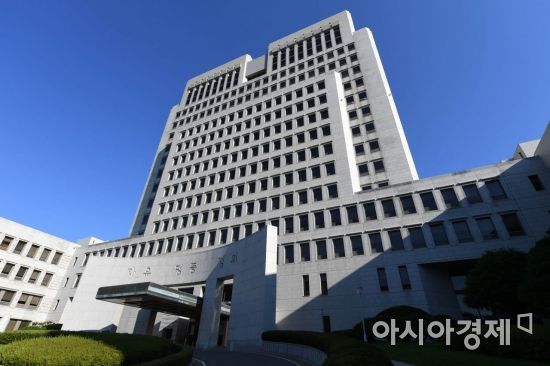 The Supreme Court ruled that even if an 8-year-old child falls and gets injured while using a teaching aid about 30 cm high during class, the academy director cannot be punished for injury due to negligence. Photo by Asia Economy DB
A, who operated a Taekwondo academy in Jeonju, conducted a so-called "balance training" class in early 2020 for lower-grade elementary school students using an oval-shaped teaching aid called "Wontop," which was 31 cm high, with a top diameter of 12 cm and a bottom diameter of 21.5 cm.
During this process, the 8-year-old victim child fell off the Wontop and suffered a left elbow fracture requiring about three months of treatment. Subsequently, A was charged with injury by negligence in the course of business for violating the duty of care by failing to provide sufficient safety instructions and install safety devices to prevent accidents.
The first-instance court acquitted A, stating that "there is insufficient evidence to recognize negligence or causation on A's part." However, the second-instance court found that "there is a risk of injury when conducting balance training on the teaching aid" and judged that "there were no necessary instructions, detailed explanations, demonstrations, or practice for falling to the floor," thus finding A negligent and sentencing him to a fine of 1.5 million won.
The Supreme Court, unlike the second-instance court, judged that it is difficult to evaluate that A violated the duty of care in the course of business. The Supreme Court stated, "There had been no previous fracture accidents during balance training, and the height of the Wontop is not excessively high for children close to the age of 8," adding, "It is difficult to generally recognize that there is a risk of serious injuries such as falls or fractures during balance training."
Furthermore, the court explained, "A consistently conducted balance training for lower-grade elementary students while operating the Taekwondo academy and carried out warm-up exercises and safety education to some extent," and "It is difficult to immediately conclude that A had a specific and direct duty of care to prevent accidents solely because the Wontop could topple or fall to the floor."
© The Asia Business Daily(www.asiae.co.kr). All rights reserved.

















