Government Announces Winter Emergency Medical Measures
Fever Clinics and COVID-19 Cooperative Hospitals Reactivated... Respiratory Disease Patients Distributed
Inter-Ministerial Joint Task Force and Special Response Period for Lunar New Year Holiday Also Operated
The government is promoting a plan to provide medical institutions that contribute to maintaining an emergency medical system?such as accommodating severe emergency patients and providing follow-up care during the winter season?with incentives of up to 450 million KRW per month. To prepare for respiratory diseases that frequently occur in winter, fever clinics and COVID-19 cooperative hospitals will be reactivated, and a 'Special Response Period for the Lunar New Year Holiday' will be operated next year, similar to the last Chuseok holiday.
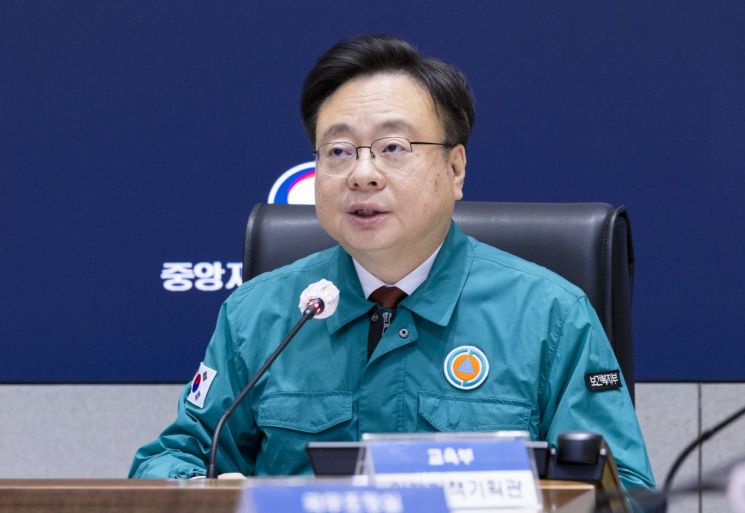 Minister of Health and Welfare Cho Kyu-hong is speaking at the Central Disaster and Safety Countermeasures Headquarters meeting on doctors' collective action held on the 6th at the Situation Room of the Government Seoul Office in Jongno-gu, Seoul. Provided by the Ministry of Health and Welfare
On the 6th, Cho Kyu-hong, Minister of Health and Welfare, held a meeting of the Central Disaster and Safety Countermeasures Headquarters for the doctors' collective action to review the implementation status of measures to increase vaccination rates in preparation for winter and discussed winter emergency medical measures with such content.
The government will first focus on strengthening and expanding support for the emergency medical system in preparation for the increase in patients with respiratory and cardiovascular-cerebrovascular diseases in winter, while maintaining a 250% increase in emergency room specialist consultation fees (medical service fees) and a 200% increase in fees for follow-up care surgeries. To this end, more than 100 fever clinics and 200 COVID-19 cooperative hospitals will be reactivated to distribute mild patients to nearby hospitals and prevent overcrowding in emergency rooms. Compensation for participating medical institutions will also be strengthened, such as a temporary additional payment of 30,000 KRW for fever clinics providing care on holidays or late at night.
In particular, a 'Pan-Governmental Joint Countermeasure Team for Respiratory Infectious Diseases' will be operated to closely monitor domestic and international respiratory disease outbreaks and implement measures such as focused management of high-risk groups and encouragement of vaccinations. The joint countermeasure team is led by the Director of the Korea Disease Control and Prevention Agency and includes experts from the Ministry of Health and Welfare, Ministry of Food and Drug Safety, Ministry of Education, and the Korean Society of Infectious Diseases.
Furthermore, as an increase in respiratory diseases such as COVID-19 and influenza is expected this winter as well, the public was urged to be sure to get vaccinated. As of the previous day, the vaccination rate for those aged 65 and older was 45.5% for COVID-19 and 78.2% for influenza. The government’s stockpile of three types of COVID-19 treatments stood at 212,000 doses as of the end of last month, and influenza treatments at 12.7 million doses, which the government considers sufficient for responding to the seasonal transition.
The emergency medical system for winter will also be strengthened. In addition to the current 14 regional base centers, about 10 more will be designated to supplement the capacity to respond to severe emergency patients. Institutions that contribute to emergency care by accommodating severe emergency patients and providing follow-up care will be evaluated and given post-incentives. The compensation scale is set at up to 450 million KRW per month for regional emergency centers, 200 million KRW for regional trauma centers, and 200 million KRW for pediatric emergency centers. The incentives paid will be used for existing personnel compensation and other purposes.
For specific diseases such as cardiovascular-cerebrovascular, pediatric, and obstetrics, the medical cooperation network within the region will be strengthened to minimize treatment gaps through rapid transfer and referral. The Lunar New Year holiday next year, which is a bridge holiday, will be designated and operated as a 'Special Response Period for the Lunar New Year Holiday,' similar to last Chuseok.
Along with this, the medical environment will be improved to prevent workforce attrition. To allow tertiary general hospitals to focus on severe and emergency care, fees for severe surgeries and anesthesia will be increased through a pilot project for structural transformation, and additional fees for emergency care and follow-up surgeries will be expanded. The intensive care unit admission fee will be increased by 50%, strengthening intensive care functions. Starting next year, capable tertiary general hospitals will be able to serve as regional emergency centers through the reorganization of the 'Emergency Medical Delivery System,' securing the final treatment capacity of follow-up departments and minimizing cases of emergency room refusal. To create an environment where medical personnel can safely provide care, legal grounds for justifiable reasons for emergency room treatment refusal will be established, and institutional improvements such as reducing the legal liability of medical personnel during emergency patient care will also be pursued.
Jung Dong-ryong, Director of Public Health Policy at the Ministry of Health and Welfare, explained, "Currently, the designation criteria for emergency medical institutions are based on personnel and facilities, but going forward, evaluation and designation will focus on the capacity and function for treating severe diseases." He added, "By designating based on function, it will be possible to more precisely understand the treatment capabilities of each medical institution when transferring or referring emergency patients."
Minister Cho said, "We will work closely with medical institutions on the ground to ensure that the emergency medical system centered on severe and emergency patients operates smoothly even during the winter when patient numbers may increase." He urged, "We also ask the public to use nearby hospitals for mild symptoms so that severe and emergency patients can receive treatment without missing the golden time."
© The Asia Business Daily(www.asiae.co.kr). All rights reserved.

















